
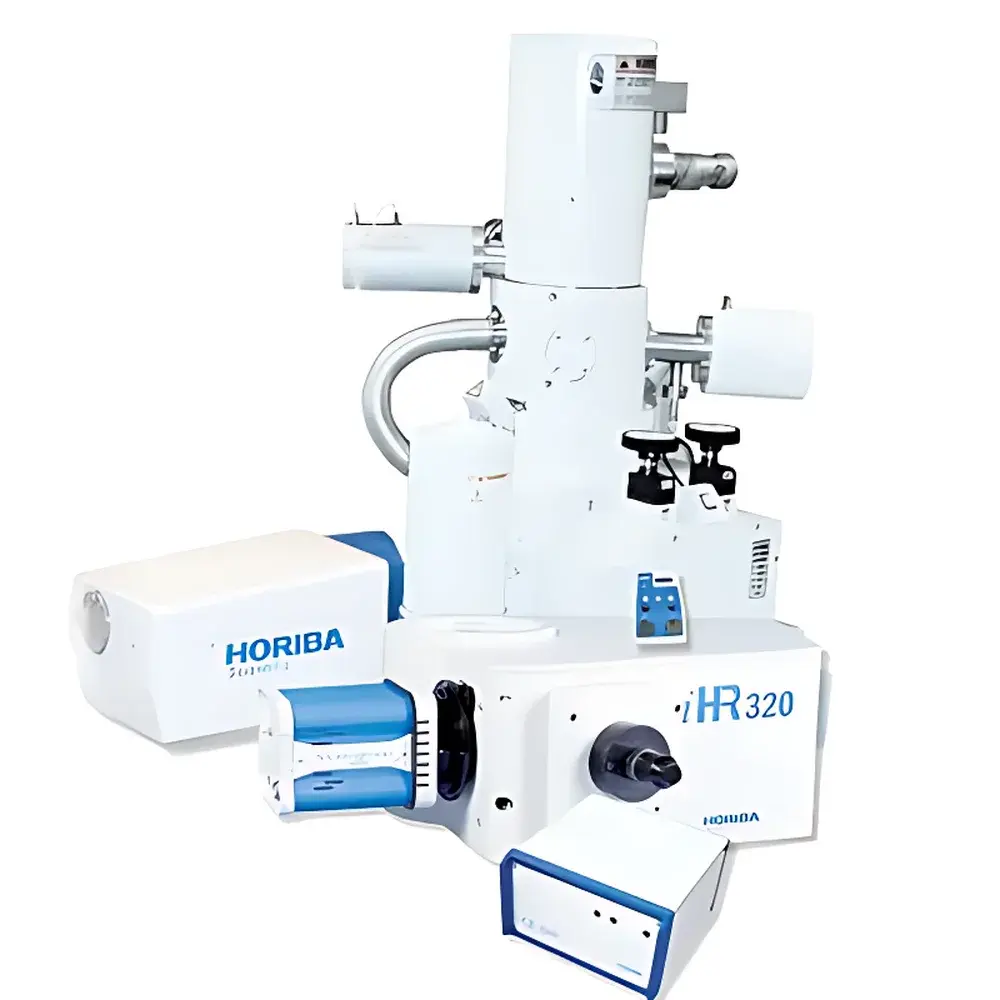
Flex-CLUE Cathodoluminescence Spectroscopy System by HORIBA
| Brand | HORIBA |
|---|---|
| Origin | France |
| Manufacturer Type | Original Equipment Manufacturer (OEM) |
| Import Status | Imported |
| Model | Flex-CLUE |
| Pricing | Available Upon Request |
Overview
The Flex-CLUE Cathodoluminescence (CL) Spectroscopy System by HORIBA is a modular, fiber-coupled analytical platform engineered for high-spatial-resolution cathodoluminescence detection in scanning electron microscopes (SEM) and scanning transmission electron microscopes (STEM). It operates on the physical principle of electron-beam–induced photon emission: when a focused electron beam impinges on a solid sample, electron-hole pairs are generated; their radiative recombination produces luminescent photons whose spectral signature encodes intrinsic material properties—including crystallographic defects, dopant distribution, strain fields, bandgap variations, and trace impurity concentrations. Unlike conventional photoluminescence or electroluminescence techniques, CL preserves nanoscale spatial correlation with SEM/STEM topographic or compositional imaging—enabling direct mapping of optical activity at sub-100 nm resolution. The Flex-CLUE system is specifically designed for integration into constrained microscope chambers, leveraging low-loss optical fibers to decouple the spectrometer from the vacuum environment while maintaining signal fidelity across ultraviolet–near-infrared (UV–NIR) wavelengths.
Key Features
- Fiber-optic coupling architecture enabling seamless integration with standard SEM/STEM columns without chamber modification
- High-collection-efficiency parabolic mirror optics optimized for angular acceptance and minimal chromatic aberration
- Configurable acquisition modes: point-spectrum acquisition, line-scan spectroscopy, and hyperspectral CL imaging synchronized with beam rastering
- Modular spectrometer options: selectable focal lengths (140 mm, 250 mm, or 320 mm) supporting trade-offs between spectral resolution, throughput, and dispersion linearity
- Dual spectral range configurations: 200–1000 nm (UV–VIS–NIR) or 400–1700 nm (extended NIR), each compatible with high-quantum-efficiency CCD or InGaAs detectors
- Interchangeable grating turrets supporting groove densities from 300 to 2400 lines/mm for application-specific resolution tuning
- Real-time spectral feedback during SEM navigation via integrated preview mode and live RGB false-color rendering
Sample Compatibility & Compliance
The Flex-CLUE system supports analysis of both conductive and non-conductive solid-state materials without requiring metal coating—provided appropriate charge compensation (e.g., low-kV operation, beam current modulation, or gas injection) is applied. It complies with international standards governing electron microscopy–based analytical instrumentation, including ISO 16700 (electron probe microanalysis), ASTM E1508 (quantitative elemental analysis by energy-dispersive X-ray spectroscopy), and IEC 62233 (safety requirements for electron optical apparatus). For regulated environments, data acquisition workflows support audit-trail generation and user-access controls aligned with GLP and GMP documentation frameworks. All optical components meet RoHS Directive 2011/65/EU and CE marking requirements for laboratory instrumentation.
Software & Data Management
Control and analysis are performed via HORIBA’s LabSpec 6 software suite, which provides native integration with major SEM manufacturers’ digital interfaces (e.g., Thermo Fisher, Zeiss, JEOL, Hitachi). The software enables synchronized acquisition of secondary electron (SE), backscattered electron (BSE), and CL signals; supports batch processing of hyperspectral datasets using multivariate statistical tools (PCA, MCR-ALS); and exports spectra in standardized formats (JCAMP-DX, ASCII, HDF5) for third-party analysis. Raw spectral data include embedded metadata (beam kV, probe current, dwell time, stage coordinates, spectrometer calibration coefficients), ensuring full traceability per ISO/IEC 17025 requirements. Optional FDA 21 CFR Part 11 compliance modules provide electronic signature validation, role-based permissions, and immutable audit logs.
Applications
- Semiconductor & optoelectronics: Defect mapping in GaN, SiC, and perovskite thin films; quantification of quantum well uniformity; identification of dislocation-related non-radiative recombination centers
- Dielectric & ceramic materials: Phase discrimination in multilayer capacitors; grain-boundary luminescence analysis in alumina and zirconia; oxygen vacancy profiling in resistive switching oxides
- Geosciences & mineralogy: Provenance analysis of zircon and apatite via U–Pb age-correlated CL zoning; carbonate diagenesis assessment through Mn²⁺/Fe²⁺ emission ratio mapping; diamond nitrogen aggregation state classification
- Forensic science: Differentiation of synthetic vs. natural gemstones; trace-element fingerprinting of glass fragments using rare-earth activator signatures
- Life sciences: Label-free visualization of biomineralization processes in bone and tooth enamel; CL-guided localization of lanthanide-doped nanoparticles in tissue sections
FAQ
What vacuum compatibility does the Flex-CLUE system require?
The optical collection head operates at ambient pressure and mounts externally to the SEM chamber via a differential-pumping-compatible flange; only the fiber feedthrough requires UHV-rated sealing.
Can Flex-CLUE be used with cryogenic stages?
Yes—fiber coupling eliminates thermal constraints on the spectrometer; compatible with liquid-nitrogen-cooled SEM stages down to 80 K.
Is polarization-resolved CL supported?
Optional half-wave plate and wire-grid polarizers can be integrated into the collection path for linear polarization analysis.
How is spectral calibration maintained over time?
Automated wavelength calibration using internal Hg–Ar lamp references is performed before each session; NIST-traceable calibration certificates are provided with each spectrometer configuration.
Does HORIBA offer application-specific method templates?
Yes—preconfigured acquisition protocols for GaN defect analysis, zircon geochronology, and forensic glass comparison are included in LabSpec 6 and regularly updated based on peer-reviewed literature benchmarks.






