
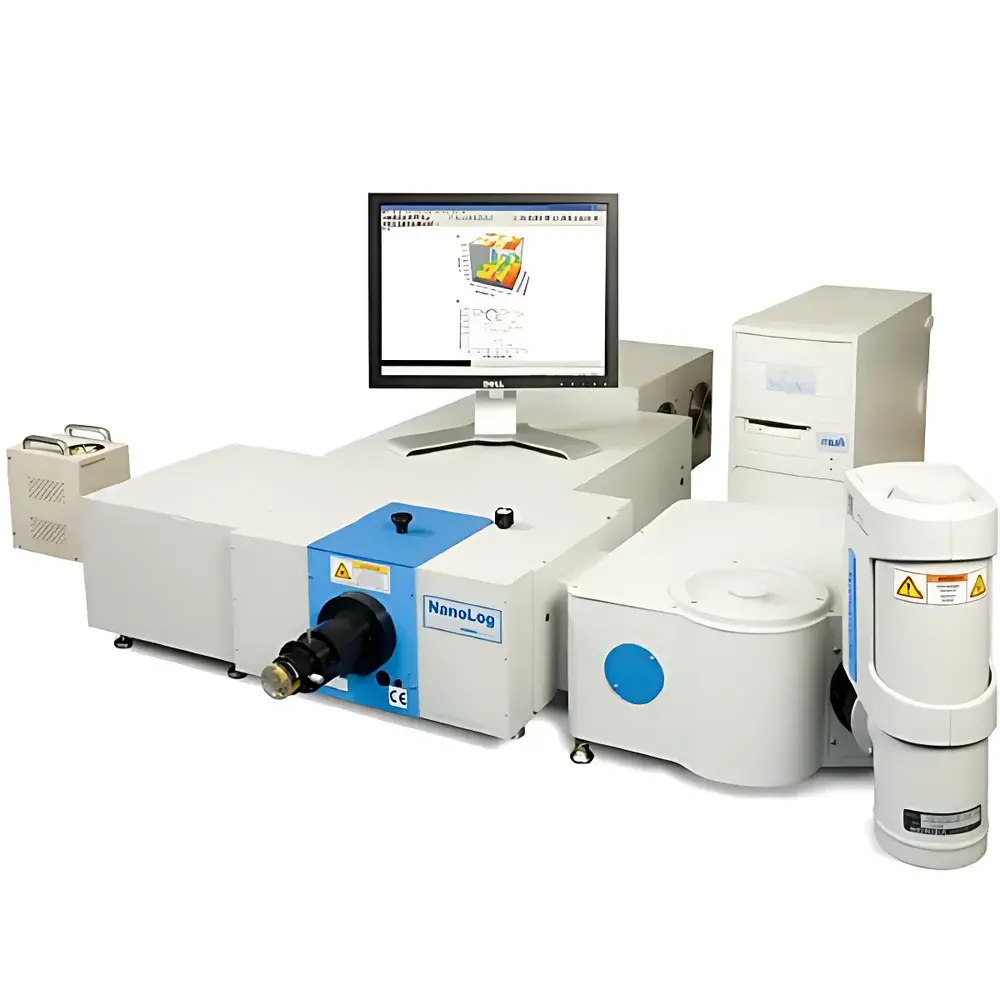
HORIBA NanoLog® Near-Infrared Fluorescence Spectrometer
| Brand | HORIBA |
|---|---|
| Origin | USA |
| Manufacturer Type | Manufacturer |
| Origin Category | Imported |
| Model | NanoLog® |
| Dispersion Element | Grating |
| Slit (Spectral Bandpass) | Not Specified |
| Resolution | Not Specified |
| Sensitivity | Not Specified |
| Wavelength Accuracy | Not Specified |
Overview
The HORIBA NanoLog® Near-Infrared Fluorescence Spectrometer is a high-performance, modular spectrofluorometer engineered for advanced photophysical characterization in the near-infrared (NIR) spectral region. Built upon HORIBA Scientific’s legacy of FluoroLog® platform architecture, the NanoLog® integrates time-correlated single-photon counting (TCSPC) for lifetime-resolved measurements with rapid, high-fidelity steady-state fluorescence acquisition. Its core optical design supports dual-mode operation—steady-state and time-resolved—enabling comprehensive analysis of emissive nanomaterials, including single-walled carbon nanotubes (SWNTs), quantum dots, NIR-emitting dyes, and low-bandgap semiconductors. The system is optimized for detection across 800–1700 nm using a Symphony II InGaAs linear array detector, with optional extension to ~2.2 µm (liquid-nitrogen-cooled) or ~3 µm (single-channel MCT). UV–Vis coverage is maintained via interchangeable detectors (PMT, CCD), ensuring seamless spectral continuity from 200 nm to beyond 3000 nm depending on configuration.
Key Features
- Modular dual-mode architecture supporting both steady-state and TCSPC-based time-resolved fluorescence spectroscopy
- Symphony II InGaAs array detector (800–1700 nm) with selectable formats: 256×1, 512×1, or 1024×1 pixels; pixel pitch: 25 µm; typical read noise: 650 e⁻ rms (LN₂-cooled)
- iHR320 emission monochromator: 320 mm focal length, f/4.1, linear dispersion 2.64 nm/mm, nominal resolution ≤0.06 nm (with 1200 gr/mm grating)
- 450 W continuous xenon lamp providing broad UV–NIR excitation coverage
- Sub-second acquisition of full excitation–emission matrix (EEM) spectra; complete 2D fluorescence maps generated in microseconds
- Dedicated NanoSizer® software for SWNT chirality assignment, diameter distribution modeling, and FRET efficiency quantification
- Interchangeable detector options: PMT (UV–NIR), CCD (UV–Vis), and InGaAs (NIR), enabling application-driven spectral range optimization
Sample Compatibility & Compliance
The NanoLog® accommodates diverse sample formats—including cuvettes (1–250 µL), solid substrates, microplates, fiber-coupled probes, and HPLC effluents—via standardized mechanical interfaces and optional accessories (e.g., Peltier temperature-controlled holders, cryogenic dewars, microscope coupling modules). All hardware and software components are designed to support GLP/GMP-aligned workflows. Data acquisition and processing comply with audit-trail requirements per FDA 21 CFR Part 11 when configured with appropriate user access controls and electronic signature protocols. Instrument performance verification follows traceable calibration standards aligned with ISO/IEC 17025 principles for analytical instrument qualification.
Software & Data Management
Control and analysis are managed through HORIBA’s FluoroLogic™ software suite, featuring intuitive workflow-driven interfaces for method setup, real-time spectral visualization, batch processing, and multi-dimensional data deconvolution. NanoSizer®—a specialized add-on module—implements physics-based algorithms for SWNT electronic structure mapping, leveraging empirical correlations between (n,m) indices and NIR fluorescence peak positions. TCSPC datasets are processed using iterative reconvolution fitting (e.g., IRF deconvolution, multi-exponential decay modeling), with lifetime histograms exportable in standard formats (CSV, HDF5). Raw and processed data adhere to FAIR principles (Findable, Accessible, Interoperable, Reusable), supporting integration into institutional LIMS or ELN environments.
Applications
- Chirality-resolved characterization of single-walled carbon nanotubes (SWNTs) in aqueous dispersions and thin films
- Quantum yield and energy transfer dynamics in NIR-II emitting nanoparticles (e.g., Ag₂S, PbS QDs)
- Time-gated imaging spectroscopy for biological tissue penetration studies
- Photostability assessment and degradation kinetics of organic NIR fluorophores
- FRET-based biosensing in the second biological window (1000–1350 nm)
- Exciton diffusion length determination in perovskite and 2D material heterostructures
- High-throughput screening of catalytic photocarrier generation in plasmonic nanocomposites
FAQ
What spectral range does the standard NanoLog® configuration cover?
The base system covers 800–1700 nm using the Symphony II InGaAs array; UV–Vis detection (200–850 nm) is enabled by swapping to PMT or CCD detectors.
Is TCSPC lifetime measurement supported across the full NIR range?
Yes—fluorescence lifetimes from 100 ps to 1 ms and phosphorescence lifetimes from 1 µs to >10 s are measurable across UV–NIR wavelengths using appropriate detector and excitation source combinations.
Can the NanoLog® be integrated with external instrumentation such as microscopes or HPLC systems?
Yes—standard optical ports, fiber-optic coupling adapters, and TTL-trigger I/O support seamless synchronization with confocal microscopes, flow cells, stopped-flow units, and chromatographic detectors.
Does NanoSizer® require reference standards for SWNT analysis?
No—NanoSizer® employs empirically validated spectral libraries and self-consistent fitting routines that do not rely on external calibration standards for (n,m) assignment or diameter distribution estimation.
What cooling options are available for the InGaAs detector?
Liquid nitrogen cooling is standard for lowest noise operation; thermoelectric (Peltier) cooling is available as an option for reduced infrastructure dependency.



