

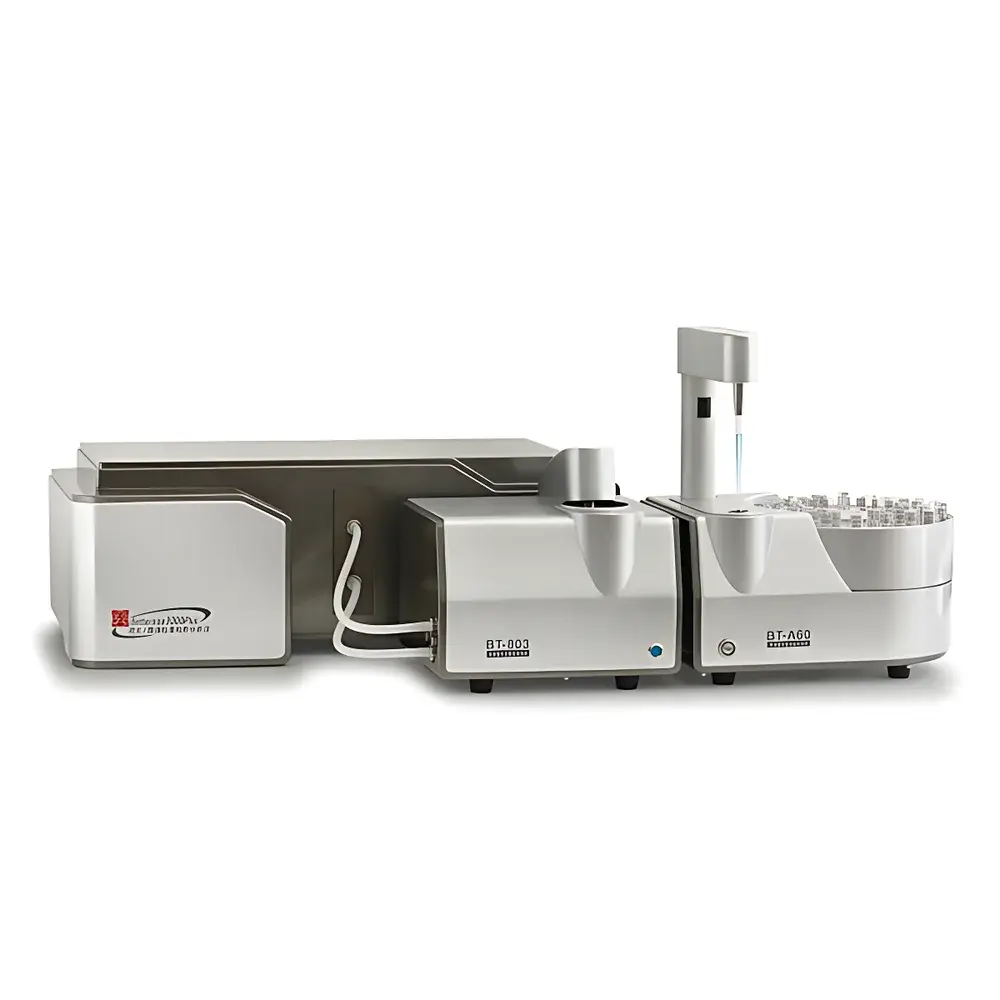
Bettersize Bettersize3000Plus Laser Diffraction & Dynamic Imaging Particle Size and Shape Analyzer
| Brand | Bettersize |
|---|---|
| Origin | Liaoning, China |
| Manufacturer | Bettersize Instrument Co., Ltd. |
| Model | Bettersize3000Plus |
| Dispersion Method | Wet Dispersion |
| Instrument Type | Laboratory Laser Diffraction Analyzer |
| Measurement Range | 0.01–3500 µm |
| Repeatability | ≤0.5% |
| Measurement Time | ≤10 s |
Overview
The Bettersize Bettersize3000Plus Laser Diffraction & Dynamic Imaging Particle Size and Shape Analyzer is an integrated dual-technology platform engineered for simultaneous, high-fidelity particle size distribution (PSD) and morphological characterization. It combines Mie scattering-based laser diffraction with real-time dynamic imaging—two complementary principles that collectively overcome inherent limitations of standalone methods. The laser optical system employs a patented dual-lens oblique-incidence configuration, enabling full angular detection of scattered light from a single laser beam (532 nm polarized solid-state fiber laser). This architecture eliminates interpolation artifacts associated with multi-beam or multi-wavelength systems while maintaining accuracy across the full 0.01–3500 µm range—including reliable D100 determination via synchronized imaging. The imaging subsystem features dual high-speed telecentric optical paths with parallel flow-cell capture, delivering statistically robust shape metrics—including circularity, aspect ratio, convexity, and surface roughness—without offline sample handling.
Key Features
- Patented dual-lens oblique-incidence optical design: Ensures continuous, gap-free angular signal acquisition from forward to backward scattering (0.017°–165°), enhancing resolution for both sub-100 nm nanoparticles and coarse particles up to 3.5 mm.
- 96-element photodetector array: Comprising front-, side-, and back-scatter channels for optimized signal-to-noise ratio and superior multi-modal resolution (validated per JJF1211-2008 and JJG167-2020 Class A standards).
- Integrated refractive index measurement: Quantifies both real and imaginary components of unknown samples in situ—critical for accurate Mie modeling of absorbing or composite materials (e.g., LiFePO4, metal oxides).
- Automated wet dispersion module: Includes dry-run protected ultrasonic disperser (0–50 W, continuously adjustable), centrifugal recirculation pump, auto-fill/drain/overflow control, bubble elimination, and programmable cleaning cycles—compatible with aqueous and organic solvents.
- Dynamic dual-path telecentric imaging: Captures >10,000 particles per second under laminar flow; enables direct D100 validation and outlier identification (e.g., agglomerates, fibrous contaminants) not resolvable by diffraction alone.
- FDA 21 CFR Part 11–compliant software architecture: With electronic signatures, audit trails, role-based access control, and data integrity safeguards aligned with GLP/GMP environments.
Sample Compatibility & Compliance
The Bettersize3000Plus accommodates diverse particulate systems—including inorganic powders (e.g., CaCO3, SiO2, ZrO2), metallics (Al, Cu, rare-earth alloys), battery cathode/anode materials (NMC, LFP, graphite), pharmaceutical excipients, catalysts, pigments, and environmental sediments. Its wet dispersion design supports pH-sensitive, shear-labile, or low-density suspensions without sonication-induced degradation. Regulatory alignment includes ISO 13320:2020 (laser diffraction), GB/T 19077–2024 (Chinese national standard), GB/T 41949–2022 (particle shape analysis), USP , EP 2.9.38, and ChP 0982. Interlaboratory validation at BAM (Germany) confirmed 100% compliance across 43 international instruments in ceramic powder testing—demonstrating metrological equivalence to Tier-1 global instrumentation.
Software & Data Management
The proprietary Bettersize Analysis Suite provides SOP-driven workflow automation, multi-method correlation reporting (diffraction + image-derived parameters), batch processing with statistical trend analysis, and export-ready templates compliant with LIMS integration. All raw scattering patterns and image sequences are stored with metadata (dispersion energy, temperature, refractive index input, operator ID). Audit trails log every parameter change, calibration event, and report generation—fully traceable per FDA 21 CFR Part 11 requirements. Data encryption, user privilege tiers, and optional network backup ensure long-term integrity and regulatory readiness.
Applications
- Battery material QC: Precise D100 verification for cathode coatings, graphite anodes, and separator slurries—critical for electrode uniformity and cell cycle life.
- Pharmaceutical development: PSD and shape profiling of milled APIs, spray-dried excipients, and inhalation powders per USP/EP monographs.
- Advanced ceramics & abrasives: Resolving bimodal distributions in zirconia, silicon carbide, or alumina powders to predict sintering density and green strength.
- Environmental monitoring: Quantifying sediment grain morphology and size thresholds for erosion modeling or contaminant binding capacity.
- Quality assurance in pigment & coating manufacturing: Correlating aspect ratio and circularity with dispersion stability, gloss, and film formation behavior.
FAQ
Does the Bettersize3000Plus require external refractive index input for accurate results?
No—it incorporates an on-board refractive index measurement function that determines both real and imaginary components experimentally, eliminating guesswork and reducing uncertainty in Mie inversion.
Can it measure D100 reliably—and how does it compare to sieve analysis?
Yes. The integrated dynamic imaging system directly observes the largest particles in suspension, providing statistically valid D100 values without mechanical sieving artifacts or static sampling bias.
Is the instrument suitable for regulated pharmaceutical environments?
Yes. Its software meets FDA 21 CFR Part 11, USP , and EP 2.9.38 requirements—including electronic signatures, audit trails, and data immutability controls.
What dispersion media are supported?
Aqueous systems (deionized water, surfactant solutions) and organic solvents (ethanol, isopropanol, acetone) via dedicated solvent-compatible circulation modules.
How is calibration verified and maintained?
Traceable NIST/GBW certified reference materials (e.g., SRM 1963, GBW(E)130109) are used for routine performance qualification; automated alignment and background correction ensure long-term optical stability.



