
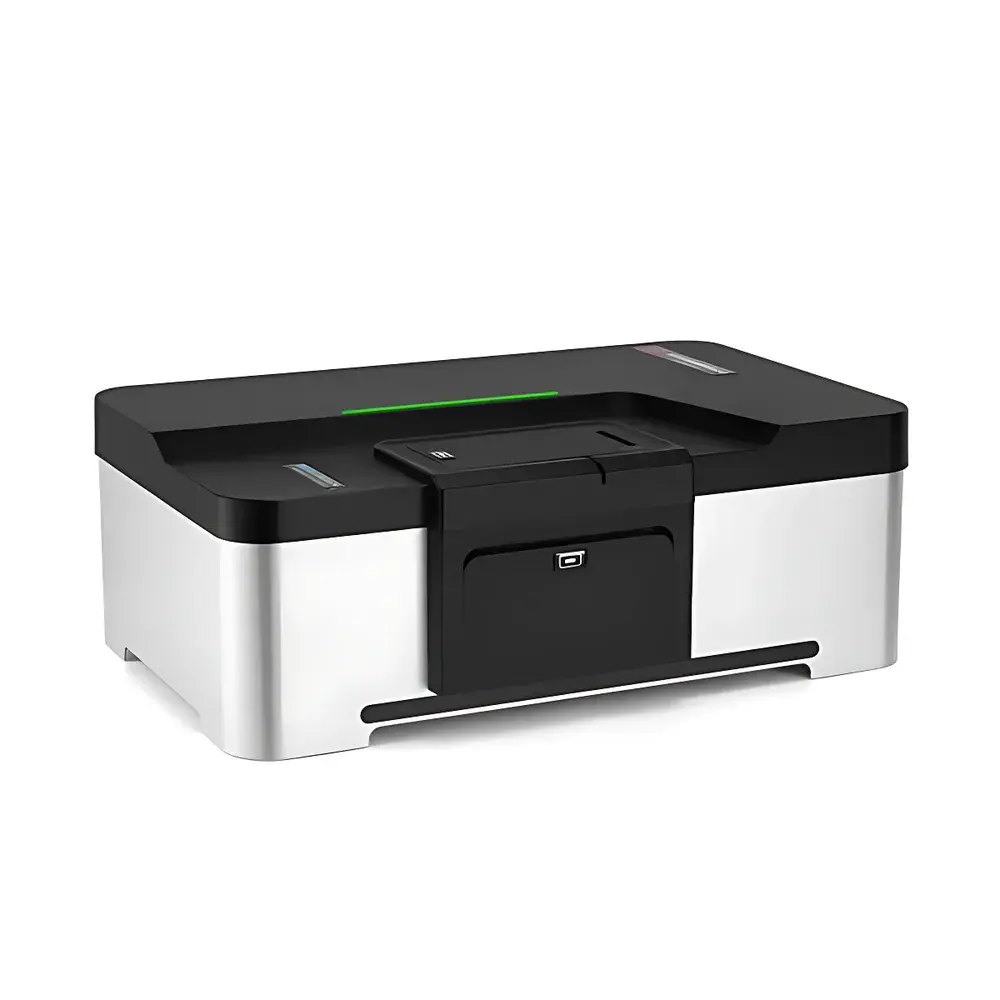
Bettersize BeNano 90 Nanoparticle Size Analyzer
| Brand | Bettersize |
|---|---|
| Model | BeNano 90 |
| Measurement Principle | Dynamic Light Scattering (DLS) and Static Light Scattering (SLS) |
| Particle Size Range | 0.3 nm – 15 µm |
| Size Reproducibility | ≤1% |
| Temperature Control Range | −15 °C to 120 °C |
| Temperature Stability | ±0.1 °C |
| Detection Angle | 90° |
| Laser Wavelength | 671 nm (solid-state) |
| Correlator | Multi-speed mode, 25 ns minimum sampling interval, 4000 channels, 10¹¹ dynamic linear range |
| Detector | APD |
| Intensity Control | 0.0001%–100%, auto/manual |
| Analysis Algorithms | Cumulants, General Purpose, CONTIN, NNLS |
| Output Parameters | Hydrodynamic Diameter (D<sub>H</sub>), Polydispersity Index (PDI), Diffusion Coefficient (D), Interparticle Interaction Parameter (k<sub>D</sub>), Intensity/Volume/Area/Number Distributions, Molecular Weight (342 Da – 2 × 10⁷ Da), Solution Viscosity & Refractive Index, Viscoelastic Moduli (G*, G′, G″), Complex Viscosity (η*), Creep Compliance (J) |
| Optional Modules | Flow Mode (coupled with FFF/GPC/SEC), 0° PD+CMOS Module for Refractive Index & Sedimentation-Based Concentration |
Overview
The Bettersize BeNano 90 Nanoparticle Size Analyzer is a high-precision benchtop instrument engineered for comprehensive characterization of colloidal and macromolecular systems using orthogonal light scattering techniques. At its core, the system implements classical dynamic light scattering (DLS) based on the principles of Brownian motion and autocorrelation analysis of intensity fluctuations in scattered laser light at a fixed 90° detection angle. Complementing DLS, the BeNano 90 integrates static light scattering (SLS) capabilities to enable absolute molecular weight determination and second virial coefficient (A2) evaluation without calibration standards. The instrument employs a thermally stabilized 671 nm solid-state laser and an avalanche photodiode (APD) detector with ultra-low noise performance and programmable intensity attenuation (0.0001%–100%), ensuring optimal signal-to-noise ratio across diverse sample types—from dilute protein solutions to concentrated polymer dispersions.
Key Features
- Wide dynamic size range: validated measurement from 0.3 nm (e.g., small peptides, metal clusters) up to 15 µm (e.g., aggregated microparticles or emulsion droplets), subject to optical contrast and scattering efficiency.
- High thermal fidelity: Peltier-based temperature control spanning −15 °C to 120 °C with stability better than ±0.1 °C—critical for studying thermal transitions (e.g., protein unfolding, micelle formation) and long-term stability assays.
- Multi-algorithm data processing: supports Cumulants (for monodisperse systems), General Purpose (for moderately polydisperse samples), CONTIN (regularized inverse Laplace transform), and NNLS (non-negative least squares) for robust resolution of multimodal distributions.
- Integrated micro-rheology: extracts viscoelastic parameters—including storage modulus (G′), loss modulus (G″), complex modulus (G*), complex viscosity (η*), and creep compliance (J)—from DLS-derived mean-squared displacement (MSD) data without mechanical deformation.
- Automated trend analysis: time-resolved and temperature-resolved DLS acquisition enables identification of critical transition points (e.g., Tm, cloud point, gelation onset) with minimal user intervention.
Sample Compatibility & Compliance
The BeNano 90 accommodates aqueous and organic solvent-based dispersions with minimal sample volume requirements (as low as 3 µL for capillary cells; standard 1 mL cuvettes). It supports routine QC testing under ISO 22412:2017 (DLS particle sizing) and ASTM E2490-18 (standard guide for DLS measurements). For regulated environments, the software architecture supports audit trail logging, electronic signatures, and user access control—facilitating alignment with FDA 21 CFR Part 11 and GLP/GMP documentation requirements when deployed with compliant IT infrastructure. Dry-air or nitrogen purge options mitigate condensation during sub-zero operation, preserving optical path integrity and measurement repeatability.
Software & Data Management
The proprietary BeNano Control & Analysis Suite provides a unified interface for instrument control, real-time correlation function monitoring, batch processing, and report generation. Raw correlator data (including full 4000-channel decay curves) are stored in vendor-neutral HDF5 format. Export options include CSV, TXT, and PDF with embedded metadata (instrument ID, operator, date/time, method parameters). SLS molecular weight calculations incorporate solvent viscosity and refractive index inputs—either measured in situ via optional 0° module or imported from literature databases. All algorithms adhere to IUPAC-recommended conventions for hydrodynamic diameter reporting and polydispersity quantification.
Applications
The BeNano 90 serves research and quality control laboratories in pharmaceuticals (protein aggregation, liposome sizing, ADC stability), nanomaterials (quantum dot dispersion, metal oxide nanoparticle synthesis), polymers (micelle CMC determination, block copolymer self-assembly), and food science (casein micelle dynamics, starch nanoparticle formulation). Its Flow Mode option enables hyphenated analysis with size-exclusion chromatography (SEC) or field-flow fractionation (FFF), delivering orthogonal, model-independent size and molecular weight distributions by coupling elution profiles (RI/UV) with on-line DLS/SLS detection—particularly valuable for heterogeneous biopolymer mixtures or polymeric nanoparticles with broad dispersity.
FAQ
What is the minimum detectable size for proteins in aqueous buffer?
For globular proteins in low-scattering media (e.g., PBS), reliable detection begins at ~0.3 nm hydrodynamic diameter—corresponding to small peptides or tightly folded domains—subject to sufficient scattering contrast and signal-to-noise ratio.
Can the BeNano 90 perform Zeta potential measurements?
No. The BeNano 90 is dedicated to size and molecular weight characterization via DLS and SLS. Zeta potential requires electrophoretic light scattering (ELS), which is not implemented in this model.
Is SEC coupling supported out-of-the-box?
Flow Mode is an optional hardware and software package requiring integration with third-party SEC/FFF systems. It includes synchronization triggers, flow-cell mounting kits, and co-acquisition modules for simultaneous RI/UV/DLS/SLS data streams.
How is temperature calibration verified?
The system uses dual-point NIST-traceable calibration (0 °C ice bath and 40 °C certified reference fluid) performed during factory acceptance testing. Users may validate thermal accuracy using certified glycol/water standards prior to critical experiments.
Are method templates compliant with regulatory submissions?
Yes. Predefined SOP templates—including instrument qualification parameters, system suitability criteria, and reporting fields aligned with ICH Q5E and USP —are provided and editable to meet specific regulatory filing requirements.



