
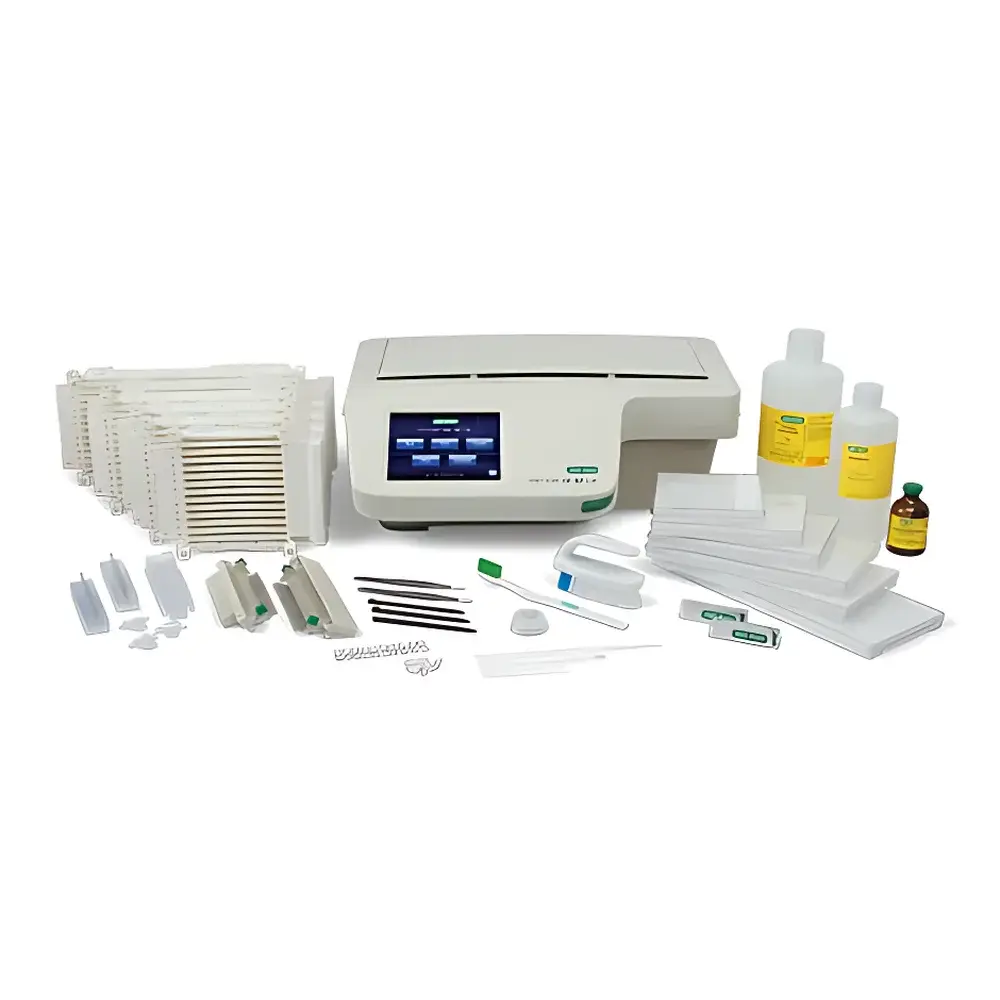
Bio-Rad PROTEAN i12 IEF System
| Brand | Bio-Rad |
|---|---|
| Origin | USA |
| Manufacturer Type | Authorized Distributor |
| Product Category | Imported Instrument |
| Model | i12 |
| Instrument Type | Transfer Electrophoresis System |
| Main Unit | Electrophoresis Apparatus with Casting/Running Tank |
| Gel Length Range | 7–24 cm |
| Sample Capacity | 12 independent lanes |
| Maximum Voltage | 10,000 V |
Overview
The Bio-Rad PROTEAN i12 IEF System is a dedicated isoelectric focusing (IEF) electrophoresis platform engineered for high-resolution protein separation based on intrinsic isoelectric points (pI). Utilizing immobilized pH gradient (IPG) gel strips, the system applies controlled high-voltage electric fields (up to 10,000 V) to drive ampholytic protein migration until each molecule reaches its pI-defined zone of zero net charge. Unlike conventional slab-gel IEF systems, the i12 architecture implements fully independent voltage and current regulation per lane—enabling simultaneous, non-interfering IEF runs under distinct experimental conditions within a single instrument footprint. This design eliminates cross-lane electrical coupling and thermal crosstalk, directly enhancing reproducibility across technical replicates and facilitating rigorous method development in proteomics workflows.
Key Features
- 12-channel independent power control: Each lane operates with discrete voltage, current, and power limits—ensuring precise, parallel optimization of focusing parameters (e.g., stepwise vs. rapid ramping, active cooling thresholds).
- Modular IPG strip compatibility: Supports standard 7–24 cm immobilized pH gradient strips from major suppliers (e.g., Cytiva, Bio-Rad, SERVA), with automated alignment guides and uniform electrode contact pressure.
- Active temperature management: Integrated Peltier-based cooling maintains strip temperature at 15–20 °C during high-voltage focusing, minimizing pH gradient drift and protein denaturation.
- Programmable run profiles: Up to 9 user-defined methods stored onboard, supporting multi-step voltage ramps, constant wattage phases, and automatic termination upon reaching target current decay thresholds.
- Robust safety architecture: Automatic arc detection, ground-fault interruption, and real-time impedance monitoring prevent strip arcing and ensure operator protection at voltages up to 10 kV.
Sample Compatibility & Compliance
The PROTEAN i12 accommodates diverse biological sample types—including cell lysates, tissue extracts, serum fractions, and purified recombinant proteins—provided they are solubilized in appropriate IEF rehydration buffers (e.g., 8 M urea, 2% CHAPS, 20 mM DTT). It complies with IEC 61010-1:2010 for laboratory electrical equipment safety and meets electromagnetic compatibility (EMC) requirements per EN 61326-1. While not certified for GMP production environments, the system supports GLP-aligned documentation practices through audit-trail-capable software (see Software & Data Management). Method parameters and run logs are exportable in CSV and XML formats for integration into LIMS or electronic lab notebooks compliant with 21 CFR Part 11 when paired with validated software configurations.
Software & Data Management
The system operates via Bio-Rad’s proprietary i12 Control Software (v3.2+), installed on Windows-based host PCs connected via USB 2.0. The interface provides real-time monitoring of voltage, current, power, and temperature per lane, with graphical overlays for comparative run analysis. All method files include metadata fields for operator ID, sample batch, IPG strip lot number, and rehydration time—enabling traceability across analytical campaigns. Audit trails record timestamped changes to methods, start/stop events, and error flags. Raw data files retain native resolution (0.1 V, 0.1 µA, 0.1 °C) and support post-acquisition reprocessing using Bio-Rad’s PDQuest Advanced software for spot matching, quantitation, and statistical validation against reference gels.
Applications
The i12 IEF System serves as a foundational tool in top-down and bottom-up proteomics pipelines. Its primary applications include: two-dimensional electrophoresis (2-DE) first-dimension separation prior to SDS-PAGE; biomarker discovery in clinical plasma or CSF samples; quality control of monoclonal antibody charge variants; characterization of post-translational modifications (e.g., deamidation, oxidation) that shift pI; and validation of recombinant protein homogeneity during upstream bioprocess development. Its 12-lane independence also enables systematic screening of IPG pH ranges (e.g., pH 3–10, 4–7, 6–9), carrier ampholyte formulations, or urea/thiourea ratios without sequential instrument downtime.
FAQ
Can the i12 system be used for preparative IEF?
Yes—when configured with wide-format 24 cm IPG strips and optimized rehydration volumes, it supports milligram-scale protein recovery for downstream MS analysis or functional assays.
Is external cooling required?
No—the built-in thermoelectric cooler maintains stable strip temperature; however, ambient lab temperature should remain ≤25 °C for optimal thermal regulation.
Does the system support legacy PROTEAN IEF accessories?
Most casting trays, electrode wicks, and rehydration trays from PROTEAN XL and Criterion IEF systems are mechanically compatible, though firmware-level protocol validation is recommended.
How is calibration verified?
Bio-Rad provides NIST-traceable voltage and temperature verification kits (Cat. #170-3925); annual calibration is advised per ISO/IEC 17025 laboratory accreditation requirements.
Can run data be exported for statistical process control (SPC)?
Yes—CSV exports include all per-lane time-series measurements, enabling integration with JMP, Minitab, or Python-based SPC libraries for Cp/Cpk analysis of focusing consistency.



