
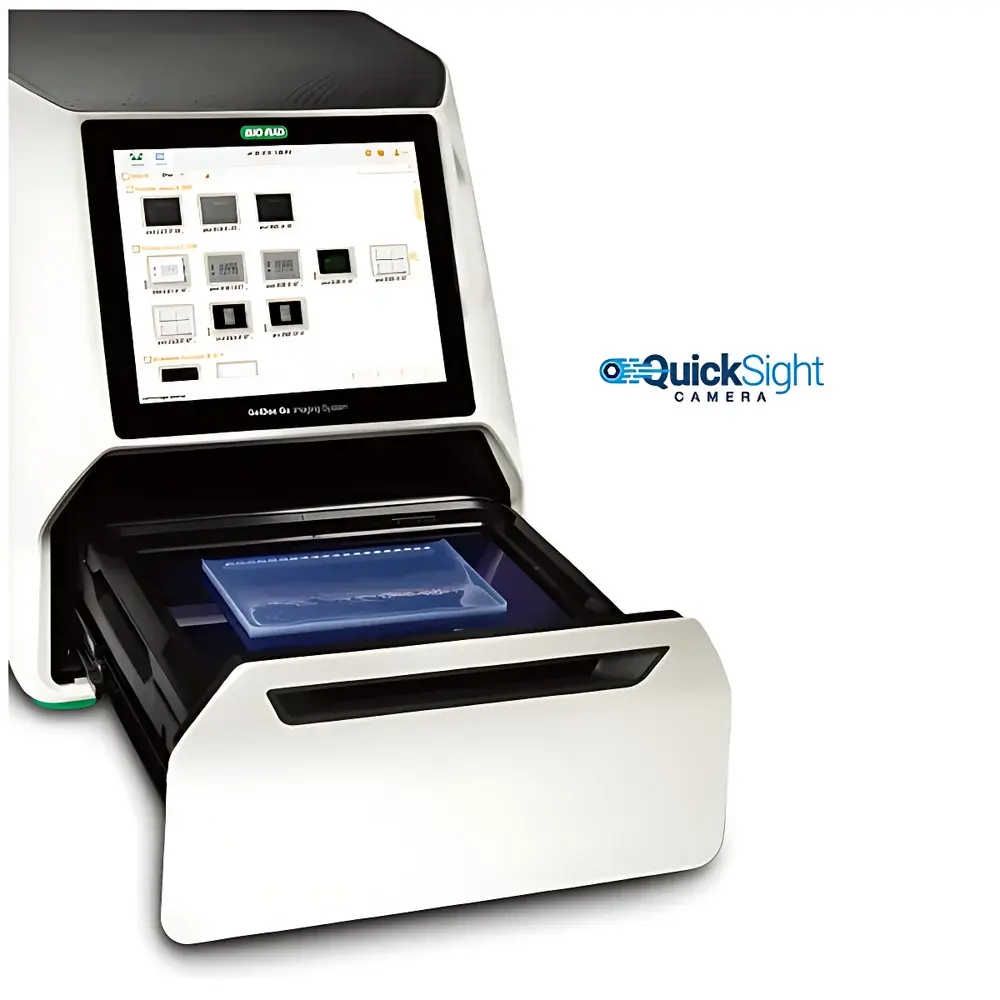
Bio-Rad GelDoc Go Gel Imaging System
| Brand | Bio-Rad |
|---|---|
| Origin | USA |
| Model | GelDoc Go |
| Instrument Type | Standalone Gel Documentation System |
| CCD Resolution | 6.3 MP |
| Bit Depth | 16-bit |
| Dynamic Range | >3.5 OD |
| CCD Sensor Size | 1-inch |
| Lens | Fixed-focus QuickSight™ Optical Lens |
| Display | 9.7-inch Capacitive Touchscreen |
| Connectivity | Integrated standalone operation (no PC required) |
Overview
The Bio-Rad GelDoc Go Gel Imaging System is a compact, fully integrated benchtop imaging platform engineered for rapid, high-fidelity documentation of nucleic acid and protein gels under UV, blue-light, and white-light excitation. Built upon Bio-Rad’s proprietary QuickSight™ optical architecture, the system employs a fixed-focus, high-transmission lens optimized for consistent working distance and minimal distortion across the entire imaging field. At its core lies a 1-inch, 6.3-megapixel scientific-grade CCD sensor with true 16-bit digitization—enabling linear signal capture across a dynamic range exceeding 3.5 optical density (OD) units. This ensures accurate quantification of both faint and saturated bands without manual exposure bracketing. Unlike PC-dependent systems, GelDoc Go operates as a self-contained instrument: all image acquisition, processing, annotation, and export functions are executed directly on the onboard processor via its responsive 9.7-inch capacitive touchscreen interface—eliminating external hardware dependencies and reducing footprint in space-constrained molecular biology labs.
Key Features
- Standalone operation with embedded Linux-based OS and intuitive touchscreen UI—no computer, drivers, or software installation required
- QuickSight™ fixed-focus optical path calibrated for standard gel tray dimensions (e.g., Mini-PROTEAN® and SUB-CELL® GT), ensuring repeatable focus and uniform illumination
- Multi-modal excitation support: integrated UV transilluminator (302 nm), blue-light transilluminator (470 nm), and white-light reflective surface for Coomassie- and silver-stained gels
- Real-time histogram display and auto-exposure optimization to maximize signal-to-noise ratio within the linear response range of the CCD
- On-device image processing suite including background subtraction, band intensity profiling, molecular weight estimation, and lane/region-of-interest (ROI) analysis
- Export formats include TIFF (uncompressed, 16-bit), JPEG, PNG, and PDF—with embedded metadata (date, exposure time, filter used, lens setting)
Sample Compatibility & Compliance
The GelDoc Go accommodates standard vertical and horizontal electrophoresis gels up to 15 × 15 cm, including agarose, polyacrylamide (PAGE), SDS-PAGE, and native gels stained with ethidium bromide, SYBR® Safe, GelGreen®, Coomassie Brilliant Blue, or silver nitrate. Its UV transilluminator meets IEC 61000-4-3 electromagnetic compatibility standards and incorporates mechanical shutter interlock and UV-blocking acrylic shield compliant with ANSI Z87.1 eye protection requirements. While not certified for GLP/GMP production environments, the system supports audit-ready workflows through timestamped image logs, user-accessible firmware version tracking, and non-modifiable raw data storage—facilitating adherence to laboratory best practices aligned with ISO/IEC 17025 documentation expectations.
Software & Data Management
All image handling occurs within the device’s embedded application environment. Raw 16-bit images are stored in non-volatile flash memory with automatic date/time stamping and user-defined project naming. The system supports USB 2.0 mass storage mode for direct transfer to external drives—no proprietary software license or activation is needed for data retrieval. Exported files retain EXIF-like metadata fields (e.g., exposure duration, LED intensity level, filter selection, and calibration status), enabling traceability in academic publication or internal protocol archiving. Although it does not implement FDA 21 CFR Part 11 electronic signature controls, its deterministic acquisition pipeline and immutable file generation support reproducible documentation suitable for teaching labs, core facilities, and early-stage R&D validation.
Applications
- Routine documentation and semi-quantitative analysis of PCR products, restriction digests, and DNA ladders in teaching and diagnostic labs
- Visualization and comparative analysis of protein expression profiles from SDS-PAGE and Western blot transfers (using chemiluminescent or fluorescent detection with optional accessories)
- Targeted gel excision guidance using on-screen ROI marking and overlay grid tools
- Time-series monitoring of electrophoretic mobility shifts (e.g., protein-DNA binding assays) with consistent exposure settings across multiple runs
- Training platform for undergraduate and graduate students due to zero-software-overhead operation and immediate visual feedback
FAQ
Does GelDoc Go require a computer to operate?
No. It is a fully standalone system with an integrated operating system and touchscreen interface.
Can I perform quantitative densitometry with GelDoc Go?
Yes—the 16-bit dynamic range and linear CCD response support relative band intensity comparisons when using consistent staining and exposure protocols.
Is the UV transilluminator safe for routine use?
Yes. It features an interlocked safety shutter and UV-absorbing shield compliant with ANSI Z87.1; users must still wear appropriate PPE (e.g., UV-blocking goggles) during open-lid operation.
What file formats can be exported?
TIFF (16-bit, uncompressed), JPEG, PNG, and PDF—with embedded acquisition metadata.
Is firmware update supported?
Yes, updates are delivered via USB drive and applied through the system’s Settings menu, with version history logged in the maintenance log.




