
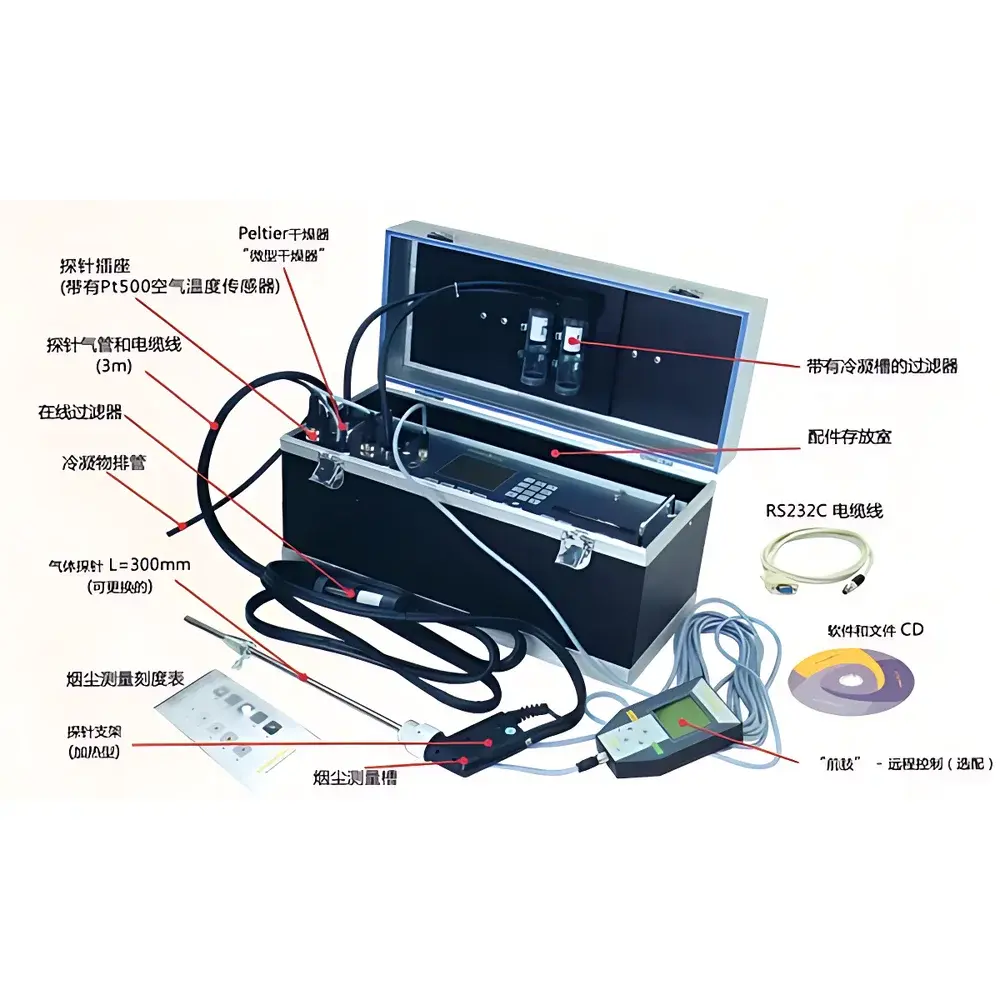
Madur GA-21plus Portable Flue Gas Analyzer
| Brand | Madur |
|---|---|
| Origin | Austria |
| Model | GA-21plus |
| Instrument Type | Portable Flue Gas Analyzer (not CEMS) |
| Measurement Principle | Electrochemical (O₂, CO, NO, NO₂, SO₂, H₂S, Cl₂, H₂) & NDIR (CO₂, CH₄) |
| O₂ Range | 0–25% (electrochemical) / 0–100% (bias-cell) |
| CO Range | 0–20,000 ppm |
| NO/NOₓ Range | 0–5,000 ppm |
| NO₂ Range | 0–1,000 ppm |
| SO₂ Range | 0–5,000 ppm |
| H₂S Range | 0–1,000 ppm |
| Cl₂ Range | 0–300 ppm |
| H₂ Range | 0–1,000 ppm |
| CO₂ Range | 0.5% or 0–100% (NDIR) |
| CH₄ Range | 0.5% or 0–100% (NDIR) |
| Gas Temperature | –40 to 1600 °C |
| Ambient Temperature | –40 to 100 °C |
| Pressure Range (Differential) | –25 to +25 hPa |
| Atmospheric Pressure | 800–1200 mbar |
| Flow Velocity | 0–50 m/s |
| Response Time (T₉₀) | 45 s (gas sensors), 30 s (temperature), 10 s (pressure/flow) |
| Accuracy | ±5 ppm or ±5% rel (electrochemical gases) |
| Repeatability | 5 ppm |
| Zero Drift Stability | ≤5% over 1 h |
| Display | Backlit graphical LCD (simultaneous multi-parameter view) |
| Data Storage | Internal memory for 1024 records (10 databases), up to 10 variables per record |
| Interface | RS232C |
| Power | 230 V/50 Hz or 110 V/60 Hz AC |
| Dimensions | 460 × 170 × 160 mm |
| Weight | 6.2 kg |
| Operating Temp. | 10–50 °C |
| Storage Temp. | –20 to +55 °C |
| Probe Max Temp. | ≥800 °C |
| Compliance | Meets SCAQMD requirements including automatic O₂ correction |
Overview
The Madur GA-21plus is a high-integrity portable flue gas analyzer engineered for precision field measurement of combustion exhaust in industrial, utility, and regulatory environments. It employs dual-sensor architecture—electrochemical cells for reactive gases (O₂, CO, NO, NO₂, SO₂, H₂S, Cl₂, H₂) and non-dispersive infrared (NDIR) detectors for CO₂ and CH₄—to deliver simultaneous, cross-compensated quantification of up to nine gas species alongside thermodynamic and fluid dynamic parameters. Its design adheres to the metrological framework of ISO 12039 (stationary source emissions — determination of mass concentration of carbon monoxide, carbon dioxide and oxygen), EN 15267 (performance certification of automated measuring systems), and foundational principles aligned with EPA Method 3A (oxygen and carbon dioxide in stationary source emissions). The instrument is not a continuous emission monitoring system (CEMS) but is validated for periodic compliance verification, combustion optimization, and stack testing where portability, traceability, and real-time calculation integrity are critical.
Key Features
- Modular electrochemical sensor configuration: Standard O₂ and CO channels; optional NO, NO₂, SO₂, H₂S, Cl₂, and H₂ modules with built-in temperature compensation and flow regulation for stable baseline performance.
- NDIR-based CO₂ and CH₄ detection with dual-range capability (0.5% low-range or 0–100% full-scale), minimizing calibration drift and enabling stoichiometric accuracy across fuel types.
- Integrated thermal and pressure metrology: K-type thermocouple for flue gas temperature (–40 to 1600 °C), Pt100 RTD for ambient temperature (–40 to 100 °C), and DMS-bridge differential/static pressure transducers (±25 hPa, 800–1200 mbar).
- Real-time combustion parameter computation: Automatic derivation of excess air (λ), combustion efficiency (η), flue gas loss (qA), CO/CO₂ ratio, and Bacharach smoke number via embedded fuel database (22 preloaded + 10 user-definable fuels).
- Robust data handling: 1024-record internal memory (10 independent databases), configurable variable logging (up to 10 per measurement), and 30-session report archive with timestamped metadata.
- Field-ready interface suite: Graphical backlit LCD with dual averaging display mode; 57-mm dot-matrix thermal printer with image capture; RS232C serial port for PC synchronization and remote firmware updates.
- Power flexibility: Dual-mode operation—AC mains (110/230 V) or rechargeable Li-ion battery (6 h runtime, 10 h full charge)—enabling uninterrupted use in remote or mobile test scenarios.
Sample Compatibility & Compliance
The GA-21plus accommodates heterogeneous flue streams from coal-, oil-, gas-, biomass-, and waste-fired systems—including boilers, gas turbines, reciprocating engines, incinerators, and industrial burners. Its heated sampling probe (rated ≥800 °C) and integrated condensate management (optional Peltier dryer) mitigate water vapor interference and prevent sensor poisoning during high-moisture sampling. All electrochemical sensors feature electronic zero-span verification with audible/visual fault alerts and continuous self-diagnostic status reporting. The analyzer conforms to SCAQMD Rule 1146.2 requirements for portable combustion analyzers, including automatic O₂ correction for dilution effects in low-oxygen flue environments. While not certified under 40 CFR Part 60 PS-18 or EN 14181 QAL1, its measurement uncertainty profile supports use in Tier 2 verification per EPA Guidance for Stack Testing and aligns with GLP-aligned field data collection protocols when operated per manufacturer’s SOPs.
Software & Data Management
The GA-21plus operates with Madur’s proprietary PC software suite (Windows-compatible), enabling bidirectional data exchange, batch export (CSV, PDF), and long-term trend analysis. Each stored measurement includes raw sensor outputs, computed parameters, environmental conditions, operator ID, and timestamp—all retained with immutable audit trail attributes. The software enforces structured session naming, supports user-defined report templates, and logs all configuration changes (e.g., fuel selection, averaging interval, sensor calibration history) for regulatory traceability. Data exports comply with FDA 21 CFR Part 11 principles when used with appropriate access controls and electronic signature implementation—though native digital signature functionality is not embedded in the device firmware. Memory management supports cyclic overwrite protection and selective archival to external media via USB adapter (optional).
Applications
- Combustion tuning and efficiency optimization in industrial boilers and heating systems.
- Emissions screening and periodic compliance verification for NOₓ, SO₂, CO, and O₂ per local air quality regulations.
- Engine-out exhaust characterization during R&D and certification testing of stationary and mobile power units.
- Pre-commissioning and post-maintenance flue gas diagnostics for fired heaters, kilns, and thermal oxidizers.
- Academic and technical training in combustion science, energy engineering, and environmental instrumentation laboratories.
- Field validation of CEMS data through parallel grab sampling and reference method correlation studies.
FAQ
Is the GA-21plus certified for regulatory compliance reporting?
It is not a certified CEMS or QAL1-analyzed system; however, it meets technical criteria for periodic stack testing under EPA Methods 3A, 6C, and 7E frameworks and is widely accepted for Tier 2 verification and combustion diagnostics.
Can the instrument measure hydrogen sulfide (H₂S) in biogas applications?
Yes—H₂S is supported as an optional electrochemical module with 0–1000 ppm range, 1 ppm resolution, and ±5 ppm or ±5% relative accuracy, suitable for landfill gas and anaerobic digester monitoring.
What is the maximum allowable flue gas temperature at the probe inlet?
The standard probe is rated for continuous exposure up to 800 °C; extended-range probes (optional) support intermittent exposure to 1200 °C.
Does the GA-21plus support automatic dilution correction for high-moisture samples?
It applies real-time O₂-based dilution correction per SCAQMD Rule 1146.2 and allows manual moisture input for stoichiometric recalculation of dry-basis concentrations.
How is sensor cross-sensitivity managed during multi-gas measurement?
Each electrochemical channel incorporates hardware-level temperature compensation and software-driven cross-interference algorithms calibrated against certified gas mixtures per ISO 12039 Annex B.
Related Products







