
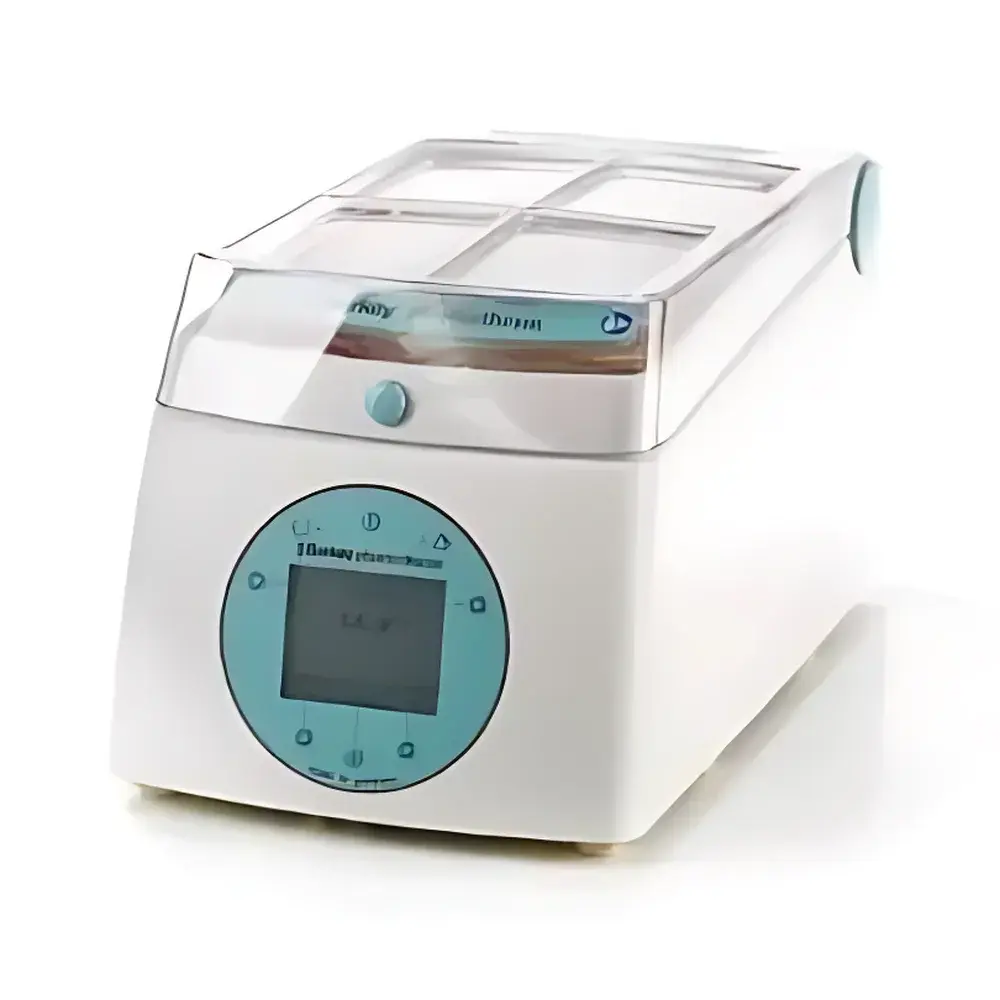
Barkey Plasmatherm Dry-Heat Cell Thawing Instrument (CE-Certified, ISO 13485 Compliant)
| Brand | AZENTA |
|---|---|
| Country of Origin | Germany |
| Model | Barkey Plasmatherm |
| Power Supply | 230 V / 50 Hz |
| Temperature Range | 25–45 °C (standard mode) |
| Dimensions (L×W×H) | 60 × 34 × 32 cm |
| Net Weight | 18 kg |
| Max. Chamber Volume | 9 L |
| Certifications | CE 0120, China NMPA Import Registration No. 20162451979, ISO 9001, ISO 13485 |
| Compliance | FDA 21 CFR Part 606.122 (Blood & Blood Components), GLP/GMP-ready |
| Interface Options | RS232, Ethernet (for TCP Logging Tool), Barcode Reader, Log Printer |
| Safety Features | Dual independent thermal fuses, liquid leakage sensor, audible/visual end-of-cycle alert, self-test at power-on |
| Heating Technology | Dry-contact conductive heating (no water bath, no direct fluid contact) |
Overview
The Barkey Plasmatherm Dry-Heat Cell Thawing Instrument is a CE-marked, ISO 13485-certified medical device engineered for precise, contamination-controlled thawing of cryopreserved biological materials in regulated biopharmaceutical and transfusion medicine environments. Unlike conventional water-bath thawers, the Plasmatherm employs dry-contact conductive heating—eliminating open water reservoirs and associated microbial risks while maintaining strict adherence to FDA 21 CFR Part 606.122, EU Annex 1, and GMP/GLP requirements. Its core principle relies on uniform thermal conduction through a temperature-stabilized aluminum heating plate, delivering reproducible heat transfer across diverse sample formats—including cryovials (1.0–5.0 mL), freezing bags (up to 500 mL), plasma units, AHF concentrates, RBC suspensions, and whole blood units—without physical immersion or condensation. The instrument’s architecture is purpose-built for cleanroom integration: smooth, non-porous polymer housing with radiused edges facilitates routine disinfection with oxidizing agents (e.g., hydrogen peroxide vapor, sodium hypochlorite), and its sealed thermal path prevents cross-contamination between cycles.
Key Features
- Dry-heat technology eliminates waterborne bioburden risk—fully compliant with sterile processing requirements for cell therapy and plasma product handling
- Five pre-validated thaw programs: Thaw + Motion (for viscous plasma), Thaw (static), Stem Cells (low-shear protocol), User (customizable T/t profile), and Continuous (maintenance mode)
- Simultaneous processing of up to four standard blood bags; expandable to eight via optional dual-heating-pad configuration
- Real-time visual monitoring through transparent polycarbonate lid and heated plate—enables observation of bag expansion, phase transition, and clot formation without interruption
- Integrated liquid leakage detection system with automatic shutdown and alarm—prevents operational hazards from accidental spillage
- Menu-driven interface with large backlit monochrome LCD displaying plain-text prompts, cycle progress, and real-time temperature feedback
- Dual redundant thermal fuses and electronic overtemperature cutoff ensure fail-safe operation under all load conditions
- Self-diagnostic boot sequence verifies sensor integrity, heater response, and safety circuit functionality prior to each use
Sample Compatibility & Compliance
The Plasmatherm accommodates a broad range of primary container types used in clinical and manufacturing settings: cryovials (1.8–5.0 mL), glass or plastic serum vials, freezing bags (25–500 mL), and rigid plasma containers. Its vertical vial-thawing configuration (via optional VialGuard Pro accessory) ensures optimal heat transfer for small-volume samples by aligning the vial’s longitudinal axis perpendicular to the heating surface—minimizing thermal gradient asymmetry and maximizing post-thaw viability recovery. All operational parameters meet regulatory expectations for traceability and audit readiness: temperature setpoints are locked to ±0.3 °C accuracy (calibrated per ISO/IEC 17025), cycle logs include timestamped start/end times, operator ID (via barcode scan), and deviation flags. The device supports full validation lifecycle management—including Installation Qualification (IQ), Operational Qualification (OQ), Performance Qualification (PQ), and Preventive Maintenance (PM)—with documentation templates aligned to ICH Q5D, USP , and EMA Guideline on Human Cell-Based Medicinal Products.
Software & Data Management
Data integrity and electronic record compliance are ensured through native Ethernet connectivity and the Barkey TCP Logging Tool—a validated Windows-based application that captures and exports tamper-evident cycle reports in CSV and PDF formats. Each log entry includes device ID, user authentication (optional LDAP integration), ambient temperature/humidity (if external sensors connected), actual vs. setpoint temperature curves, alarm events, and digital signatures compliant with FDA 21 CFR Part 11. Optional RS232 and barcode reader interfaces enable seamless integration into LIMS or MES platforms for automated batch release workflows. Audit trails are immutable and retain full history for ≥10 years, satisfying long-term archival mandates under EU Annex 11 and FDA data retention guidance.
Applications
- Clinical-scale thawing of hematopoietic stem cells (HSCs), CAR-T products, and mesenchymal stromal cells (MSCs) under cGMP conditions
- Routine thawing of Fresh Frozen Plasma (FFP), Cryoprecipitate, and Factor VIII concentrates in blood banks
- QC release testing of cryopreserved reference standards and master cell banks
- Process development and scale-down modeling for cryopreservation protocol optimization
- Regulatory submission support—provides documented evidence of consistent thermal profiles required for BLA/MAA dossiers
FAQ
Does the Plasmatherm require periodic water replacement like traditional water baths?
No. As a dry-heat system, it contains no water reservoir—eliminating maintenance associated with microbial monitoring, deionized water replenishment, or bath disinfection.
Can the instrument be validated for use in FDA-registered facilities?
Yes. Full IQ/OQ/PQ documentation packages—including test protocols, raw data worksheets, and summary reports—are available upon request and align with ASTM E2500 and ISO 13485 requirements.
Is temperature calibration traceable to national standards?
All factory calibrations are performed using NIST-traceable RTDs, with certificate of calibration provided per unit. On-site recalibration services are offered annually as part of PM contracts.
What safety certifications does the device hold?
CE 0120 (MDR Class IIa), China NMPA Import Registration (20162451979), ISO 13485:2016 certified quality management system, and conformity with IEC 61010-1 for laboratory equipment safety.
How is user access controlled for GxP environments?
Role-based login (via barcode or manual entry) restricts parameter modification to authorized personnel; all changes are logged with timestamp, user ID, and reason code—supporting ALCOA+ data integrity principles.
Related Products




