
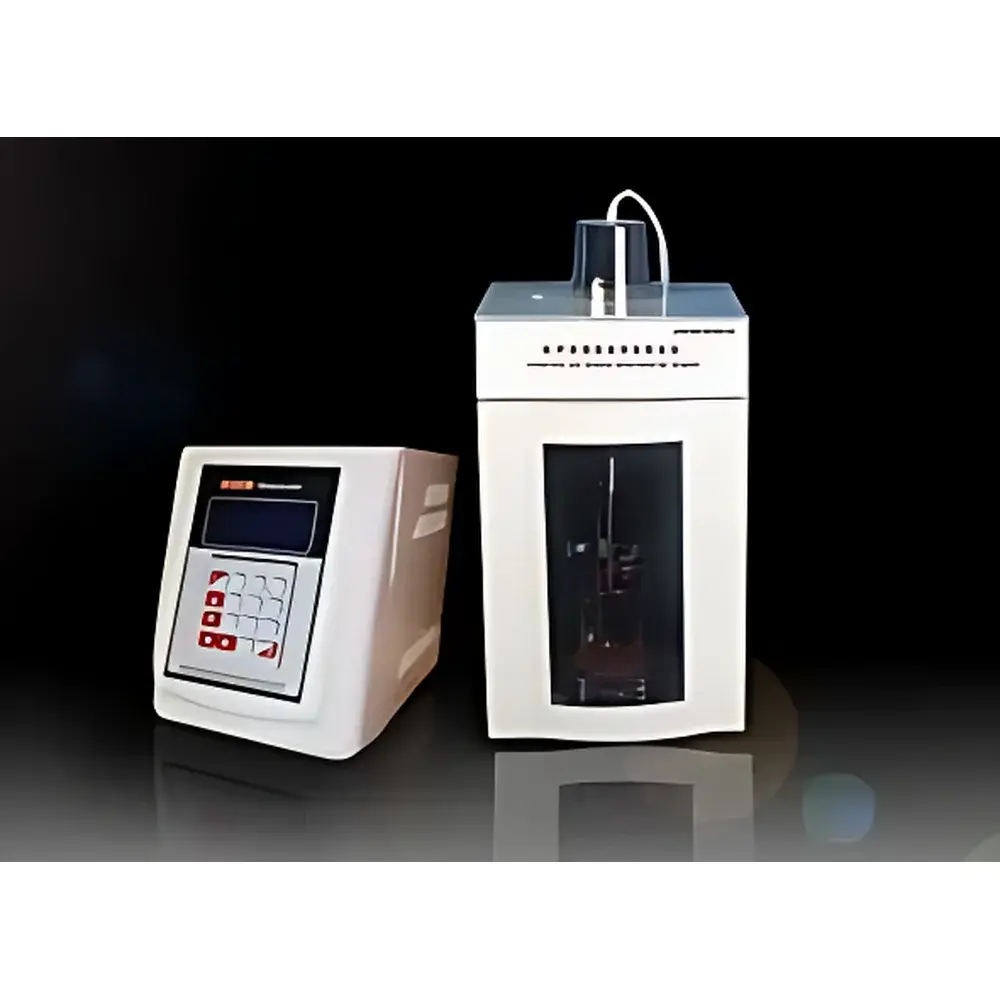
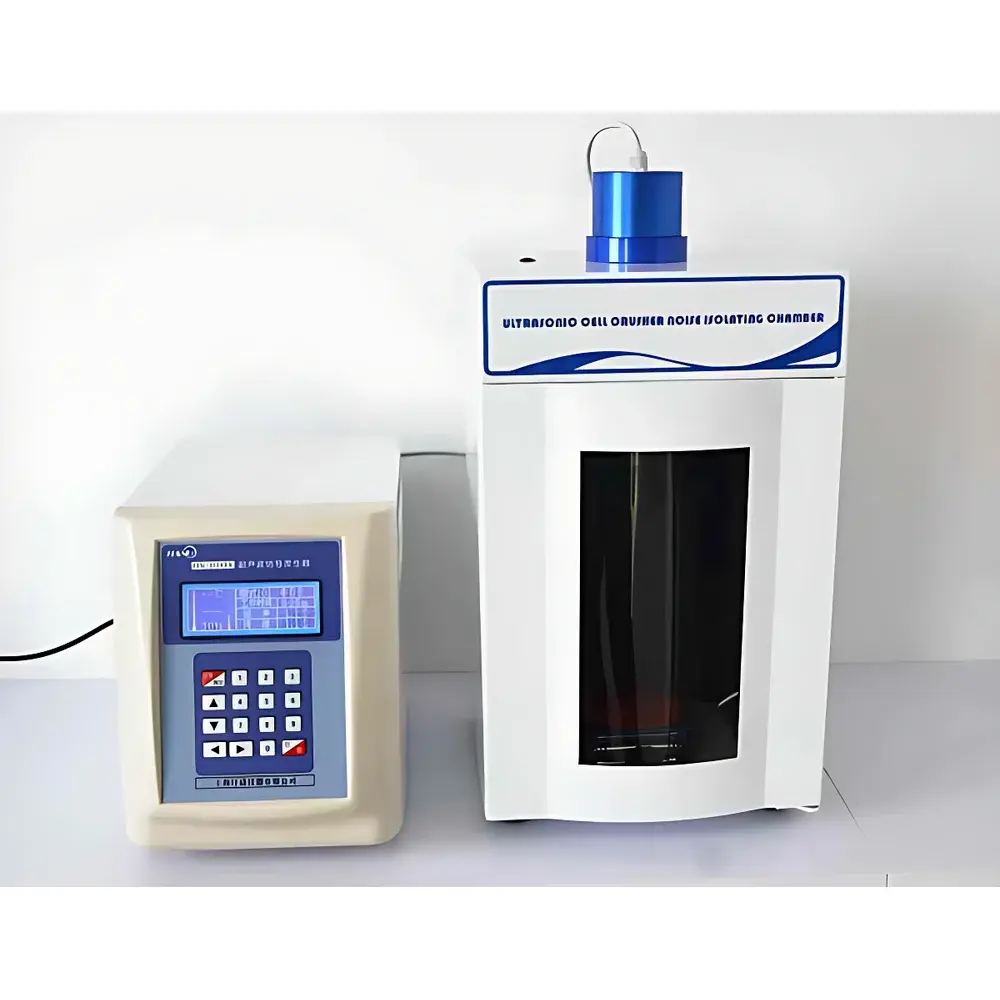
Hanuo HN99-IIDL Temperature-Controlled Ultrasonic Cell Disruptor
| Brand | Hanuo |
|---|---|
| Origin | Shanghai, China |
| Model | HN99-IIDL |
| Instrument Type | Ultrasonic Cell Disruptor |
| Ultrasonic Power | 1800 W |
| Operating Frequency | 19–23 kHz |
| Temperature Range | 0–90 °C |
| Sample Volume Capacity | 1500 mL |
| Number of Samples per Run | 1 |
Overview
The Hanuo HN99-IIDL Temperature-Controlled Ultrasonic Cell Disruptor is an engineered platform for controlled mechanical lysis of biological cells and tissues via high-intensity ultrasonic cavitation. It operates on the principle of acoustic cavitation—where rapid pressure fluctuations in a liquid medium generate transient microbubbles that collapse violently, producing localized shear forces, microstreaming, and thermal transients sufficient to disrupt cellular membranes and subcellular structures. Unlike non-temperature-regulated ultrasonicators, the HN99-IIDL integrates real-time Peltier-based or circulating coolant-compatible temperature control (0–90 °C) to mitigate thermal denaturation of heat-sensitive biomolecules—including proteins, nucleic acids, and enzyme complexes—during extended or high-power sonication protocols. Designed for reproducible sample preparation in upstream bioprocessing, it supports consistent cell disruption across diverse microbial, mammalian, plant, and yeast systems under defined thermal and acoustic parameters.
Key Features
- Digitally controlled ultrasonic output with adjustable amplitude (0–100%), enabling precise energy delivery across variable sample viscosities and volumes.
- Automatic frequency tracking (19–23 kHz) ensures stable resonance coupling between transducer and probe, minimizing impedance mismatch and enhancing energy transfer efficiency.
- Integrated temperature monitoring and regulation system with external sensor port; maintains setpoint within ±1.5 °C over full operating range (0–90 °C), critical for preserving epitope integrity or enzymatic activity.
- Dual-mode operation: continuous and pulsed (duty cycle programmable from 0.1–99.9 s ON/OFF), reducing cumulative thermal load while maintaining effective lysis kinetics.
- Microprocessor-based controller with non-volatile memory storing up to 50 user-defined protocols—including power, time, pulse sequence, temperature setpoint, and amplitude settings.
- High-efficiency titanium alloy probe (Φ20 mm or Φ22 mm standard), corrosion-resistant and fatigue-tested for >10,000 operational cycles under rated load conditions.
- Acoustically damped enclosure constructed with multi-layer composite sound-absorbing materials, achieving ≥45 dB(A) noise reduction at 1 m distance during full-power operation.
Sample Compatibility & Compliance
The HN99-IIDL accommodates single-batch processing of up to 1500 mL liquid samples in jacketed or insulated vessels, supporting scalable lysis from benchtop R&D (e.g., 1–50 mL bacterial cultures) to pilot-scale extraction (e.g., 500–1500 mL algal biomass suspensions). Compatible with standard laboratory glassware (e.g., beakers, conical flasks, jacketed reactors) and optional flow-through adapters for continuous processing. Complies with IEC 61000-6-3 (EMC emissions) and IEC 61000-6-2 (immunity) standards. Temperature control functionality aligns with GLP documentation requirements when paired with validated external data loggers. While not FDA 21 CFR Part 11–certified out-of-box, audit trails and protocol export capabilities support integration into GMP-compliant workflows with appropriate IT validation.
Software & Data Management
The embedded firmware enables local parameter configuration and real-time display of instantaneous power, temperature, elapsed time, and duty cycle via a backlit 5.7-inch LCD interface. All executed protocols are timestamped and stored internally with operator ID fields (user-configurable). Data export is supported via USB 2.0 to CSV-formatted files for downstream analysis in Excel, MATLAB, or LIMS platforms. Optional RS-485 or Ethernet modules (sold separately) permit remote command execution and status polling via Modbus RTU or TCP/IP, facilitating integration into automated lab environments and centralized instrument management systems.
Applications
- Preparative isolation of intracellular proteins, inclusion bodies, and organelles from E. coli, S. cerevisiae, and CHO cell lines.
- Nucleic acid extraction for next-generation sequencing library prep—minimizing DNA shearing through optimized low-duty-cycle pulsing.
- Disruption of tough-walled microorganisms (e.g., Mycobacterium, fungal spores) and plant tissues for metabolite profiling.
- Emulsification of lipid nanoparticles (LNPs) and nanostructured lipid carriers (NLCs) in mRNA vaccine development pipelines.
- Homogenization of tissue lysates for proteomic digestion and phosphoproteome enrichment prior to LC-MS/MS.
- Accelerated solvent extraction of phytochemicals and natural pigments from botanical matrices under controlled thermal conditions.
FAQ
What is the maximum recommended sample volume for optimal cavitation efficiency?
For uniform energy distribution and minimal standing-wave interference, the recommended working volume is 250–1200 mL using the Φ22 mm probe. Volumes exceeding 1200 mL require extended sonication time or auxiliary mixing.
Can the unit operate continuously at 1800 W without overheating?
Yes—when coupled with active cooling (e.g., recirculating chiller at ≤15 °C inlet temperature) and pulsed mode (e.g., 5 s ON / 3 s OFF), continuous operation for ≥30 minutes is thermally sustainable.
Is probe sterilization possible via autoclaving?
No—the titanium alloy probe is not autoclavable due to thermal stress on piezoelectric stack bonding; instead, surface decontamination is performed using 70% ethanol or 0.5% sodium hypochlorite followed by sterile water rinse.
Does the system support external temperature feedback from a calibrated Pt100 sensor?
Yes—the rear panel includes a dedicated analog input (0–10 V) compatible with third-party temperature sensors, allowing closed-loop control independent of the built-in thermistor.
How is amplitude consistency maintained across varying sample loads?
The system employs real-time impedance compensation: the generator dynamically adjusts drive voltage to maintain constant displacement amplitude at the probe tip, irrespective of changes in liquid density, viscosity, or air entrainment.





