
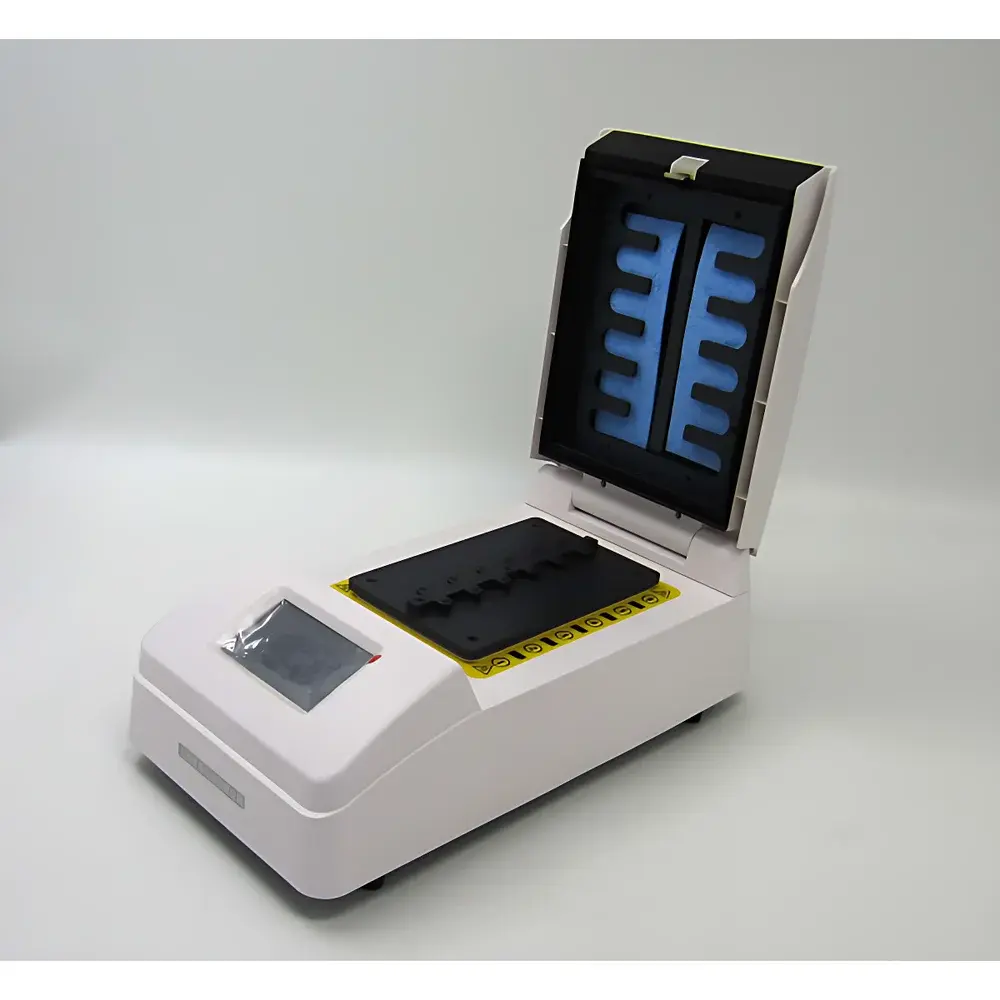
Hanuo LF-2000 In Situ Hybridization Instrument
| Brand | Hanuo |
|---|---|
| Origin | Shanghai, China |
| Model | LF-2000 |
| Temperature Control Range | Ambient +5°C to 100°C with Auto-Cooling |
| Temperature Uniformity | ≤ ±1°C |
| Sample Capacity | 12 microscope slides |
| Humidity Control | Integrated |
| Heating Time | ≤3 min (37°C → 95°C) |
| Cooling Time | ≤5 min (95°C → 45°C) |
| Programmable Protocols | 105 user-defined methods |
| Display Resolution | 0.1°C |
| Timer Range | 1 min – 99 h 59 min |
| Power Supply | AC 220 V / 50 Hz |
| Dimensions | 440 × 220 × 120 mm |
| Weight | 4.5 kg |
| Power Consumption | 330 W |
Overview
The Hanuo LF-2000 In Situ Hybridization (ISH) Instrument is a benchtop, fully automated platform engineered for precision-controlled nucleic acid hybridization directly on fixed tissue sections or cytological preparations mounted on standard glass microscope slides. It operates on the principle of thermal regulation and environmental stabilization to enable reproducible DNA/RNA denaturation and probe hybridization under tightly defined temperature and humidity conditions—critical for fluorescence in situ hybridization (FISH), chromogenic in situ hybridization (CISH), and RNA ISH workflows. Unlike manual water bath or oven-based protocols, the LF-2000 eliminates inter-operator variability by automating time-critical steps including denaturation, hybridization, and post-hybridization wash pre-conditioning. Its integrated architecture supports simultaneous execution of denaturation and hybridization cycles, reducing total assay turnaround time while maintaining stringent thermal fidelity across all 12 slide positions.
Key Features
- Full-touch 7-inch LCD interface with switchable English/Chinese language menus for intuitive protocol navigation and real-time parameter monitoring.
- Patented single-hand slide insertion mechanism with spring-loaded slide clamps ensures rapid, vibration-free loading without compromising thermal seal integrity.
- Active humidity control system maintains optimal ambient moisture levels inside the reaction chamber—preventing slide drying during extended hybridization periods (up to 99 h 59 min).
- Three operational modes: (1) Denaturation + Hybridization, (2) Hybridization-only, and (3) Multi-step sequential runs—enabling full customization for complex ISH/FISH panel assays.
- Auto-preheat and auto-cool functions minimize idle time between runs; heating ramp from 37°C to 95°C completes in ≤3 minutes, cooling from 95°C to 45°C in ≤5 minutes.
- High-stability thermal block design delivers uniform temperature distribution (≤±1°C deviation across all 12 positions), validated per ISO/IEC 17025 traceable calibration procedures.
- Onboard storage for up to 105 user-defined protocols—including temperature profiles, dwell times, humidity setpoints, and step sequencing—with password-protected access and audit-ready modification logs.
Sample Compatibility & Compliance
The LF-2000 accommodates standard 25 × 75 mm microscope slides (including charged, poly-L-lysine, or silanized variants) and is compatible with common ISH reagents—including digoxigenin-, biotin-, and fluorophore-labeled probes—as well as commercial FISH probe kits (e.g., Abbott Molecular, Dako, Zytovision). The instrument meets essential safety and electromagnetic compatibility requirements per IEC 61010-1:2010 and conforms to GB 4793.1–2007 (China National Standard for Laboratory Equipment Safety). While not certified for clinical diagnostic use under FDA 510(k) or CE-IVD, it is routinely deployed in research-grade molecular pathology labs operating under GLP-aligned quality systems. Its programmable logging capability supports basic audit trail generation for internal SOP compliance.
Software & Data Management
The LF-2000 operates via embedded firmware with no external PC dependency. All protocols are stored locally in non-volatile memory with timestamped creation/modification records. Each run generates an immutable session log—including start/end time, actual vs. setpoint temperatures at 30-second intervals, humidity readings, and error flags—which can be exported via USB flash drive in CSV format. Although the device does not support network connectivity or LIMS integration, its structured data output facilitates downstream analysis in Excel or laboratory information management systems using standard parsing scripts. Firmware updates are delivered via USB and include version-controlled release notes compliant with ISO 13485 change control documentation practices.
Applications
- Fluorescence in situ hybridization (FISH) for oncology biomarker detection (e.g., HER2, EGFR, ALK, ROS1).
- Chromogenic in situ hybridization (CISH) in formalin-fixed paraffin-embedded (FFPE) tissue sections.
- RNA in situ hybridization (RNA-ISH) for spatial gene expression profiling in developmental biology and neurobiology studies.
- Microbial identification in clinical microbiology via rRNA-targeted probes.
- Validation of CRISPR/Cas9 editing efficiency through locus-specific probe hybridization.
- Quality assurance testing of probe labeling efficiency and hybridization stringency optimization.
FAQ
Does the LF-2000 support overnight hybridization protocols?
Yes—it accepts timer settings up to 99 hours and 59 minutes, and its active humidity control prevents sample desiccation during extended incubations.
Can I run fewer than 12 slides without affecting temperature stability?
Yes—the thermal block is calibrated to maintain uniformity regardless of slide count (1–12); empty slots remain thermally inert and do not induce gradient drift.
Is the instrument compatible with automated slide stainers?
The LF-2000 is a standalone hybridization module and does not interface mechanically or electronically with stainer platforms; however, its standardized slide dimensions ensure seamless transfer to downstream staining instruments.
What maintenance is required for long-term reliability?
Annual verification of temperature/humidity sensor accuracy using NIST-traceable references is recommended; no consumables or routine calibration parts are required beyond standard lab-grade cleaning of the chamber interior.
Does the device comply with FDA 21 CFR Part 11 requirements?
No—the LF-2000 lacks electronic signature capability, role-based access control, and permanent audit trail archiving required for Part 11 compliance; it is intended for research use only.




