
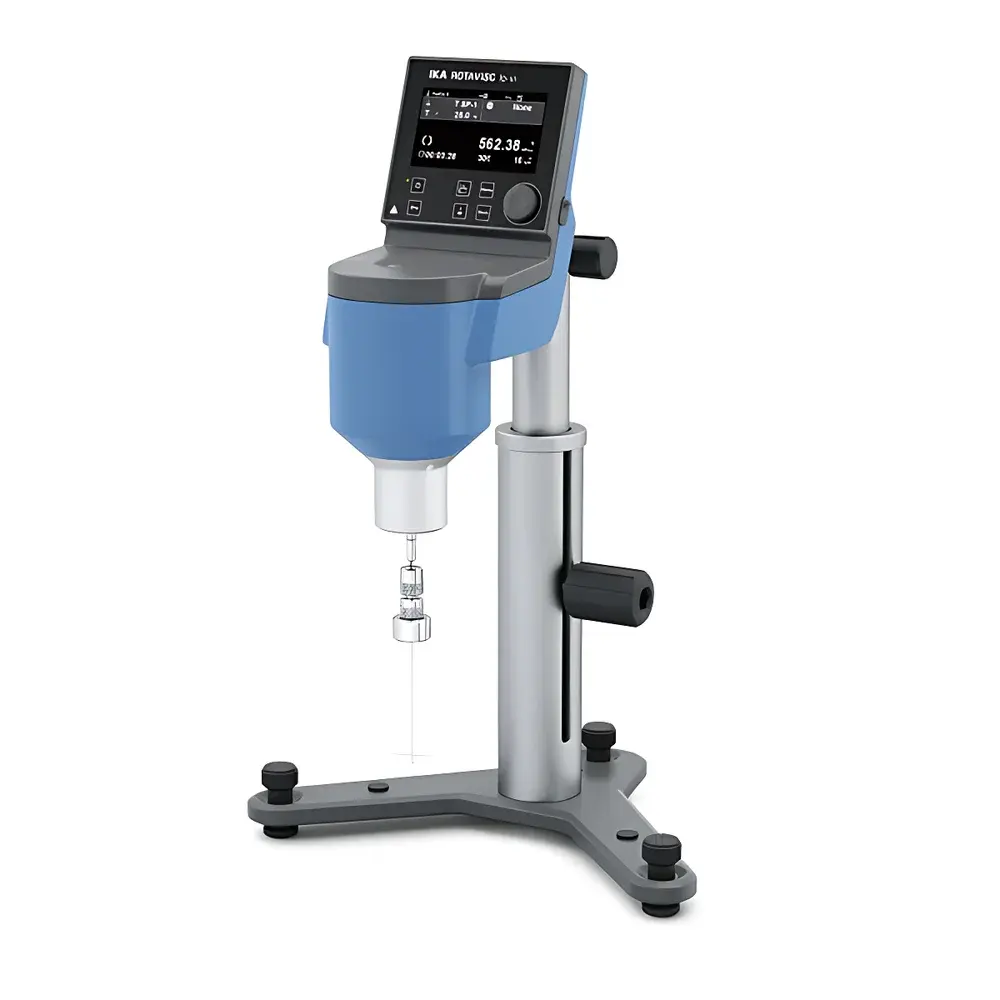
IKA ROTAVISC lo-vi Complete Rotational Viscometer
| Brand | IKA |
|---|---|
| Origin | Germany |
| Manufacturer | IKA Werke GmbH & Co. KG |
| Product Type | Benchtop Rotational Viscometer |
| Viscosity Range | 1–6,000,000 mPa·s |
| Temperature Accuracy | ±0.1 K |
| Speed Range | 0.01–200 rpm |
| Torque Accuracy (FSR) | ±1% |
| Repeatability (FSR) | ±0.2% |
| Motor Power | 4.8 W |
| Display | TFT touchscreen |
| Interfaces | RS-232, USB |
| Protection Class | IP40 |
| Dimensions (W×H×D) | 351 × 629 × 372 mm |
| Weight | 7.1 kg |
| Operating Ambient | 0–40 °C, ≤80% RH |
| Compliance | DIN EN 60529, CE, RoHS |
Overview
The IKA ROTAVISC lo-vi Complete is a high-precision benchtop rotational viscometer engineered for reliable, traceable viscosity measurement across diverse industrial and academic laboratories. Based on the Couette principle—where torque exerted on a rotating spindle immersed in a fluid is directly proportional to its dynamic viscosity—the instrument delivers quantitative rheological data under controlled shear conditions. Designed for routine quality control, R&D formulation validation, and process consistency monitoring, it supports both single-point viscosity determination and time-dependent flow behavior analysis (e.g., thixotropy, yield stress estimation via ramp protocols). Its modular architecture integrates seamlessly with external temperature control systems (e.g., circulating baths), enabling precise thermal management critical for temperature-sensitive samples such as polymer melts, pharmaceutical suspensions, or food emulsions.
Key Features
- Full-range rotational speed control from 0.01 to 200 rpm with ±0.01 rpm setting resolution, facilitating low-shear and high-shear characterization
- TFT touchscreen interface with intuitive icon-based navigation, real-time viscosity curve plotting, and on-screen timer functionality
- Integrated torque sensor with 0.0673 mN·m maximum spring torque and ±1% full-scale accuracy, validated per ISO 2555 and ASTM D2196
- Automatic measurement mode with programmable start/stop triggers, dwell times, and multi-step shear rate profiles
- Comprehensive hardware package: SP1–SP4 standard spindle set, protective guard leg, PT100-compatible temperature probe, and ROTASTAND manual lift stand (200 mm travel, 5 kg dynamic load capacity)
- Dual digital interfaces (RS-232 and USB) for direct connection to LWS 6 VISC software—enabling synchronized control of viscometers, thermostats, and data logging with audit-trail-capable metadata tagging
- Robust mechanical design compliant with IP40 ingress protection and certified to DIN EN 60529, CE, and RoHS directives
Sample Compatibility & Compliance
The ROTAVISC lo-vi Complete accommodates Newtonian and non-Newtonian fluids—including paints, adhesives, cosmetics, lubricants, and biological gels—within a working volume of up to 600 mL using standard cylindrical sample containers. Its spindle geometry (SP1–SP4) conforms to DIN 53019-1 and ISO 3219 standards for geometry-defined shear field generation. Temperature measurement is referenced to a calibrated PT100 sensor (±0.1 K accuracy), supporting GLP/GMP-aligned workflows where thermal stability is mandated (e.g., USP , ISO 16520-1). The system meets essential requirements for regulatory documentation: all measurements include timestamped metadata, user ID assignment, and configurable electronic signatures compatible with FDA 21 CFR Part 11-compliant software environments when used with validated LWS 6 VISC configurations.
Software & Data Management
LWS 6 VISC serves as the central platform for method development, instrument orchestration, and structured data archiving. It enables automated calibration routines (single- or multi-point), batch report generation (PDF/CSV/XLSX), and comparative analysis across historical datasets. Raw torque, speed, temperature, and time vectors are stored with full traceability—including operator login, environmental logs, and firmware revision stamps. Exported datasets retain SI-unit integrity and support third-party statistical packages (e.g., JMP, MATLAB) for advanced rheological modeling. The software architecture supports network deployment in shared lab environments and includes role-based access control to enforce procedural compliance during QC release testing.
Applications
- Quality assurance of incoming raw materials (e.g., resins, solvents, surfactant solutions) against specification limits
- Stability assessment of shear-thinning formulations during storage or transport simulation
- Optimization of mixing parameters in pilot-scale bioreactors or homogenization processes
- Viscoelastic screening of hydrogels and injectable drug carriers under physiological temperature conditions
- Educational use in undergraduate rheology labs for demonstrating Newtonian/non-Newtonian behavior, activation energy calculations (via Arrhenius plots), and power-law index derivation
FAQ
What spindle geometries are included with the ROTAVISC lo-vi Complete?
The instrument ships with the SP1–SP4 standard spindle set, covering low-, medium-, and high-viscosity ranges per DIN 53019-1. Optional spindles (e.g., ultra-low-volume cone-plate, vane, or T-bar) are available for specialized applications.
Is the device suitable for measuring yield stress?
While not a dedicated yield stress rheometer, the lo-vi Complete supports ramped-speed protocols and torque threshold detection; however, accurate yield point determination requires complementary instruments such as controlled-stress rotational rheometers per ISO 3219 Annex C.
Can the viscometer operate unattended overnight?
Yes—programmable timers (0.017–6000 min range), automatic shutdown, and stable thermal coupling allow extended-duration measurements under monitored lab conditions.
Does the 10-year warranty cover calibration services?
The 10-year limited warranty covers parts and labor for manufacturing defects. Calibration certificates and periodic verification services are offered separately through IKA-certified service centers and comply with ISO/IEC 17025 requirements.
How does the system ensure data integrity during power interruption?
All active measurements write to non-volatile memory at configurable intervals; upon restart, the device resumes logging from the last saved state, preserving continuity for long-term kinetic studies.
Related Products



