
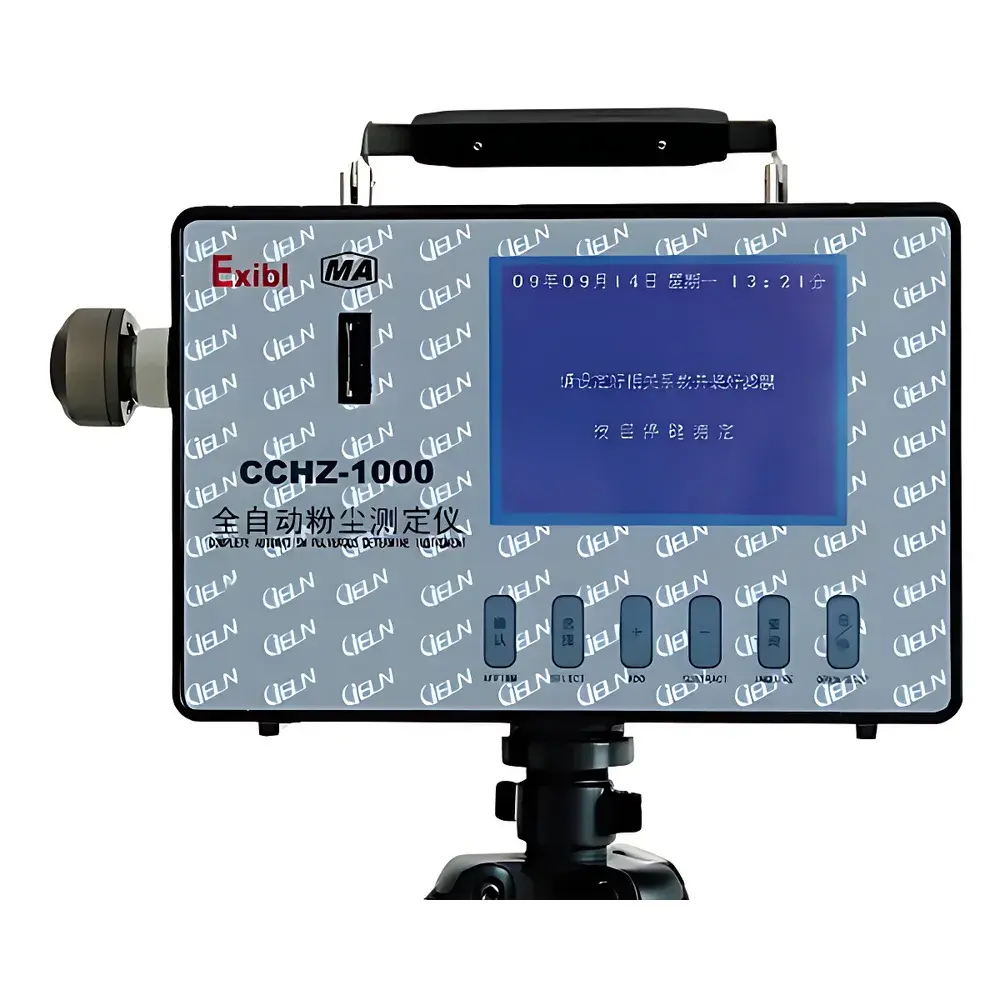
CCHZ-1000 Digital Dust Monitor
| Brand | 1124123/13213112 |
|---|---|
| Origin | Jiangsu, China |
| Model | CCHZ-1000 |
| Measurement Principle | Light Scattering |
| Safety Rating | Exib I (150 °C) Intrinsically Safe |
| Measurement Range | 0–1000 mg/m³ |
| Resolution | 0.001 mg/m³ |
| Accuracy | ±10% |
| Relative Stability Error | ±2.5% |
| Sampling Flow Rate | 2.0 L/min (±2.5%) |
| Data Storage Capacity | 50 test records |
| Dimensions | 220 × 150 × 82 mm |
| Weight | 1.9 kg |
Overview
The CCHZ-1000 Digital Dust Monitor is a portable, intrinsically safe particulate concentration measurement instrument engineered for real-time, on-site quantification of airborne dust mass concentration in occupational and hazardous environments. It operates on the principle of light scattering—where incident light from a calibrated LED source interacts with suspended particles, generating scattered intensity proportional to particle size distribution and mass concentration within the sampled air stream. The instrument complies with MT163–1997 (“General Technical Specifications for Direct-Reading Dust Concentration Meters”) and is specifically designed for rapid assessment of respirable and total dust in coal mining, metallurgy, cement production, and other industrial settings where explosive atmospheres may be present. Its Exib I (150 °C) certification confirms compliance with IEC 60079-0 and IEC 60079-11 standards for intrinsic safety in Zone 1 hazardous locations, making it suitable for underground coal mine use and other Class I, Division 1 environments.
Key Features
- Intrinsically safe Exib I (150 °C) explosion-proof design certified per IEC 60079 series, enabling safe operation in methane-rich or volatile organic vapor environments.
- Dual-mode sampling capability: supports both continuous and timed sampling protocols to align with ISO 7708 (respirable fraction), GB/T 20964 (Chinese occupational exposure standards), and OSHA Method ID-130.
- Integrated respirable dust cyclone separator meeting BMRC (British Medical Research Council) inhalability curve performance criteria, ensuring physiologically relevant particle fraction collection.
- High-stability optical detection circuitry with temperature-compensated photodetector array, minimizing drift under variable ambient conditions (10–40 °C, ≤90% RH).
- Embedded microprocessor with real-time data processing, anti-interference filtering algorithms, and automatic zero-point compensation during idle periods.
- Backlit Chinese-language LCD display with intuitive menu navigation, real-time concentration readout (mg/m³), battery status, flow rate, and error indicators.
- Rechargeable lithium-ion power system with undervoltage protection and low-power sleep mode; operational runtime ≥8 hours at 2 L/min flow rate.
Sample Compatibility & Compliance
The CCHZ-1000 is validated for measurement of mineral dusts—including coal dust, silica, limestone, and iron ore—with aerodynamic diameter distributions spanning 0.1–100 µm. Its cyclonic inlet achieves >90% cut-point efficiency at 4 µm (aerodynamic diameter), satisfying respirable dust definition per ISO 7708 and ACGIH TLV® conventions. The device meets national metrological verification requirements under JJG 846–2015 (Calibration Regulation for Dust Meters) and supports traceability through factory calibration certificates referenced to NIST-traceable aerosol generators (e.g., Palas RBG 1000). It is not intended for use with sticky, hygroscopic, or highly conductive aerosols without prior validation.
Software & Data Management
Data acquisition and storage are handled entirely onboard: up to 50 sequential measurement records—including timestamp, average concentration, sampling duration, flow rate, and battery voltage—are retained in non-volatile memory. No external software or driver installation is required for data retrieval; records can be reviewed directly on-device or exported via RS232 serial interface (optional USB-to-serial adapter) to standard spreadsheet or LIMS platforms. All stored entries include immutable metadata required for GLP-compliant recordkeeping. While the instrument does not support FDA 21 CFR Part 11 electronic signature functionality, audit trails and manual logbook correlation are supported per ISO/IEC 17025 clause 7.7.
Applications
- Real-time monitoring of respirable coal dust exposure in underground mine roadways, conveyor transfer points, and longwall faces.
- Occupational hygiene surveys in foundries, quarries, and abrasive blasting operations to verify compliance with permissible exposure limits (PELs) defined in GBZ 2.1–2019.
- Engineering control evaluation—e.g., effectiveness assessment of local exhaust ventilation (LEV) systems before and after maintenance.
- Emergency response screening during dust release incidents (e.g., silo overfill, conveyor belt rupture) to guide evacuation or PPE deployment decisions.
- Baseline environmental monitoring near stockpiles, crushing plants, and material handling facilities subject to regional air quality regulations.
FAQ
What particle size fractions does the CCHZ-1000 measure?
It measures both total suspended particulates (TSP) and respirable dust (≤4 µm aerodynamic diameter) using its integrated BMRC-calibrated cyclone separator.
Is calibration traceable to international standards?
Yes—factory calibration is performed using polydisperse aerosols generated by traceable equipment; calibration certificates reference NIST-traceable mass concentration standards.
Can the instrument be used in non-coal mining environments?
Yes, provided the atmosphere remains within Exib I (150 °C) classification limits and dust composition falls within validated mineral aerosol ranges.
Does the device support external data logging or cloud connectivity?
No—it features standalone data storage only; no Wi-Fi, Bluetooth, or IoT integration is included in the base configuration.
What maintenance is required between calibrations?
Users must inspect and clean the optical chamber and cyclone inlet after each shift in high-dust environments; annual recalibration is recommended per JJG 846–2015.







