
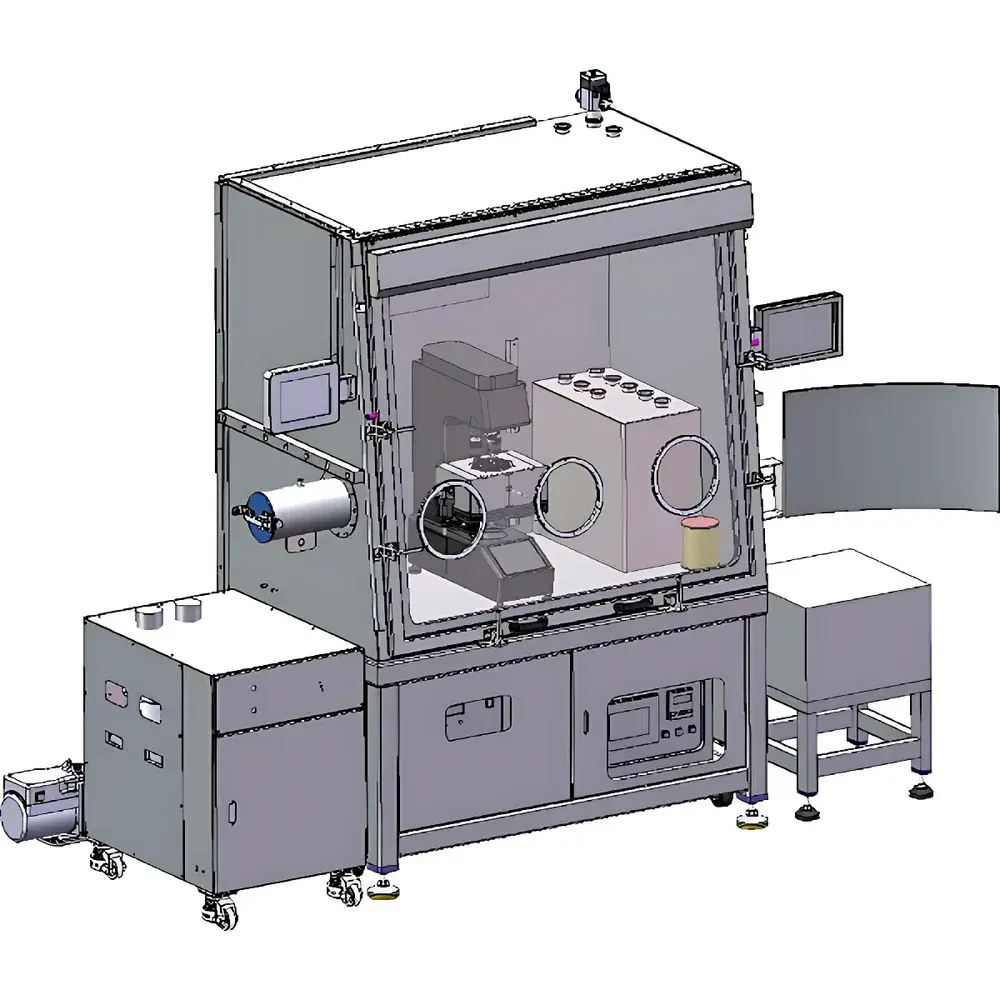
YANRUN HMAS-HT600 Full-Field High-Temperature Vickers Hardness Tester
| Brand | YANRUN |
|---|---|
| Origin | Shanghai, China |
| Manufacturer Type | Manufacturer |
| Country of Origin | China |
| Model | HMAS-HT600 |
| Instrument Type | Vickers Hardness Tester |
| Temperature Range | Room Temperature to 600 °C |
| Load Range | 1–30 kgf (standard), up to 150 kgf (optional) |
| Optical Magnification | 10× objective (20× optional), system magnification up to 2000× |
| Temperature Control Accuracy | ±1 °C |
| Heating Element | HRE high-temperature alloy |
| Thermocouple | Type S |
| Furnace Chamber Dimensions | 80 × 80 × 60 mm |
| Sample Max Size | Ø20 × 20 mm |
| Auto Sample Exchange Time | ≤20 s (in-situ at 600 °C) |
| Multi-axis Motion Control | 4-axis, resolution ≤0.1 µm, positioning accuracy ≤±1.5 µm |
| Indenter Material | Cubic Boron Nitride (CBN) with Inconel shank |
| Indenter Geometry | Square pyramid (standard), spherical/conical/cylindrical (optional) |
| Image Resolution | 1.44 µm (10×), 1.19 µm (20×) |
| Hold Time | Up to 30 min |
| Force Resolution | 0.01% FS |
| Load Accuracy | ±2% (≤1 kgf), ±0.5% (>1 kgf) |
| Heating Rate | 1–40 °C/min |
| Temperature Gradient Uniformity | ≤±5 °C across chamber |
Overview
The YANRUN HMAS-HT600 is a full-field, in-situ high-temperature Vickers hardness tester engineered for quantitative mechanical property evaluation of advanced materials under controlled thermal conditions ranging from ambient temperature to 600 °C. Unlike conventional hardness testers requiring post-test cooling or ex-situ measurement, the HMAS-HT600 integrates a precision-controlled high-temperature furnace with a fully synchronized optical imaging and force-loading system—enabling real-time indentation observation, load application, and image-based analysis within a thermally stable environment. Its design adheres to the fundamental principles of Vickers microhardness testing (ASTM E384, ISO 6507-1), extended to elevated temperatures via thermally compensated mechanics, refractory indenter materials (CBN), and high-stability optical paths. The system supports both static and dynamic thermal protocols—including ramp-and-hold, stepwise temperature gradients, and isothermal dwell cycles—making it suitable for studying time- and temperature-dependent deformation mechanisms in superalloys, ceramics, intermetallics, and high-entropy alloys.
Key Features
- Full-field thermal integration: Entire test volume—including indenter, sample stage, optics, and load train—operates continuously at up to 600 °C without thermal drift-induced misalignment.
- In-situ high-magnification imaging: 10× objective (20× optional) with diffraction-limited resolution (1.44 µm), coupled with real-time digital capture and auto-focus algorithms for precise indentation geometry assessment.
- High-precision multi-axis motion control: Four-axis (X/Y/Z/ZB) servo-driven stage with ≤0.1 µm resolution and ≤±1.5 µm repeatability; enables automated grid mapping, crack-length measurement, and multi-point hardness profiling across thermal gradients.
- Rapid in-situ sample exchange: Fully automated carousel-based changer completes sample swap within ≤20 seconds at operational temperature—eliminating thermal cycling delays and preserving experimental continuity.
- Modular load system: Standard 30 kgf capacity with selectable 16/32/61/127-force-step configurations; force transducer calibrated per ISO 14644-1 traceable standards; loading accuracy meets ASTM E92 requirements across full range.
- Thermally robust indenter assembly: CBN-tipped square-pyramid indenter mounted on Inconel shank (110 mm length); designed for minimal thermal expansion mismatch and maintained tip geometry stability at 600 °C.
- Configurable environmental interface: Optional inert-atmosphere glovebox (H2O/O2 ≤1 ppm), water-cooling module (±0.3 °C stability), and forced-gas quenching (≤10 s cooldown) for rapid thermal arrest post-indentation.
Sample Compatibility & Compliance
The HMAS-HT600 accommodates cylindrical and disc-shaped specimens up to Ø20 × 20 mm, compatible with metallic alloys, oxide and non-oxide ceramics, metal-matrix composites, and thin-film coatings on bulk substrates. All structural components exposed to elevated temperatures are fabricated from high-purity HRE alloy and 304 stainless steel, conforming to ASME BPVC Section II and ASTM B571 specifications for high-temperature service. Temperature control utilizes dual-zone S-type thermocouples with PID+feedforward regulation, certified to meet ISO/IEC 17025 calibration traceability through NIST-traceable reference standards. The system architecture supports GLP-compliant operation, including electronic audit trails, user-access-level controls, and data integrity features aligned with FDA 21 CFR Part 11 requirements when integrated with validated software modules.
Software & Data Management
Control and analysis are executed via a dedicated Windows-based platform running on an industrial-grade wall-mounted PC. The software provides synchronized orchestration of thermal ramping, force application, stage positioning, image acquisition, and real-time feature extraction—including automatic indentation detection, diagonal length measurement, crack-length quantification, and load-displacement curve generation. All raw data (images, thermal logs, force-time traces, position coordinates) are stored in vendor-neutral HDF5 format with embedded metadata (timestamp, operator ID, calibration certificate ID, environmental conditions). Export options include CSV, TIFF, and XML for third-party statistical analysis (e.g., Weibull modulus calculation, Arrhenius activation energy fitting). Software validation documentation—including IQ/OQ protocols and cybersecurity hardening reports—is available upon request for regulated laboratory environments.
Applications
- High-temperature creep resistance characterization of Ni-based superalloys used in turbine blades and combustion chambers.
- Thermal stability assessment of ceramic matrix composites (CMCs) under oxidizing and inert atmospheres.
- In-situ evaluation of interfacial hardness evolution in diffusion-bonded dissimilar material joints (e.g., TiAl/Inconel).
- Fracture toughness estimation (KIC) via indentation crack length analysis at elevated temperatures per ASTM C1327.
- Process optimization of hot isostatic pressing (HIP) and spark plasma sintering (SPS) by correlating hardness homogeneity with thermal history.
- Development of temperature-dependent constitutive models for finite element simulation of thermo-mechanical fatigue.
FAQ
What hardness scales does the HMAS-HT600 support?
The system is configured for Vickers hardness (HV) measurement per ISO 6507 and ASTM E384. Optional hardware modules enable Rockwell (HR) and Brinell (HBW) testing via interchangeable indenters and load profiles.
Can the system perform measurements during heating or cooling ramps?
Yes—programmable thermal protocols allow indentation at user-defined setpoints during dynamic temperature transitions, enabling kinetic studies of thermal softening or precipitation hardening.
Is remote monitoring and control supported?
Standard Ethernet (TCP/IP) and optional OPC UA interfaces permit integration into centralized lab automation systems and secure remote supervision via authenticated TLS-encrypted connections.
What maintenance intervals are recommended for the high-temperature components?
Furnace elements and thermocouples require annual verification; CBN indenters are rated for ≥500 indentations at 600 °C before recalibration; optical windows should be inspected quarterly for thermal stress birefringence.
Does the system comply with international safety standards?
Yes—the furnace enclosure meets IEC 61000-6-2/6-4 EMC requirements, and electrical safety conforms to UL 61010-1 and EN 61010-1 for laboratory equipment.



