
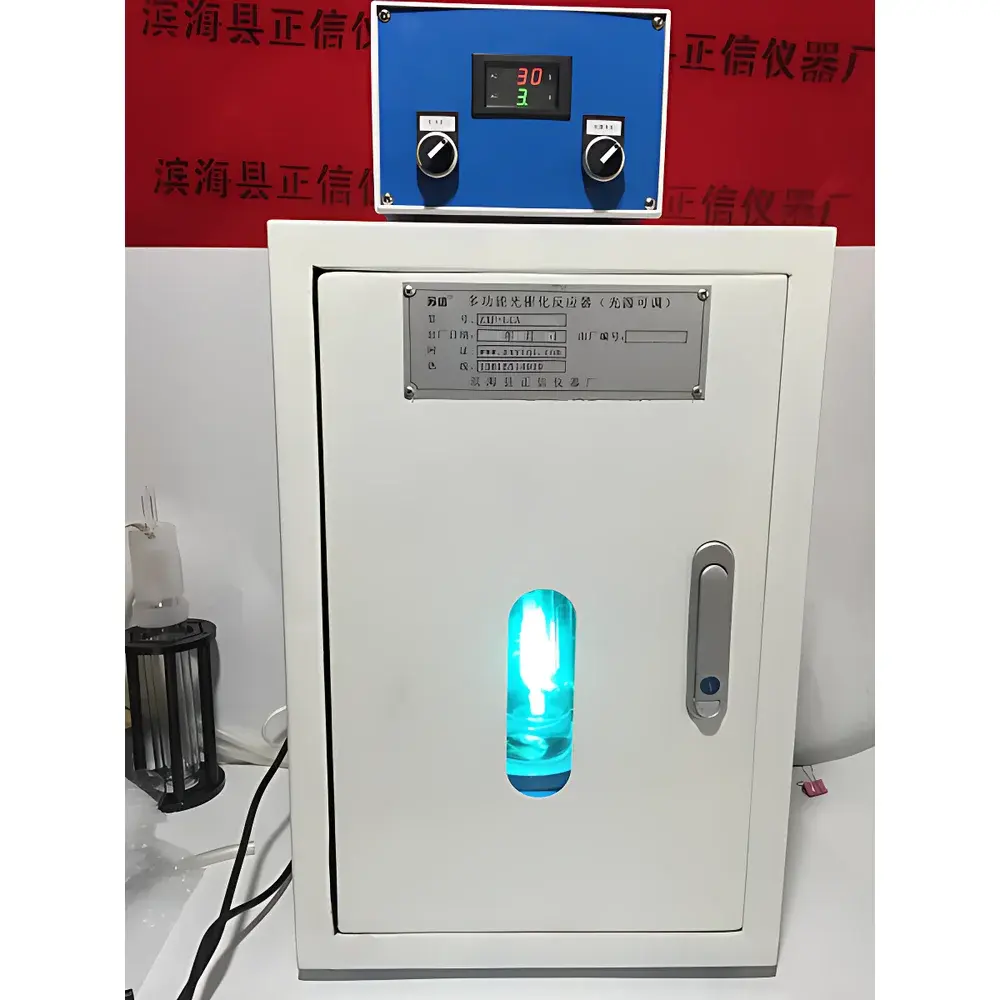
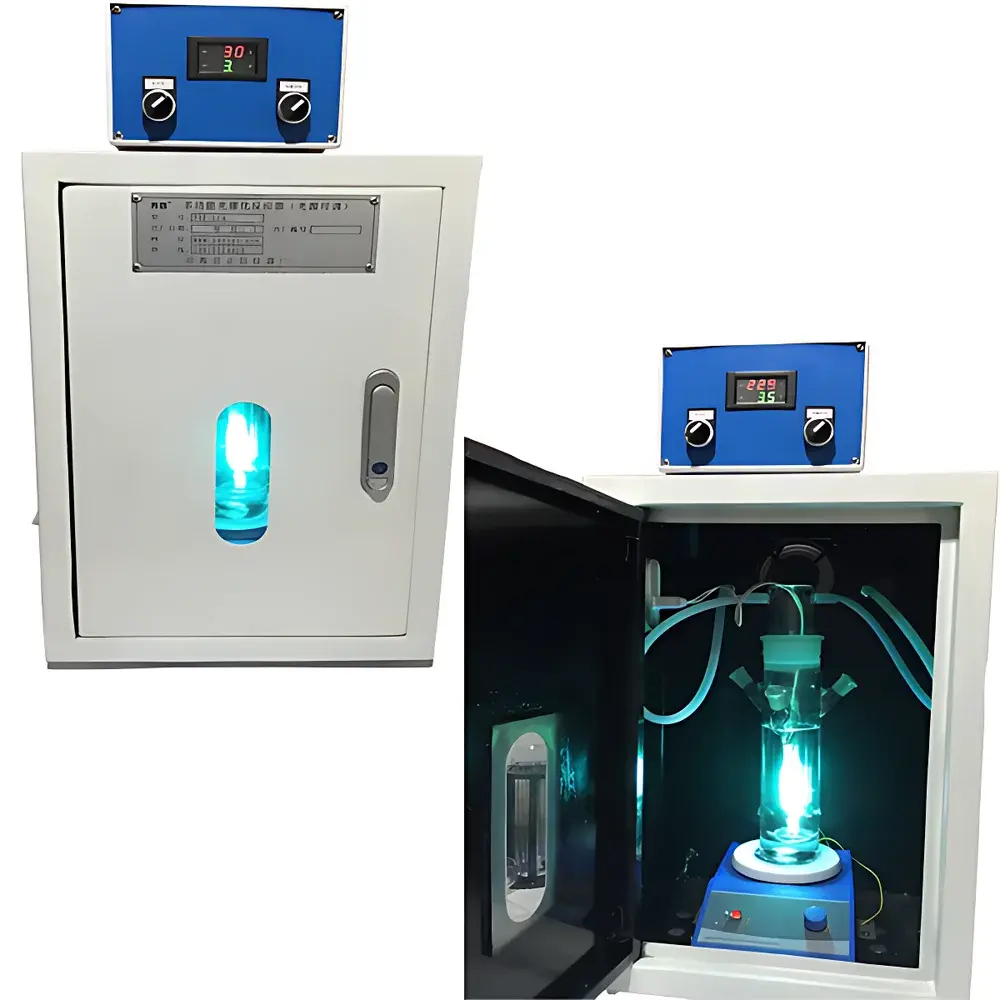
ZXYIQI LCA Benchtop Photocatalytic Reactor
| Brand | ZXYIQI |
|---|---|
| Origin | Jiangsu, China |
| Manufacturer Type | Authorized Distributor |
| Country of Manufacture | China |
| Model | LCA |
| Unit Price | USD 1,200 (FOB Jiangsu) |
| Reactor Volume | 10–100 mL (small-scale) |
| Construction Material | 316 Stainless Steel |
| Operating Pressure | Low-pressure (≤0.3 MPa gauge) |
| Vacuum Capability | ≤−0.095 MPa (absolute) |
| Light Source | Modular UV-C (254 nm, 8 W) and optional visible-light LED arrays |
| Illumination Geometry | 5-position circumferential lamp holder with independent on/off control |
| Reaction Vessel | Quartz glass immersion well (standard), compatible with TiO₂-coated or uncoated configurations |
| Stirring | Integrated high-torque magnetic stirrer (0–1200 rpm, adjustable) |
| Power Supply | 220 V AC, 50 Hz |
Overview
The ZXYIQI LCA Benchtop Photocatalytic Reactor is an engineered platform for controlled photochemical experimentation under ambient or low-pressure conditions. Designed around the principles of heterogeneous photocatalysis and actinometric irradiation, it enables reproducible quantification of photon-driven reaction pathways—including oxidative degradation, reductive synthesis, and radical-mediated transformations. Its core architecture integrates uniform circumferential illumination with precise magnetic agitation to minimize concentration gradients and photon flux heterogeneity—critical parameters in kinetic studies governed by Langmuir–Hinshelwood or Eley–Rideal mechanisms. The reactor operates within standard laboratory environments without requiring external cooling or gas supply infrastructure, making it suitable for rapid screening of photocatalyst performance (e.g., TiO₂, g-C₃N₄, perovskite oxides) and comparative quantum yield determination per ISO 10676:2021 and ASTM E2058-22 guidelines.
Key Features
- Modular five-lamp circumferential array with individual switching—enables selective irradiation intensity tuning and spatial uniformity optimization across sample volume
- High-purity quartz reaction vessels (≥99.99% SiO₂) with UV-transmittance >90% at 254 nm; compatible with catalyst immobilization (e.g., coated inner walls or suspended nanoparticles)
- Low-pressure stainless steel housing (316 SS) rated to 0.3 MPa gauge pressure and −0.095 MPa absolute vacuum—supports inert atmosphere purging (N₂, Ar) and volatile product containment
- Integrated magnetic stirring system delivering 0–1200 rpm with torque stability ±2% over 24 h—ensures homogeneous suspension of particulate photocatalysts and consistent mass transfer coefficients
- Dedicated control panel with isolated circuits for lamp power, stirrer speed, and system power—minimizes electromagnetic interference during concurrent spectroscopic monitoring or electrochemical coupling
- Standardized 220 V AC / 50 Hz input with CE-compliant internal fusing and thermal cutoff—designed for long-duration operation under GLP-aligned lab protocols
Sample Compatibility & Compliance
The LCA reactor accommodates liquid-phase, gas–liquid biphasic, and slurry-based reaction systems. It supports aqueous, organic (e.g., methanol, acetonitrile), and mixed-solvent media, with compatibility confirmed for pH 2–12 and temperatures up to 60 °C under continuous irradiation. Quartz vessels resist hydrolysis and UV-induced leaching, satisfying USP requirements for extractables testing. The system complies with IEC 61000-6-3 (EMC emission limits) and IEC 61010-1 (safety for laboratory equipment). While not certified for explosion-proof use, its low-pressure design aligns with OSHA 1910.119 process safety thresholds for non-reactive solvent handling.
Software & Data Management
The LCA operates as a standalone hardware platform with no embedded firmware or proprietary software. All operational parameters—lamp activation timing, stirrer speed, and duration—are manually set via front-panel controls. This analog architecture ensures full audit trail transparency: no electronic data storage, no automated logging, and zero risk of data corruption or software obsolescence. Users retain complete ownership of raw analytical outputs (e.g., GC-MS chromatograms, HPLC peak areas, EPR spectra) generated externally. For regulatory workflows requiring 21 CFR Part 11 compliance, manual logbooks with dual-signature entries (operator + supervisor) are recommended—and fully supported by the system’s deterministic, non-programmable interface.
Applications
- Quantitative evaluation of photocatalytic degradation kinetics (e.g., methyl orange, phenol, pharmaceutical residues) under simulated solar or monochromatic UV irradiation
- Screening of novel photocatalyst formulations for hydrogen evolution (HER) or CO₂ reduction in aqueous electrolytes
- Actinometric calibration using potassium ferrioxalate or Aberchrome 540 to determine effective photon flux (Einstein·L⁻¹·s⁻¹) at the reaction plane
- Time-resolved radical trapping experiments (e.g., using DMPO or TEMP for •OH or ¹O₂ detection via EPR)
- Photostability assessment of UV-sensitive compounds (e.g., APIs, dyes, polymers) under controlled irradiance profiles
- Teaching laboratories: demonstration of photoinduced electron transfer, band-gap excitation, and surface redox processes
FAQ
Is the LCA reactor compatible with external light sources such as Xe lamps or solar simulators?
Yes—quartz vessel geometry and open-top design permit integration with collimated external sources; however, optical alignment and irradiance homogenization must be validated independently.
Can the system operate under anaerobic conditions?
Yes—vacuum/nitrogen purge cycles can be performed via the dual-valve port; residual O₂ levels <10 ppm are achievable with three consecutive 0.09 MPa vacuum–N₂ fill cycles.
What maintenance is required for long-term reliability?
Annual inspection of quartz vessel integrity (scratches, clouding), recalibration of stirrer torque output, and verification of lamp spectral output using a NIST-traceable spectroradiometer.
Does the reactor support temperature control?
No built-in heating/cooling—but external thermostatic jackets (e.g., Julabo F25) can be clamped to the vessel sleeve; maximum recommended jacket temperature is 70 °C.
Are replacement quartz vessels and UV lamps available through ZXYIQI authorized channels?
Yes—standard quartz immersion wells (10/25/50 mL) and 254 nm low-pressure mercury lamps (8 W, G8T5 base) are stocked globally via ZXYIQI’s distributor network with lead time ≤2 weeks.



