
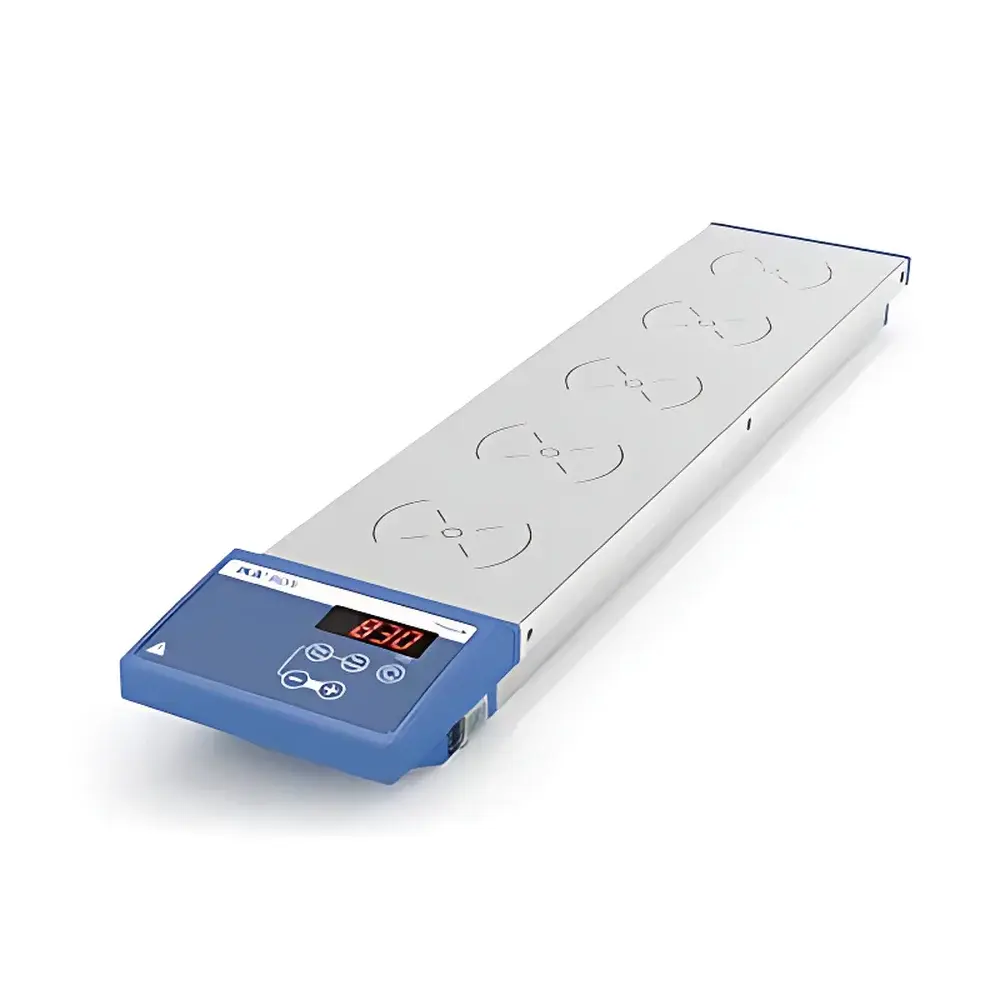
IKA RO 5 Five-Position Digital Magnetic Stirrer
| Brand | IKA |
|---|---|
| Origin | Germany |
| Manufacturer | IKA Werke GmbH & Co. KG |
| Type | Magnetic Stirrer |
| Model | RO 5 |
| Number of Stirring Positions | 5 |
| Position Spacing | 90 mm |
| Max. Stirring Volume (H₂O) | 0.4 L |
| Speed Range | 0–1200 rpm |
| Speed Resolution | 10 rpm steps |
| Speed Deviation per Position | 0 % |
| Stir Bar Length Compatibility | 25–30 mm |
| Plate Material | Stainless Steel 1.4301 |
| Plate Dimensions | 120 × 470 mm |
| Device Dimensions (W × H × D) | 120 × 60 × 570 mm |
| Weight | 3.66 kg |
| Ambient Temperature Range | 5–40 °C |
| Relative Humidity Limit | ≤80 % (non-condensing) |
| Ingress Protection | IP40 per DIN EN 60529 |
| Input Voltage | 100–240 V AC, 50/60 Hz |
| Power Consumption | 13 W |
| DC Supply | 24 V =, 500 mA |
Overview
The IKA RO 5 is a precision-engineered five-position digital magnetic stirrer designed for reproducible, synchronized multi-vessel agitation in analytical, quality control, and research laboratories. Unlike conventional single-point stirrers or mechanically coupled multi-stirring systems, the RO 5 employs independent, wear-free magnetic drive coils beneath each of its five stainless steel stirring positions—enabling true parallel operation without mechanical linkage or speed coupling. Each position operates at identical setpoints with zero speed deviation (±0 %), ensuring uniform mixing kinetics across all vessels—a critical requirement for comparative dissolution testing, parallel reaction screening, or standardized sample preparation workflows. The device implements closed-loop speed regulation via integrated Hall-effect sensing, maintaining consistent rotational velocity even under variable load conditions (e.g., viscosity shifts or vessel geometry differences). Its non-heating configuration complies with applications where thermal stability is essential—such as enzymatic assays, cold-chain sample homogenization, or temperature-sensitive polymer dispersion—eliminating heat-induced artifacts common in heated stirrers.
Key Features
- Five independent stirring positions with precise 90 mm center-to-center spacing—optimized for standard rack-mounted test tubes, vials, and low-profile beakers.
- Zero-speed-deviation control architecture: All positions maintain identical rpm within ±0 % tolerance, verified per IKA factory calibration protocol.
- Wear-free, silent magnetic drive system using encapsulated coil technology—no moving parts, no brush erosion, and no audible hum during continuous 24/7 operation.
- Robust 1.4301 stainless steel working plate with chemical-resistant surface finish; resistant to common solvents, acids, and bases used in routine lab protocols.
- Compact, sealed housing (IP40-rated per DIN EN 60529) prevents liquid ingress into internal electronics—enhancing operational safety and service life in high-humidity or splash-prone environments.
- Intuitive capacitive touch interface with real-time rpm display, forward/reverse direction toggle, and diagnostic error code reporting (e.g., overload, sensor fault, power anomaly).
- Detachable transparent anti-slip mat included—provides secure vessel positioning while enabling visual monitoring of stir bar motion and sample homogeneity.
Sample Compatibility & Compliance
The RO 5 supports standard laboratory glassware and plastic containers up to 0.4 L volume per position when using compatible stir bars (25–30 mm length, PTFE- or glass-coated). Its non-heated design meets ISO/IEC 17025 requirements for equipment used in accredited testing laboratories where thermal influence must be excluded from method validation. The unit conforms to IEC 61010-1:2010 for electrical safety in laboratory equipment and carries CE marking under the EU Low Voltage Directive (2014/35/EU) and EMC Directive (2014/30/EU). While not certified for hazardous area use, its IP40 rating aligns with general-purpose lab environments operating within ambient conditions of 5–40 °C and ≤80 % RH (non-condensing).
Software & Data Management
The RO 5 operates as a standalone instrument with no proprietary software dependency. All operational parameters—including speed setpoint, direction mode, and runtime—are configured locally via the front-panel touch interface. Error codes are displayed numerically (e.g., “E03” for overcurrent detection) and logged internally for traceability during GLP-compliant procedures. Though it lacks USB or Ethernet connectivity, its stable analog control loop ensures uninterrupted performance in regulated environments where network-connected devices may introduce cybersecurity or validation overhead. For audit readiness, users may document settings manually or integrate the RO 5 into electronic lab notebooks (ELNs) via timestamped operator entries aligned with SOP-defined mixing protocols.
Applications
- Parallel sample preparation for HPLC, GC, or ICP-MS analysis—ensuring identical homogenization across calibration standards, blanks, and unknowns.
- Dissolution testing of pharmaceutical dosage forms under USP guidelines, where isothermal agitation is required without heating interference.
- Cell culture media equilibration and reagent dilution in biotechnology labs adhering to ISO 13485 or FDA 21 CFR Part 11 principles.
- Environmental water sample homogenization prior to filtration or metal speciation analysis (EPA Method 200.7/200.8).
- Quality assurance workflows in food and beverage labs performing AOAC 984.27 or ISO 5725-based repeatability studies.
FAQ
Does the RO 5 support external control or data logging?
No—the RO 5 is a fully self-contained, manually operated instrument without analog output, digital interface, or remote command capability.
Can it accommodate larger vessels exceeding 0.4 L?
Operation beyond 0.4 L per position is not recommended, as torque delivery and stir bar stability degrade outside the validated volume range.
Is the stainless steel plate autoclavable?
No—the plate is not designed for steam sterilization; cleaning is limited to wipe-down with ethanol, isopropanol, or mild detergent solutions.
What stir bar specifications ensure optimal performance?
Use PTFE- or glass-coated bars 25–30 mm in length and 6–8 mm in diameter; avoid ferrite-core or oversized bars that may cause resonance or uneven rotation.
How does the RO 5 handle viscosity changes during mixing?
Its closed-loop speed regulation maintains set rpm within specification across viscosity ranges typical of aqueous solutions (1–100 mPa·s); significant non-Newtonian behavior may require manual speed adjustment.



