
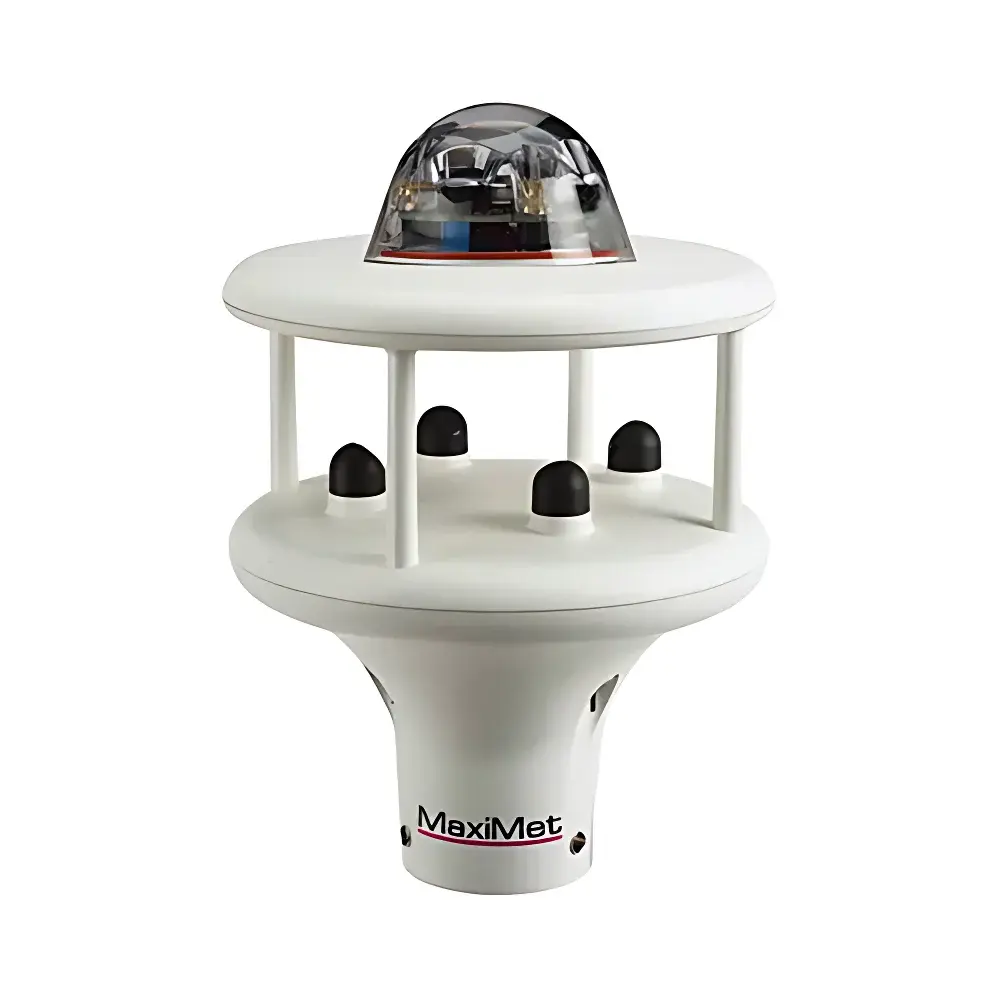
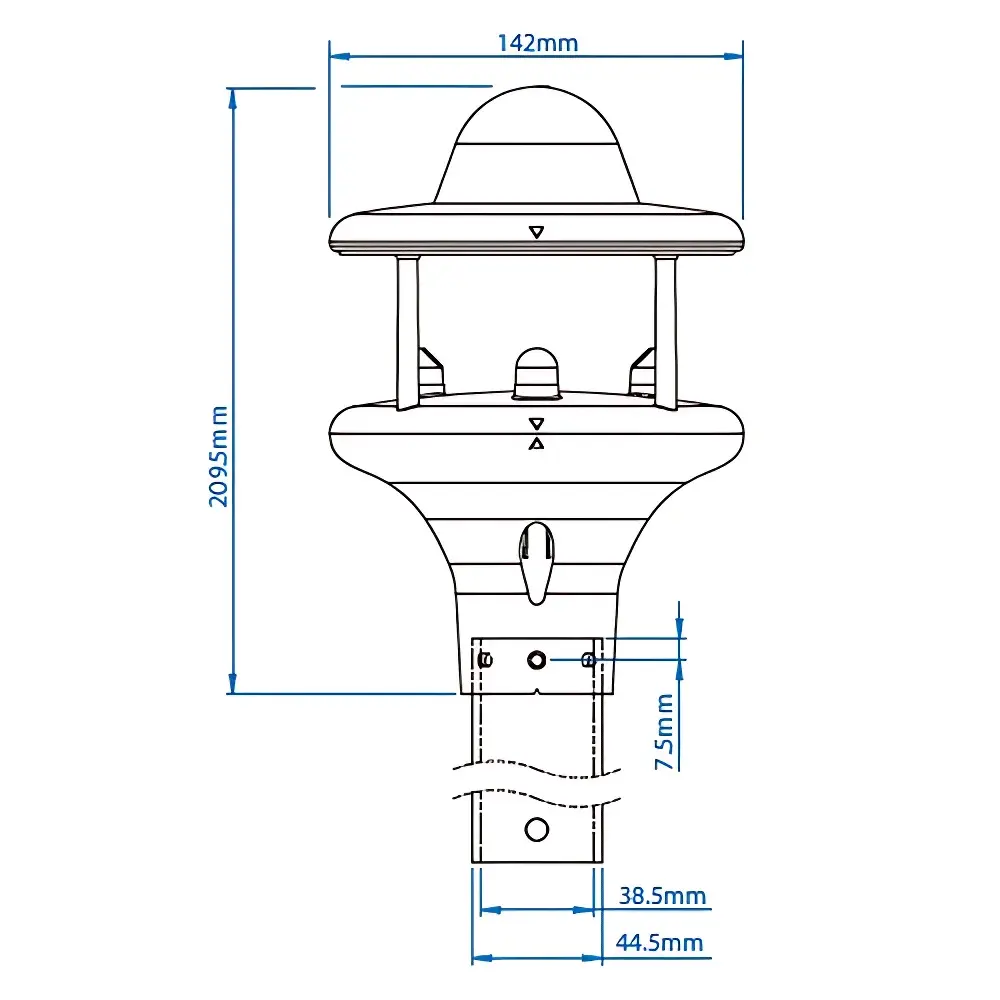
Gill GMX240 Compact Weather Station
| Brand | Gill |
|---|---|
| Origin | United Kingdom |
| Model | GMX240 |
| Instrument Type | Portable Weather Station |
| Compliance | WMO-compliant data output |
| Communication Interfaces | RS232 / RS422 / RS485 (ASCII), SDI-12, NMEA 0183, Modbus RTU, Optional Analog Output |
| Power Supply | 12–30 VDC |
| Operating Temperature | −40 °C to +70 °C |
| IP Rating | IP66 |
| Rain Sensor Type | Optical (0.08 mm resolution, no moving parts) |
| Wind Measurement | Ultrasonic (no mechanical wear) |
| Optional GPS Module | Altitude, Sunrise/Sunset, Solar Position, Twilight, Mean Solar Noon, MSL Pressure Correction |
Overview
The Gill GMX240 Compact Weather Station is a fully integrated, ultrasonic-based environmental monitoring system engineered for high-reliability deployment in demanding outdoor applications. Designed and manufactured in the UK by Gill Instruments—a globally recognized leader in precision meteorological instrumentation—the GMX240 implements proven physical measurement principles to deliver traceable, WMO-aligned atmospheric data without mechanical wear or calibration drift. Its core architecture combines ultrasonic anemometry for wind vector quantification, optical precipitation sensing for rain intensity and accumulation, and optional GPS-enhanced true-wind correction and georeferenced time-stamped metadata. Unlike traditional cup-and-vane or tipping-bucket systems, the GMX240 eliminates moving parts across all primary sensors, significantly reducing long-term maintenance requirements and improving data continuity in remote or unattended installations.
Key Features
- Ultrasonic Wind Measurement: Dual-axis transducer array measures wind speed (0.01–60 m/s) and direction (0–360°) with sub-degree resolution; outputs apparent wind, WMO-standard 2/10-minute averages, gust statistics, and tilt-compensated vectors via integrated electronic compass.
- Optical Precipitation Detection: Solid-state rain sensor detects individual droplet impacts on a hydrophobic optical surface; provides real-time rainfall rate (mm/hr), cumulative depth (mm/total), and binary rain/no-rain status—calibrated to emulate standard tipping-bucket output while eliminating mechanical hysteresis and freezing artifacts.
- Optional Integrated GPS: Enables true-wind vector calculation (requiring vessel/platform motion data), precise altitude referencing (MSL correction), solar geometry computation (sunrise/sunset, solar noon, twilight phases), and geotagged data logging compliant with ISO 17025 traceability frameworks.
- Ruggedized Enclosure: IP66-rated aluminum housing with passive thermal management; operational across −40 °C to +70 °C ambient range; compatible with industrial power supplies (12–30 VDC) and lightning-protected signal interfaces.
- Multistandard Communication: Native support for RS232/RS422/RS485 (ASCII), SDI-12, NMEA 0183, and Modbus RTU protocols; optional analog voltage/current outputs (0–5 V, 4–20 mA) for legacy SCADA integration.
Sample Compatibility & Compliance
The GMX240 is validated for continuous operation in diverse environmental regimes—including coastal salt-spray exposure, agricultural field deployments, urban infrastructure monitoring, and transportation corridor networks. Its measurement algorithms adhere to WMO Guide to Meteorological Instruments and Methods of Observation (CIMO Guide, Chapter 12) for wind averaging and precipitation classification. Data structures conform to IEC 61000-6-2/6-4 EMC standards and are suitable for inclusion in GLP-compliant environmental reporting workflows. When equipped with GPS and configured for timestamped, georeferenced logging, the station supports audit-ready data provenance per ISO/IEC 17025:2017 Clause 7.5.2.
Software & Data Management
The GMX240 operates autonomously with onboard non-volatile memory (up to 32 MB) for buffered data storage during communication outages. Configuration and firmware updates are performed via serial command interface or Gill’s proprietary MetLink software (Windows/Linux), which supports automated data export to CSV, NetCDF, or SQL-compatible formats. All data streams include embedded metadata headers specifying sensor ID, UTC timestamp (GPS-synchronized when enabled), measurement units, and diagnostic flags (e.g., heater activation, signal saturation). For regulated environments, optional secure firmware enables encrypted data transmission and configurable audit trails aligned with FDA 21 CFR Part 11 requirements for electronic records.
Applications
- Real-time microclimate monitoring for smart building HVAC control and energy optimization
- Aviation ground weather observation at regional airports and helipads (per ICAO Annex 3)
- Road weather information systems (RWIS) supporting dynamic signage and winter maintenance dispatch
- Offshore platform and maritime vessel environmental telemetry
- Agricultural decision support systems requiring evapotranspiration modeling inputs
- Educational meteorology labs emphasizing sensor physics and data validation methodologies
- Renewable energy site assessment (wind resource mapping, soiling impact on PV yield)
FAQ
Does the GMX240 require routine mechanical calibration?
No—ultrasonic wind and optical rain sensors are factory-calibrated and do not require periodic recalibration under normal operating conditions. Annual verification against reference standards is recommended for ISO 17025 accreditation.
Can the optical rain sensor distinguish drizzle from heavy rain?
Yes—the sensor resolves individual drop impacts and applies particle-size discrimination algorithms to classify precipitation type and intensity, enabling differentiation between light drizzle (D 5 mm).
Is GPS mandatory for basic operation?
No—GPS is optional. The station functions fully without it, delivering apparent wind, rain accumulation, and barometric pressure. True-wind calculation and solar position metadata require GPS module installation and motion input.
What mounting options are available?
Standard mounting uses a 32 mm OD stainless-steel mast clamp. Custom brackets for pole, roof, or tower integration are available through Gill’s engineering support team.
How is data integrity maintained during power interruption?
The unit features brown-out detection and write-protected memory buffering; all active measurements prior to power loss are retained and transmitted upon recovery without gap or duplication.
Related Products







