
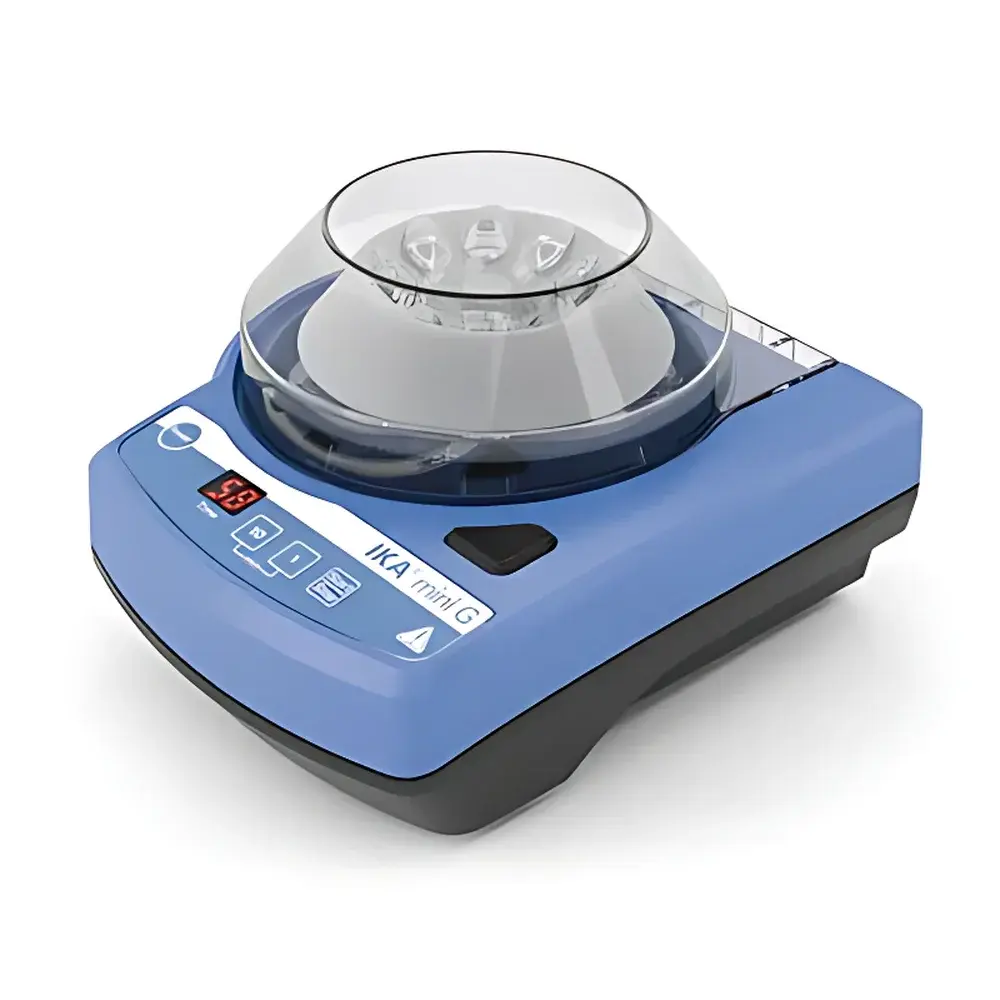
IKA mini G Compact Benchtop Centrifuge
| Brand | IKA |
|---|---|
| Origin | Germany |
| Manufacturer | IKA-Werke GmbH & Co. KG |
| Type | Miniature Low-Speed Benchtop Centrifuge |
| Model | IKA mini G |
| Maximum Speed | 6000 rpm |
| Maximum RCF | 2000 × g |
| Maximum Capacity | 8 × 2.0 mL |
| Timer Range | 1–99 min (digital LED display) |
| Dimensions (W × D × H) | 155 × 175 × 105 mm |
| Weight | 1.4 kg |
| Power Supply | 24 V DC |
| Motor Input/Output Power | 12 W / 8 W |
| Safety Rating | DIN EN 60529 IP30 |
| Operating Ambient Temperature | 5–40 °C |
| Relative Humidity Limit | ≤80% |
| Rotor Exchange | Tool-Free |
| Quick-Stop Function | Yes |
| Lid Interlock | Active (operation only with lid closed) |
| Noise Level | <45 dB(A) |
| Rotor Type | Fixed-angle, universal for 0.2–2.0 mL tubes |
Overview
The IKA mini G is a compact, fixed-speed benchtop centrifuge engineered for routine low-speed separation tasks in molecular biology, clinical diagnostics, and teaching laboratories. Designed around the principles of rotor dynamics and gravitational sedimentation, it delivers reproducible centrifugal force up to 2000 × g at a precisely controlled speed of 6000 rpm—sufficient for pelleting cells, clarifying lysates, microfiltering reagents, and preparing PCR-ready samples. Its minimalist architecture prioritizes operational safety, space efficiency, and user accessibility without compromising mechanical robustness or thermal stability. Unlike high-speed or refrigerated models, the mini G operates passively cooled, eliminating compressor complexity while maintaining consistent performance across ambient conditions from 5 to 40 °C. Its sealed 24 V DC brushless motor ensures long-term reliability, low electromagnetic interference, and compliance with laboratory electrical safety standards.
Key Features
- Fixed-speed operation at 6000 rpm with ±5% speed tolerance—optimized for repeatable low-G applications requiring minimal parameter variability.
- Digital timer with 7-segment LED display (1–99 minutes), enabling precise dwell-time control for standardized protocols such as spin-column binding or antibody precipitation.
- Integrated lid interlock mechanism: motor activation is physically disabled unless the transparent polycarbonate lid is fully closed and latched—meeting DIN EN 60529 IP30 ingress protection and basic functional safety requirements.
- Tool-free rotor exchange system allows rapid adaptation between configurations: standard 8-position 1.5/2.0 mL fixed-angle rotor or dedicated 4 × 8-position PCR strip rotor.
- Autoclavable components: all rotors and tube adapters (0.2 mL, 0.4 mL, 0.5 mL, and 1.5/2.0 mL) are certified for steam sterilization at 121 °C and 2 bar, supporting GLP-compliant workflows where biocontamination control is critical.
- Ultra-quiet operation (<45 dB[A]) achieved through balanced rotor dynamics, vibration-damping housing, and optimized airflow—suitable for shared lab benches and laminar flow hoods.
- Quick-stop function halts rotation within seconds upon lid opening or timer expiration, minimizing sample disturbance and improving throughput in multi-step assays.
Sample Compatibility & Compliance
The IKA mini G accommodates a broad range of microcentrifuge formats including conical 1.5/2.0 mL tubes, 0.2–0.5 mL PCR tubes, and full 8-strip PCR plates. Its maximum load density limit of 1.2 kg/dm³ ensures safe operation with common aqueous buffers, ethanol precipitates, and glycerol-stabilized enzyme stocks. The device complies with key international safety and electromagnetic compatibility directives: DIN EN 61010-1 (electrical safety for laboratory equipment), DIN EN 61326-1 (EMC for measurement/control devices), and RoHS/REACH substance restrictions. While not designed for ISO 13485-certified production environments, its construction and documentation support audit readiness for ISO/IEC 17025-accredited testing labs performing method validation under internal SOPs.
Software & Data Management
The IKA mini G operates as a standalone instrument with no embedded firmware or external software interface. All operational parameters—including elapsed time and active status—are displayed via front-panel LED indicators. This design eliminates data logging dependencies, reduces cybersecurity exposure, and aligns with FDA 21 CFR Part 11 “paper-based record” equivalency pathways when paired with manual logbook entries. For laboratories implementing electronic lab notebooks (ELNs), centrifugation steps may be documented using timestamped annotations referencing batch-specific run conditions (e.g., “mini G, 6000 rpm × 5 min, rotor lot #X-2023”). No drivers, USB ports, or network connectivity are provided—ensuring deterministic behavior and minimizing maintenance overhead.
Applications
- Routine microfiltration of enzyme solutions, serum supernatants, or nucleic acid extracts prior to downstream analysis.
- Cell pelleting in non-suspension mammalian cultures or bacterial preps where high g-force is unnecessary.
- PCR setup: rapid spin-down of reaction mixtures into tube bottoms and consolidation of strip wells before thermal cycling.
- Spin-column purification: supporting silica-membrane binding steps in DNA/RNA isolation kits (e.g., QIAamp, NucleoSpin).
- Educational use: demonstrating sedimentation kinetics, density gradient fundamentals, and centrifugal force calculations in undergraduate biophysics curricula.
- Point-of-care prep: integration into mobile diagnostic units where footprint, power efficiency, and mechanical simplicity are prioritized over programmability.
FAQ
Is the IKA mini G suitable for centrifuging hazardous or infectious samples?
Yes—provided users follow institutional biosafety level (BSL)-appropriate containment practices. The sealed rotor chamber and autoclavable components reduce cross-contamination risk; however, the unit lacks a sealed aerosol barrier or negative-pressure enclosure, so BSL-2+ work requires secondary containment (e.g., sealed buckets or safety cups).
Can the mini G accommodate 5 mL tubes?
No—the maximum recommended capacity is 2.0 mL per position. Attempting larger volumes risks imbalance, excessive vibration, and premature bearing wear.
Does the timer continue counting during power interruption?
No—the device has no battery backup or non-volatile memory. A power loss resets the timer and stops rotation; users must restart manually after restoration.
What maintenance is required beyond rotor autoclaving?
Routine cleaning of the chamber with 70% ethanol and periodic inspection of lid latch integrity are sufficient. No lubrication, calibration, or sensor recalibration is specified by IKA for this model.
Is the 24 V DC power supply included with the instrument?
Yes—a CE-certified external switching power adapter (input: 100–240 V AC, output: 24 V DC) is supplied as standard equipment.



