
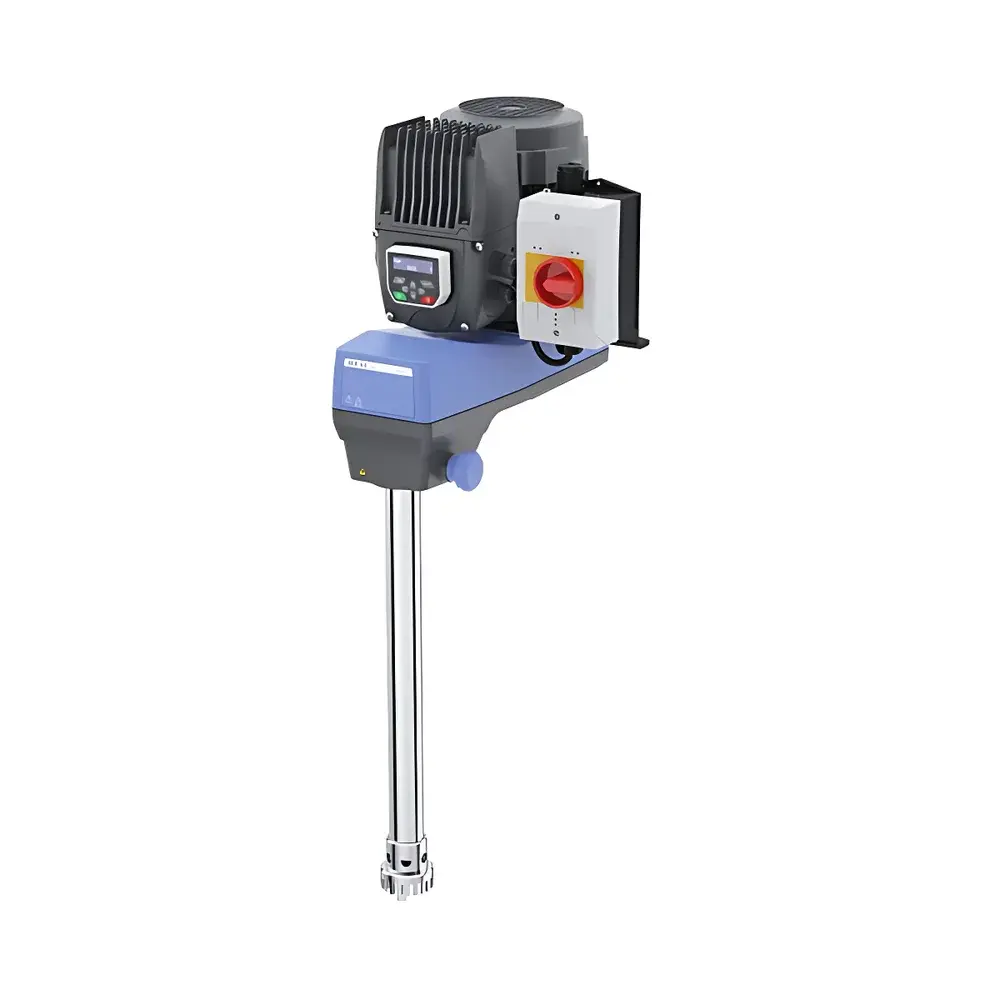
IKA T 65 digital ULTRA-TURRAX® High-Shear Batch Homogenizer
| Brand | IKA |
|---|---|
| Origin | Germany |
| Manufacturer | IKA-Werke GmbH & Co. KG |
| Type | Imported Industrial-Grade Laboratory Homogenizer |
| Model | T 65 digital ULTRA-TURRAX® |
| Motor Input Power | 2600 W |
| Motor Output Power | 2200 W |
| Volume Range (H₂O) | 2–50 L |
| Max. Viscosity | 5000 mPa·s |
| Speed Range | 1000–9500 rpm |
| Speed Accuracy | ±3 % |
| Speed Control | Continuous (Stepless) Electronic Regulation |
| Speed Display | LED, 7-Segment |
| Protection Rating | IP 54 (DIN EN 60529) |
| Noise Level (without dispersing tool) | 75 dB(A) |
| Dimensions (W×D×H) | 300 × 390 × 400 mm |
| Weight | 30 kg |
| Ambient Temperature Range | 5–40 °C |
| Relative Humidity Limit | ≤80 % RH |
| Voltage | 3 × 400 V / 3 × 230 V |
| Frequency | 50/60 Hz |
Overview
The IKA T 65 digital ULTRA-TURRAX® is a high-performance, industrial-grade batch homogenizer engineered for reproducible high-shear dispersion, emulsification, and particle size reduction in laboratory and pilot-scale environments. Based on the proven ULTRA-TURRAX® rotor-stator principle, it generates intense hydrodynamic shear forces through precise relative motion between a rotating inner rotor and a fixed outer stator—enabling efficient mechanical disintegration of aggregates, deagglomeration of nanoparticles, and stabilization of oil-in-water or water-in-oil emulsions. Designed for rigorous daily use in QC labs, formulation development, and process scale-up studies, the T 65 digital integrates robust mechanical architecture with digital speed control and real-time monitoring to support GLP-compliant workflows. Its wide operational volume range (2–50 L H₂O equivalent) bridges the gap between benchtop homogenization and early-stage manufacturing, making it especially suitable for pharmaceutical suspension development, battery slurry preparation, polymer nanocomposite dispersion, and food-grade emulsion optimization.
Key Features
- High-power drive system delivering 2200 W mechanical output and 2600 W electrical input for sustained high-torque operation across viscosity gradients
- Digital electronic speed regulation with continuous (stepless) adjustment from 1000 to 9500 rpm and ±3 % speed accuracy—maintaining constant rotational velocity regardless of load fluctuations
- Three interchangeable rotor-stator geometries (S, M, L) optimized for distinct rheological regimes: low-viscosity fine dispersion (S), medium-viscosity emulsification (M), and high-viscosity pastes or suspensions (L)
- IP 54-rated housing (per DIN EN 60529) ensuring resistance to dust ingress and water splashing—suitable for shared lab environments and controlled production support areas
- LED-based 7-segment speed display with integrated error-code diagnostics for rapid troubleshooting and operational transparency
- Quick-release, plug-in dispersing tool interface enabling tool changes without tools; stainless-steel dispersing elements rated for vacuum and overpressure applications up to 6 bar (gauge)
- Integrated electronic overload protection preventing motor damage during transient torque spikes or stalled conditions
Sample Compatibility & Compliance
The T 65 digital accommodates samples ranging from low-viscosity aqueous solutions to highly structured pastes (up to 5000 mPa·s). Its modular rotor-stator system allows adaptation to diverse material behaviors—including shear-thinning polymers, thixotropic gels, and particulate-laden slurries—without compromising homogenization efficiency. All wetted parts comply with FDA-compliant materials standards (e.g., AISI 316 stainless steel), supporting applications under cGMP and ISO 13485 frameworks. The instrument meets electromagnetic compatibility requirements per EN 61326-1 and safety standards per EN 61010-1. While not inherently 21 CFR Part 11 compliant, its digital speed logging capability—when paired with validated external data acquisition software—supports audit-trail generation for regulated environments.
Software & Data Management
The T 65 digital operates as a standalone instrument with no embedded PC interface; however, its stable analog/digital control architecture permits integration into centralized lab automation systems via optional analog voltage output (0–10 V) for speed signal mirroring. For documentation traceability, users may log operational parameters manually or via third-party SCADA-compatible data loggers. IKA’s LabWorldSoft platform (sold separately) supports remote parameter configuration and event-based logging when used with compatible IKA controllers—though native firmware does not store historical run data or enforce user access controls. All calibration and maintenance records must be maintained externally per GLP Annex 11 and ISO/IEC 17025 requirements.
Applications
- Pharmaceutical: Preparation of nanostructured drug carriers, uniform active pharmaceutical ingredient (API) suspensions, and sterile emulsion pre-formulations
- Materials Science: Dispersion of carbon nanotubes, graphene flakes, and metal oxide nanoparticles in polymer matrices or solvent systems
- Electrochemical Energy: Homogenization of cathode/anode slurries for lithium-ion battery electrode coating processes
- Food & Beverage: Development of stable plant-based dairy alternatives, flavor oil emulsions, and functional ingredient suspensions
- Chemical R&D: Catalyst slurry homogenization, pigment dispersion in coatings, and surfactant-mediated micelle formation studies
FAQ
Is the T 65 digital ULTRA-TURRAX® suitable for continuous processing?
No—it is designed exclusively for batch-mode operation. Continuous inline homogenization requires dedicated IKA systems such as the LR 1000 or RCT basic series with flow-cell configurations.
Can the dispersing tools be autoclaved?
Yes—stainless-steel dispersing elements (S/M/L types) are autoclavable at 121 °C for 20 minutes; verify seal integrity and torque specifications post-sterilization.
Does the unit include a dispersing tool by default?
No—dispersing tools are sold separately and selected based on application requirements (e.g., S-type for low-viscosity fluids, L-type for viscous pastes).
What is the minimum recommended fill level for stable operation?
A minimum working volume of 2 L (water-equivalent) is required to ensure adequate heat dissipation and avoid cavitation-induced rotor imbalance.
How often should the motor brushes be inspected or replaced?
Under typical usage (≤4 h/day), brush inspection is recommended every 1,500 operating hours; replacement intervals vary with load profile and ambient conditions.



