
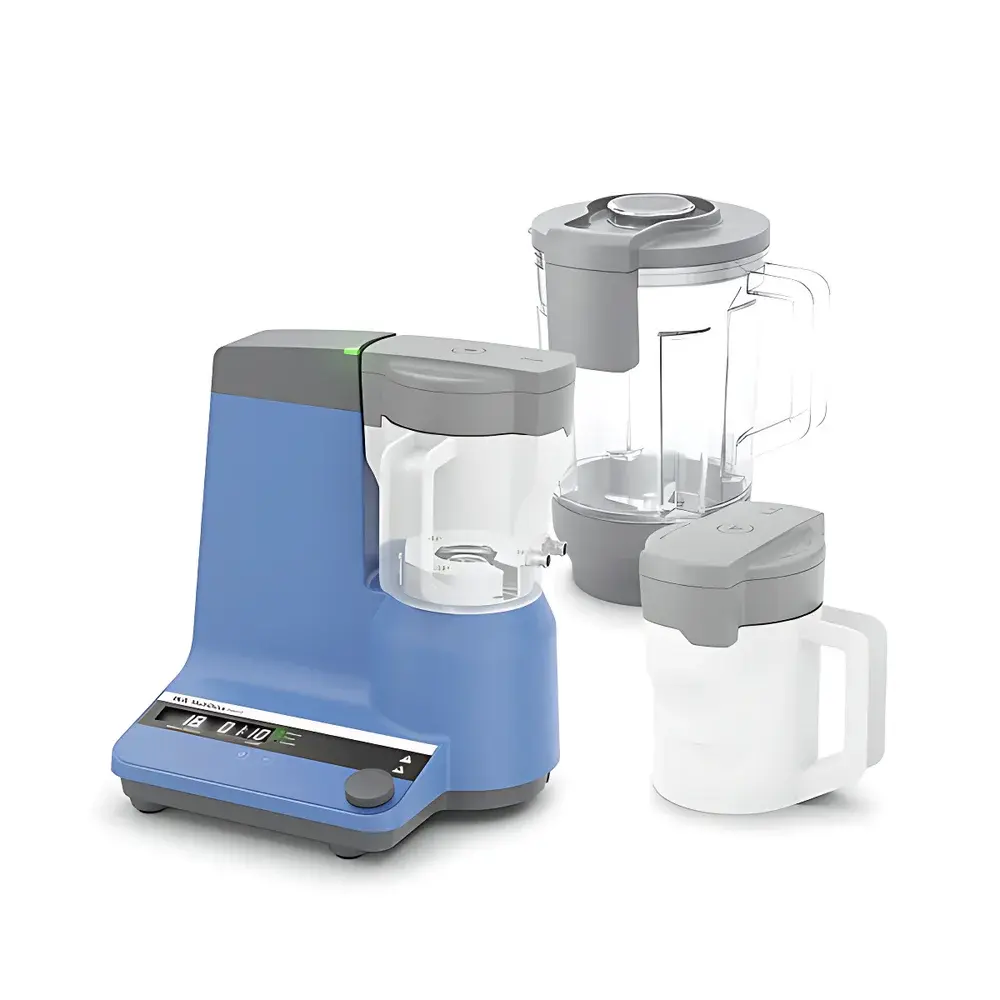
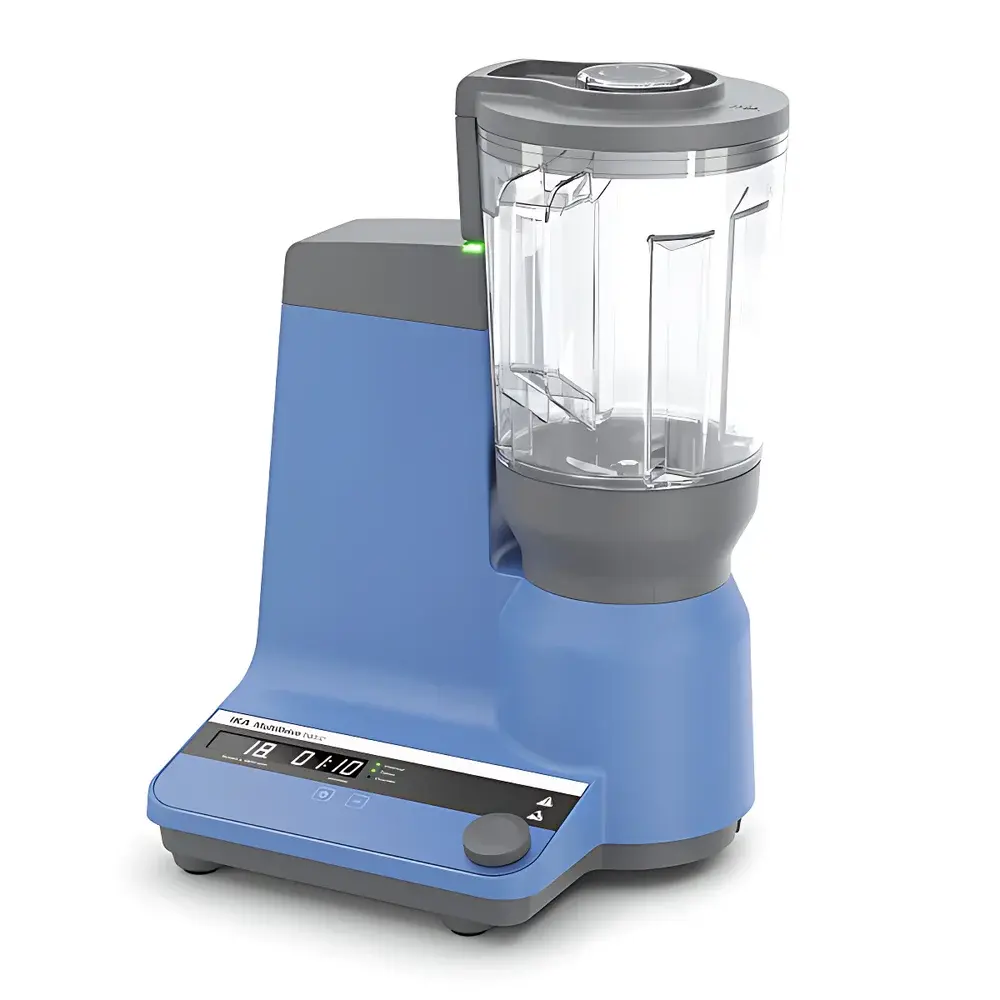
IKA MultiDrive Basic High-Speed Benchtop Grinder
| Brand | IKA |
|---|---|
| Origin | Germany |
| Manufacturer | IKA-Werke GmbH & Co. KG |
| Model | MultiDrive Basic |
| Type | High-Speed Rotational Grinder |
| Sample Suitability | Hard, brittle, fibrous, and soft materials |
| Max. Feed Size | < 7 mm |
| Final Particle Size | ≤ 0.01 mm (10 µm) |
| Batch Capacity | 2000 mL |
| Drive Power | 1000 W (input), 800 W (output) |
| Speed Range | 3,000 – 20,000 rpm |
| Speed Accuracy | ±5% |
| Cooling | Integrated water-jacketed grinding chamber (dry-ice compatible) |
| Grinding Chamber Material | Stainless steel 1.4301 |
| Cutting Tools | Stainless steel 1.4034 |
| Duty Cycle | 5 min ON / 10 min OFF |
| Dimensions (W × D × H) | 300 × 450 × 250 mm |
| Weight | 8.5 kg |
| Ambient Operating Conditions | 5–40 °C, ≤80% RH |
| Protection Class | IP31 (DIN EN 60529) |
| Electrical Supply | 230 V / 50–60 Hz (also compatible with 100–120 V variants) |
| USB Interface | Yes (for parameter export and documentation) |
Overview
The IKA MultiDrive Basic is a high-performance, benchtop high-speed rotational grinder engineered for reproducible, scalable batch-size comminution of diverse laboratory samples—including hard, brittle, fibrous, and moderately soft materials. It operates on the principle of high-shear mechanical impact combined with controlled centrifugal acceleration, enabling rapid particle size reduction through dynamic interaction between rotating cutting tools and stationary grinding elements. Unlike planetary or ball-mill systems, the MultiDrive Basic delivers direct-drive torque transmission to the rotor assembly, minimizing energy loss and ensuring consistent power delivery across its full speed range (3,000–20,000 rpm). Its modular design centers on interchangeable grinding chambers—each engineered for specific material classes—and supports both coarse pre-crushing and fine grinding down to ≤10 µm. The system is designed for compliance with general laboratory safety standards (DIN EN 60529 IP31) and integrates seamlessly into quality-controlled environments where traceable process parameters are required.
Key Features
- High-power direct-drive motor delivering 1000 W input / 800 W output for sustained high-load operation
- Precisely adjustable speed control (3,000–20,000 rpm) with ±5% accuracy, enabling method optimization across material hardness and viscosity profiles
- Integrated water-jacketed grinding chamber for active thermal management; compatible with external chillers or dry-ice cooling without sample contamination
- Intermittent operation mode activated via front-panel button—ideal for heat-sensitive or highly abrasive samples requiring controlled duty cycles (5 min ON / 10 min OFF)
- USB interface for exporting operational logs, speed/time settings, and user-defined protocols—supports audit-ready documentation in GLP/GMP-aligned workflows
- Robust construction using corrosion-resistant stainless steel 1.4301 (grinding chamber) and hardened stainless steel 1.4034 (cutting tools), compliant with ISO 8502-3 for surface cleanliness validation
Sample Compatibility & Compliance
The MultiDrive Basic accommodates feed particles up to 7 mm in diameter and achieves final particle sizes ≤10 µm under optimized conditions—making it suitable for pharmaceutical excipient milling, geological sample homogenization, polymer pellet size reduction, and botanical tissue disruption. It handles materials with Mohs hardness up to 5 (e.g., limestone, chalk, dried plant matter, certain ceramics), but is not intended for metals or ultra-hard minerals (>6 Mohs). All contact surfaces comply with FDA-recommended materials for non-sterile laboratory use (USP ). While not certified for cleanroom use, its sealed housing and IP31 rating meet standard biosafety level 2 (BSL-2) containment requirements per CDC/NIH guidelines. No internal lubricants contact the sample path, eliminating risk of hydrocarbon contamination during analytical preparation.
Software & Data Management
The MultiDrive Basic does not require proprietary software; instead, it leverages native USB mass-storage functionality to save parameter sets (.txt format) directly to standard USB drives. Each saved file includes timestamped records of speed setpoint, total run time, cycle count, and activation mode (continuous or intermittent). This architecture ensures compatibility with LIMS integration via automated script-based ingestion and satisfies basic 21 CFR Part 11 requirements for electronic record retention when paired with institutional document control policies. Exported logs may be cross-referenced with analytical data (e.g., laser diffraction particle size distributions) to establish method transfer correlations in method validation protocols (ICH Q5A, USP ).
Applications
- Pharmaceutical R&D: Pre-formulation grinding of APIs and excipients prior to dissolution testing or tablet compression studies
- Materials Science: Homogenization of composite precursors, ceramic powders, and battery electrode slurries
- Environmental Testing: Reduction of soil, sediment, or fly ash samples to sub-10 µm fractions for heavy metal extraction (EPA Method 3050B)
- Food & Agriculture: Preparation of dried plant tissues for DNA extraction or nutrient analysis (AOAC 991.42)
- Academic Research: Rapid sample conditioning for SEM/EDS, XRD, or BET surface area analysis where particle morphology preservation is secondary to compositional uniformity
FAQ
Is the MultiDrive Basic suitable for cryogenic grinding?
Yes—its grinding chamber accepts dry-ice cooling via the integrated jacket; however, liquid nitrogen immersion is not supported due to sealing constraints.
Can I use this grinder for wet grinding?
No—the MultiDrive Basic is designed exclusively for dry grinding; no liquid-tight seals or dispersion media compatibility are provided.
Are grinding cups included with the base unit?
No—grinding chambers (e.g., MI 250, MI 500) are optional accessories and must be selected based on sample type and throughput requirements.
Does the device support regulatory-compliant audit trails?
It provides timestamped parameter exports via USB; full electronic signature and change-control capabilities require integration with third-party LIMS or ELN platforms.
What maintenance intervals are recommended?
Visual inspection of cutting tools and chamber integrity before each use; annual verification of speed calibration and thermal jacket seal integrity by authorized IKA service partners.



