
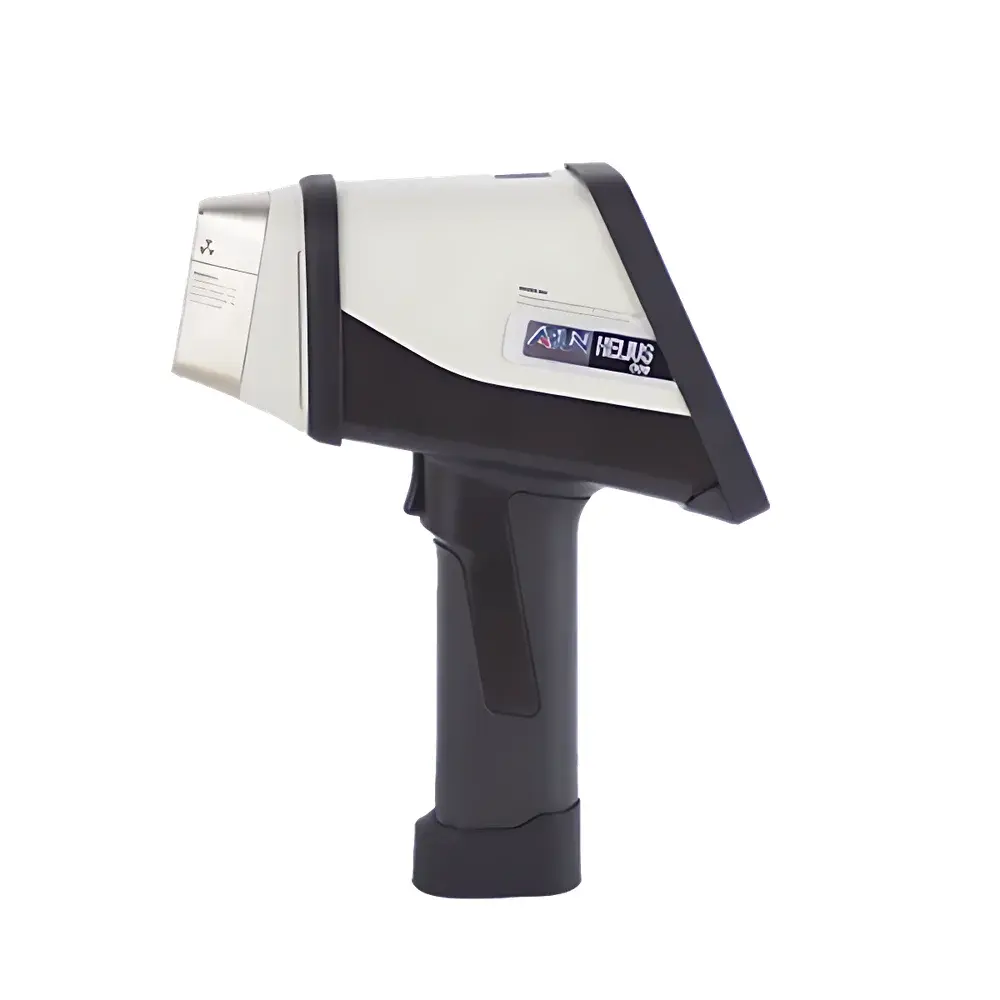
ARUN TECHNOLOGY HELIUS Series Handheld Energy Dispersive X-Ray Fluorescence Spectrometer
| Brand | ARUN TECHNOLOGY LTD. |
|---|---|
| Origin | United Kingdom |
| Manufacturer Type | Authorized Distributor |
| Product Origin | Imported |
| Model | HELIUS Series |
| Pricing | Upon Request |
Overview
The ARUN TECHNOLOGY HELIUS Series Handheld Energy Dispersive X-Ray Fluorescence (ED-XRF) Spectrometer is an industrial-grade, field-deployable elemental analysis instrument engineered for rapid, non-destructive qualitative and quantitative determination of elements from magnesium (Mg, Z=12) to uranium (U, Z=92). Operating on the fundamental principle of energy-dispersive X-ray fluorescence, the HELIUS system irradiates a sample with a micro-focus X-ray tube and measures the characteristic secondary X-rays emitted by constituent atoms. These energies are resolved using a high-resolution silicon PIN (Si-Pin) semiconductor detector, enabling precise peak identification and intensity-based quantification. The instrument integrates a proprietary AXRUNI analytical engine—combining fundamental parameter (FP) algorithms with empirical calibration libraries—to deliver laboratory-comparable accuracy in situ. Designed for mission-critical environments including scrap yards, mining sites, environmental monitoring stations, and manufacturing QA/QC labs, the HELIUS platform meets the operational demands of ISO 18115-1:2017 (XRF terminology), ASTM E1621–23 (standard guide for ED-XRF elemental analysis), and supports traceability frameworks aligned with ISO/IEC 17025 requirements.
Key Features
- Real-time, non-destructive elemental analysis with typical measurement times ranging from 1–3 seconds for alloy grade identification to 10–30 seconds for sub-100 ppm quantification in solid matrices
- Ergonomic handheld form factor weighing <1.5 kg, featuring balanced center-of-gravity design and tapered test head geometry optimized for access to weld seams, curved surfaces, and confined geometries
- High-sensitivity Si-Pin detector with Peltier cooling, delivering stable spectral resolution (<180 eV at Mn Kα) across ambient temperatures from –10 °C to +50 °C
- Robust mechanical architecture certified to IP54 ingress protection rating—dust-resistant and protected against water splashes from any direction
- Long-life rechargeable lithium-ion battery supporting continuous operation for 10–12 hours under typical field duty cycles (e.g., 5-sec measurements every 30 sec)
- Zero-maintenance front window: proprietary polymer-based X-ray transmission window eliminates fragile beryllium foil and associated regulatory handling constraints
- Intuitive icon-driven user interface on a 5-inch sunlight-readable capacitive touchscreen with adjustable backlight and glove-compatible touch response
Sample Compatibility & Compliance
The HELIUS series accommodates heterogeneous solid samples—including ferrous and non-ferrous alloys, geological core fragments, soil slurries (dried or pressed pellets), electronic components, catalysts, and precious metal jewelry—without requiring vacuum or helium purge. Its fixed-anode X-ray tube (40 kV, 20 µA nominal) and selectable filter set enable optimized excitation for light elements (e.g., Mg, Al, Si) and heavy metals (e.g., Pb, Cd, Hg, As) alike. All firmware and data handling routines comply with GLP/GMP documentation expectations: audit trails record operator ID, timestamp, measurement parameters, calibration status, and spectral metadata. Data export formats (CSV, DXF, SPC) support integration into LIMS and ERP systems. Instrument validation protocols align with ICH Q2(R2) guidelines for analytical procedure verification where applicable.
Software & Data Management
Preloaded AXRUNI software provides embedded grade-matching against customizable material libraries compliant with UNS, EN, ASTM, and GB standards. Users may import, edit, or construct proprietary alloy databases—including multi-layered hierarchical grading rules—and assign custom pass/fail thresholds per element. Spectral acquisition, peak deconvolution, matrix correction, and uncertainty estimation occur onboard without cloud dependency. Raw spectra and processed reports are stored locally with SHA-256 hashing for integrity verification. Optional USB-C and Bluetooth 5.0 interfaces enable secure data transfer to Windows/Linux workstations; encrypted SD card storage (up to 128 GB) ensures chain-of-custody compliance during forensic or regulatory inspections.
Applications
- Metal scrap sorting and PMI (Positive Material Identification) per ASME B31.3 and API RP 578
- Soil and sediment screening for EPA Method 6200 (field XRF) and EU CLP-regulated heavy metals (Pb, Cr, Ni, Cd)
- Jewelry and bullion authentication, including karat verification and hallmark validation
- RoHS/WEEE compliance screening of electronics assemblies and PCB substrates
- Geological exploration support via rapid lithological classification and pathfinder element mapping
- In-process QC of plating thickness and composition in electroplating lines
FAQ
Does the HELIUS require annual recalibration or factory servicing?
No scheduled annual recalibration is mandated; however, daily verification using certified reference materials (CRMs) is recommended per ISO 17025 clause 7.7. Field recalibration kits and drift-correction routines are included.
Can the instrument analyze liquids or powders directly?
Yes—liquids must be contained in XRF-compatible sample cups with polymer windows; powders should be homogenized and pressed into pellets or loaded into cup holders to ensure consistent geometry and density.
Is the HELIUS compliant with FDA 21 CFR Part 11 for electronic records?
While the base firmware does not include Part 11–specific electronic signature modules, optional validated software packages with role-based access control, biometric login, and full audit trail generation are available under separate qualification protocol.
What safety certifications does the device hold?
Certified to IEC 62471 (photobiological safety), IEC 61010-1 (electrical safety), and UKCA/CE marked for Class 1 X-ray equipment; radiation exposure at 5 cm from the aperture is <1 µSv/h during operation.
How is data backup and synchronization managed across multiple instruments?
AXRUNI Cloud Sync (optional subscription) enables centralized database management, version-controlled library updates, and cross-device report reconciliation via TLS 1.3–encrypted HTTPS endpoints.




