
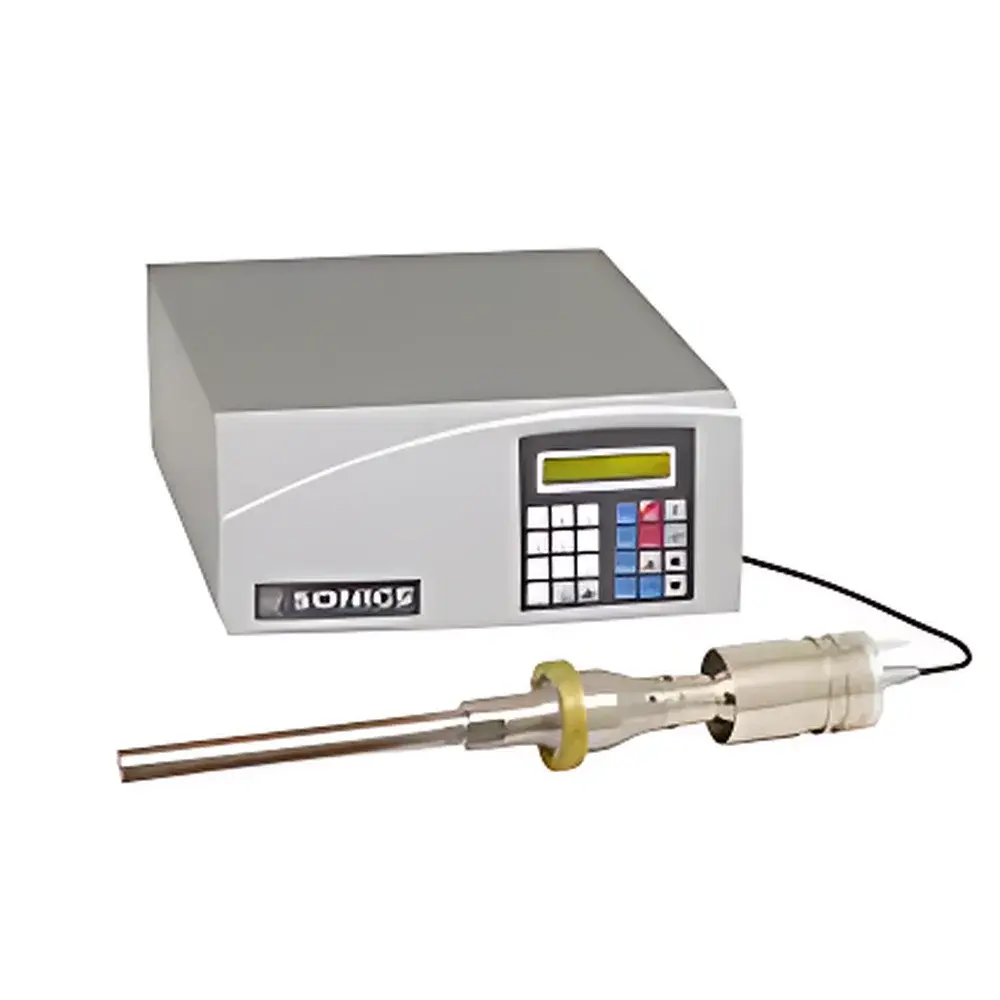
SONICS VCX1500 Industrial-Scale Ultrasonic Cell Disruptor
| Brand | Sonics |
|---|---|
| Origin | USA |
| Model | VCX1500 |
| Output Power | 1500 W |
| Operating Frequency | 20 kHz |
| Maximum Continuous Flow Rate | 100 L/h (with optional flow-through chamber) |
| Standard Probe Tip Diameter | 25 mm |
| Probe Material | Titanium Alloy (Grade 5) |
| Cooling | Air-Cooled Transducer |
| Control System | Microprocessor-Based with Real-Time Parameter Display |
| Timer & Pulse Mode | Yes |
| Amplitude Adjustment | Variable (0–100%) |
| Input Power Requirement | 200 V, 50/60 Hz |
| Dimensions (H×W×D) | 279.4 × 380 × 463.5 mm |
| Net Weight | 9.5 kg |
| Transducer Model | CV294 |
| Transducer Dimensions | Ø76.2 mm × 158.7 mm |
| Transducer Weight | 900 g |
| Cable Length | 3 m |
| Compliance | CE, UL Listed |
| Standard Configuration | Host unit, 25 mm probe, tool kit, operator manual |
Overview
The SONICS VCX1500 is an industrial-scale ultrasonic cell disruptor engineered for high-intensity, continuous-duty lysis of microbial, mammalian, and plant cells in bioprocessing environments. It operates on the principle of cavitation-induced mechanical shear—generating controlled acoustic energy at a fixed resonant frequency of 20 kHz to induce transient microbubble formation and collapse within the sample medium. This process delivers reproducible disruption of cellular membranes and subcellular structures without significant thermal degradation when operated under pulsed or temperature-monitored conditions. Designed for scalability from benchtop development to pilot- and production-scale applications, the VCX1500 supports both batch and continuous-flow processing modes, making it suitable for upstream biomanufacturing workflows including recombinant protein extraction, inclusion body solubilization, organelle isolation, and nucleic acid release.
Key Features
- 1500 W nominal output power with real-time digital monitoring of delivered acoustic energy and load impedance
- Air-cooled CV294 transducer with integrated thermal protection circuitry to prevent overheating during extended operation
- Microprocessor-based control interface featuring programmable timer (1 s–24 h), pulse mode (on/off ratio adjustable from 0.1–99.9%), and variable amplitude control (0–100% full scale)
- Digital display showing instantaneous power, amplitude, elapsed time, and system status indicators
- Overload protection circuitry that monitors line current and automatically reduces output or halts operation upon detection of abnormal electrical load
- Modular probe architecture supporting interchangeable titanium alloy probes: standard 25 mm tip (50 mL–several liters), optional 13 mm (1–50 mL) and 19 mm (10–500 mL) variants
- Compatible with flow-through processing via the 630-0583 large-capacity chamber, enabling throughput up to 100 L/h under optimized cooling and residence time conditions
Sample Compatibility & Compliance
The VCX1500 accommodates a broad range of biological matrices—including bacterial suspensions (e.g., E. coli, Bacillus spp.), yeast cultures (S. cerevisiae, P. pastoris), mammalian cell lines (CHO, HEK293), plant tissue homogenates, and soft animal tissues. Its robust transducer-probe coupling ensures stable energy transmission across viscosity ranges typical of fermentation broths (up to ~15 cP) and clarified lysates. The system conforms to CE marking requirements for electromagnetic compatibility (EMC Directive 2014/30/EU) and low-voltage safety (LVD Directive 2014/35/EU). It is UL Listed per UL 61010-1 for laboratory equipment. When used in regulated environments, the device supports GLP-compliant documentation through external data logging; while the VCX1500 itself does not include FDA 21 CFR Part 11–compliant audit trails, its analog/digital outputs can be interfaced with validated SCADA or LIMS systems for electronic record integrity.
Software & Data Management
The VCX1500 operates as a standalone instrument with no embedded operating system or network connectivity. All operational parameters are set and monitored locally via the front-panel interface. For integration into automated platforms, the unit provides TTL-compatible trigger inputs for external start/stop control and analog voltage outputs (0–10 V) proportional to real-time power delivery and amplitude setting. Users may log operational metadata—including run duration, total energy delivered (J), average amplitude (%), and pulse duty cycle—using third-party DAQ hardware and software such as LabVIEW, MATLAB, or Python-based acquisition frameworks. SONICS provides comprehensive technical documentation, including calibration procedures for probe displacement verification and acoustic power measurement protocols aligned with ASTM E2810-11.
Applications
- High-yield extraction of intracellular proteins and enzymes from E. coli and other prokaryotic hosts
- Preparation of antigenic lysates for vaccine development and immunoassay standards
- Disruption of filamentous fungi and algae for metabolite recovery
- Chromatin shearing for ChIP-seq library preparation (when paired with appropriate cooling and microtip configurations)
- Emulsification and nanoparticle dispersion in biopolymer-based delivery systems
- Cell lysis validation studies supporting ICH Q5A and USP sterility test method development
FAQ
What is the maximum recommended sample volume for batch processing with the standard 25 mm probe?
For optimal energy transfer and temperature control, the 25 mm probe is rated for batch volumes between 50 mL and 2 L. Volumes exceeding 1 L require active external cooling (e.g., ice-water jacket or recirculating chiller) to maintain sample temperature below 25 °C.
Can the VCX1500 be integrated into a GMP manufacturing suite?
Yes—though the instrument lacks built-in electronic signature or audit trail functionality, its mechanical and electrical design meets ISO 13485-aligned construction standards. Integration with validated PLC-controlled utilities (cooling, feed pumps, exhaust) and external data capture enables qualification per IQ/OQ protocols.
Is probe calibration traceable to NIST standards?
SONICS provides factory calibration certificates for probe tip displacement amplitude (µm peak-to-peak) measured via laser vibrometry. Traceability to NIST is maintained through accredited metrology laboratories engaged by SONICS for transducer performance verification.
Does the system support remote operation or Ethernet connectivity?
No—the VCX1500 has no native network interface. Remote triggering and analog signal readout are supported via hardwired I/O ports, requiring external controllers for supervisory automation.
What maintenance is required for long-term reliability?
Routine inspection of probe threads and horn surface integrity is recommended after every 200 hours of operation. Transducer performance should be verified annually using SONICS’ recommended acoustic power meter (Model VP-100) and alignment jig.




