
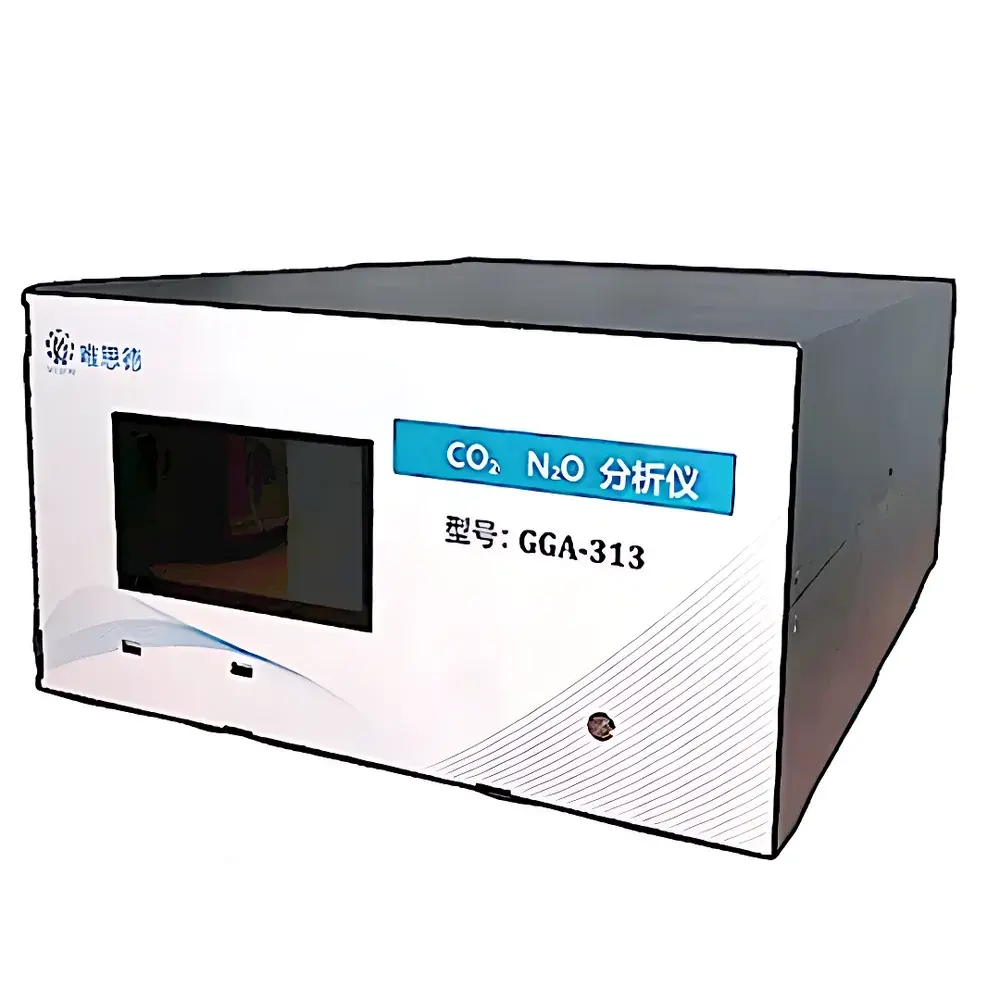
Wisdom Optics GGA-313 High-Precision CO₂, N₂O, and H₂O Cavity Ring-Down Spectrometer (CRDS) Analyzer
| Brand | Wisdom Optics |
|---|---|
| Origin | Beijing, China |
| Model | GGA-313 |
| Detection Principle | Mid-Infrared Cavity Ring-Down Spectroscopy (CRDS) |
| Configuration | Online Continuous Monitoring System |
| Response Time | <1 s (t₉₀) |
| Repeatability | ±0.2 ppm CO₂, ±0.2 ppb N₂O, ±300 ppm H₂O (1σ, 1 s) |
| Drift | ≤2 ppm CO₂, ≤2 ppb N₂O over 24 h |
| Linear Range | 0–2000 ppm CO₂, 0–10 ppm N₂O, 0–3% H₂O |
| Sample Flow Rate | ~200 sccm |
| Operating Temperature | 0–45 °C |
| Power Consumption | 70 W (startup/heating), 45 W (steady-state) |
| Input Voltage | 200–240 VAC, 50/60 Hz |
| Dimensions (W×D×H) | 530 × 430 × 225 mm |
| Weight | 15 kg |
| Inlet/Outlet Fitting | 1/4″ Swagelok® |
| Communication Interfaces | RS-232, USB |
Overview
The Wisdom Optics GGA-313 is a field-deployable, high-precision multicomponent gas analyzer engineered for continuous, real-time quantification of carbon dioxide (CO₂), nitrous oxide (N₂O), and water vapor (H₂O) in ambient air, eddy covariance flux towers, soil respiration chambers, and industrial stack emissions. It employs mid-infrared cavity ring-down spectroscopy (CRDS), a highly selective and sensitive absorption-based optical technique that measures trace gas concentrations by detecting the exponential decay rate of laser light trapped within a high-finesse optical cavity. Unlike conventional non-dispersive infrared (NDIR) or tunable diode laser absorption spectroscopy (TDLAS) systems, CRDS decouples sensitivity from path length—enabling effective optical path lengths exceeding 76 meters within a compact 40 cm physical cavity. This architecture delivers sub-part-per-trillion (ppt) equivalent noise performance for N₂O and sub-ppb precision for CO₂ at 1-second integration, while maintaining robust immunity to optical misalignment and vibration-induced signal loss.
Key Features
- Triple-species simultaneous detection: CO₂, N₂O, and H₂O are measured concurrently with independent spectral fitting algorithms, eliminating cross-sensitivity artifacts through wavelength-specific line selection and pressure-broadening correction.
- Ultra-stable thermal and pressure control: Integrated high-resolution PID-controlled oven (±0.01 °C stability) and piezoresistive pressure transducer (±0.05 % FS) actively stabilize cavity conditions to suppress baseline drift and ensure metrological traceability across ambient temperature fluctuations (0–45 °C).
- Low-power, low-footprint design: With a total mass of only 15 kg and power draw of 45 W in steady-state operation, the GGA-313 meets stringent requirements for remote, solar-powered monitoring stations and mobile platforms including UAV-mounted payloads and vehicle-integrated emission testing suites.
- Ruggedized optical cavity: The core measurement cell utilizes ultra-low-expansion (ULE) glass mirrors with reflectivity >99.998 % at 4.5 µm, enabling long cavity lifetimes (>5 years) and minimal maintenance under continuous operation.
- Real-time background correction: Onboard zero-air referencing capability allows automated subtraction of instrumental baseline and environmental interference, supporting compliant reporting under EPA Method TO-15 and ISO 14644-8 ambient air quality protocols.
Sample Compatibility & Compliance
The GGA-313 accepts unfiltered, humidified gas streams directly—no external drying or conditioning is required due to its native H₂O co-measurement and compensation algorithm. It complies with key regulatory and research-grade standards including ASTM D6348–21 (gas chromatography validation framework), ISO 13861:2012 (occupational health exposure limits), and supports GLP/GMP data integrity requirements via time-stamped audit logs and user-access controls. Its CRDS methodology is recognized in IPCC Tier 3 inventory reporting guidelines for atmospheric greenhouse gas monitoring and aligns with NOAA Global Monitoring Laboratory (GML) calibration traceability chains using NIST SRM-certified reference gases.
Software & Data Management
The instrument ships with Wisdom Analyze™ v3.2 firmware and PC-based acquisition software supporting real-time visualization, spectral diagnostics, and automated calibration sequence execution. All raw ring-down decay waveforms, fitted absorbance spectra, and derived concentration time series are stored in HDF5 format with embedded metadata (UTC timestamps, cavity pressure/temperature, laser current, mirror reflectivity estimates). Export options include CSV, NetCDF, and direct OPC UA server integration for SCADA and LIMS interoperability. Software enforces 21 CFR Part 11-compliant electronic signatures, role-based access control, and immutable audit trails for all configuration changes and calibration events.
Applications
- Atmospheric science: Long-term CO₂/N₂O flux monitoring at AmeriFlux, ICOS, and NEON sites; urban emission mapping and source attribution studies.
- Agricultural research: In situ soil N₂O efflux quantification under variable moisture and fertilizer regimes; livestock barn ventilation emission profiling.
- Industrial compliance: Continuous emissions monitoring (CEMS) for cement kilns, biogas upgrading plants, and wastewater treatment facilities per EU Directive 2010/75/EU (IED).
- Climate modeling validation: High-frequency vertical profile measurements from tethered balloon platforms and boundary layer towers.
- Laboratory reference: Primary standard transfer and intercomparison studies against NIST-traceable CRDS and FTIR reference analyzers.
FAQ
Does the GGA-313 require external gas standards for routine operation?
No—its internal zero-air purge and dual-wavelength referencing enable drift-corrected operation for up to 72 hours without external calibration. However, periodic verification (e.g., weekly) using certified CO₂/N₂O/N₂ mixtures is recommended for regulatory reporting.
Can the analyzer operate in high-humidity environments without condensation damage?
Yes—the sample path is heated to 45 °C and maintained above dew point; integrated H₂O measurement allows dynamic compensation of spectral interference, eliminating need for Nafion dryers or chilled mirrors.
Is the system compatible with third-party data loggers and telemetry networks?
Yes—RS-232 and USB interfaces support ASCII command/response protocol; Modbus RTU and MQTT adapters are available as optional add-ons for integration into existing environmental telemetry infrastructure.
What is the minimum detectable concentration for N₂O at 1-second integration?
The instrument achieves a 1σ noise-equivalent concentration of 0.2 ppb N₂O (1 s, 100 Hz averaging), validated per ISO 11352:2012 using synthetic air matrices.
How is optical alignment maintained during transport or field deployment?
The monolithic cavity structure and kinematic mirror mounts eliminate manual realignment; factory alignment remains stable under shock loads up to 50 g (per IEC 60068-2-27) and continuous vibration per MIL-STD-810G.
Related Products







