
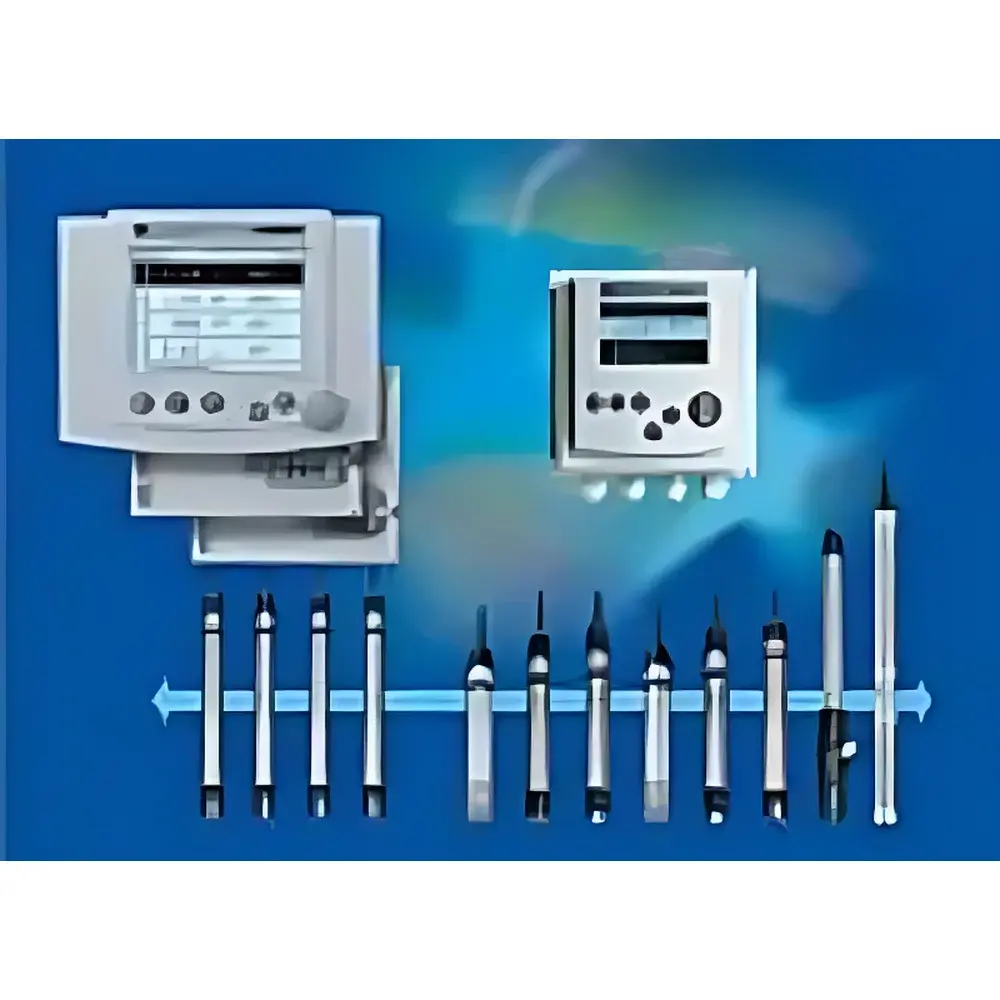
WTW IQ Sensor Net Online Multi-Parameter Water Quality Monitoring System
| Origin | Imported |
|---|---|
| Manufacturer Type | Authorized Distributor |
| Model | IQ Sensor Net |
| Instrument Type | Online Water Quality Analyzer |
| Measurable Parameters | pH, ORP, Temperature, Dissolved Oxygen (DO), Conductivity, Turbidity, Total Suspended Solids (TSS), Chemical Oxygen Demand (COD), Biochemical Oxygen Demand (BOD), Salinity, Ammonium-N (NH₄⁺-N), Nitrate-N (NO₃⁻-N), Nitrite-N (NO₂⁻-N), Total Organic Carbon (TOC), Spectral Absorption Coefficient (SAC), Phosphate (PO₄³⁻) |
| Enclosure Rating | Transmitter IP66 / Sensors IP68 |
| Communication | RS-485/232, MODBUS RTU, PROFIBUS DP |
| Analog Outputs | ≥6 × 4–20 mA |
| Relay Outputs | ≥6 |
| Digital Signal Transmission Distance | Up to 1000 m over 2-wire shielded cable |
| Power Supply | 24 VDC via signal cable |
| Sensor Auto-Recognition | Yes |
| Max. Connected Sensors | 20 |
| Cleaning Technology | Integrated ultrasonic cleaning (turbidity/TSS sensors) |
| Measurement Principle | Potentiometric (pH/ORP), Optical luminescence (DO), 4-electrode conductivity, 90° scattered light turbidimetry (FNU), UV-VIS absorbance (COD/SAC/NO₃⁻/NH₄⁺/PO₄³⁻), respirometric (BOD), catalytic oxidation (TOC) |
Overview
The WTW IQ Sensor Net Online Multi-Parameter Water Quality Monitoring System is a fully digital, modular platform engineered for continuous, high-reliability environmental monitoring in wastewater treatment plants, drinking water distribution networks, surface water quality stations, and industrial effluent discharge points. Unlike legacy analog systems that require dedicated transmitters per parameter, IQ Sensor Net implements a distributed architecture where each sensor functions as an autonomous measurement node—performing on-board signal conditioning, temperature compensation, calibration storage, and digital encoding. All sensors communicate via standardized digital protocols over a single 2-wire shielded cable carrying both power (24 VDC) and bidirectional data. This eliminates signal degradation, ground-loop interference, and installation complexity associated with multi-channel analog wiring. The system operates on the principle of decentralized intelligence: raw physical phenomena (e.g., hydrogen ion activity, oxygen quenching of luminescent dyes, light scattering at 90°, or UV absorbance at 254 nm) are converted to calibrated digital values at the sensor level, ensuring metrological traceability and long-term stability across diverse field conditions.
Key Features
- Modular, scalable architecture supporting up to 20 IQ digital sensors on one network—expandable without hardware replacement or firmware reconfiguration.
- True plug-and-play operation: newly connected sensors are automatically detected, identified, and integrated into the system; no manual address assignment or parameter mapping required.
- Hot-swap capability: sensors may be replaced in-field without powering down the transmitter or interrupting data acquisition; calibration and configuration profiles migrate seamlessly to the new unit.
- Integrated ultrasonic cleaning on turbidity and TSS sensors ensures optical path integrity in high-fouling environments—eliminating manual maintenance intervals and drift from biofilm accumulation.
- Two-wire digital bus enables sensor deployment up to 1000 meters from the central controller, permitting optimal placement in remote or hazardous locations (e.g., open channels, submerged tanks, or outdoor kiosks).
- Robust electromagnetic compatibility (EMC) design with built-in lightning protection circuits—compliant with IEC 61000-4 series standards—ensuring operational continuity in electrically noisy infrastructure environments.
- Configurable analog outputs (≥6 × 4–20 mA) and relay outputs (≥6) support direct integration with SCADA, PLCs, and alarm panels; all outputs are software-mapped to any measured parameter or derived value.
Sample Compatibility & Compliance
The IQ Sensor Net platform accommodates a broad range of aqueous matrices—including raw sewage, activated sludge, tertiary effluent, riverine and lacustrine waters, potable water, and industrial process streams. Sensor materials (e.g., sapphire optical windows, PEEK housings, platinum and ruthenium oxide electrodes) resist chemical corrosion, abrasion, and biofouling under continuous immersion. Calibration protocols align with ISO 7027 (turbidity), ISO 5814 (dissolved oxygen), ISO 7888 (conductivity), and EN 27888 (pH). The system supports audit-ready data logging compliant with GLP and GMP requirements, including timestamped calibration records, sensor diagnostics, and event-triggered alarms. While not FDA 21 CFR Part 11-certified out-of-the-box, its secure user access control, electronic signature support (via optional software modules), and immutable audit trail functionality enable qualification for regulated applications under internal SOPs.
Software & Data Management
System configuration, real-time visualization, historical trend analysis, and alarm management are performed via WTW’s IQ Software Suite—a Windows-based application supporting local and remote access. The software provides full device discovery, sensor health monitoring (e.g., signal-to-noise ratio, coating detection, response time validation), and automated report generation in PDF or CSV format. Data export adheres to standard formats compatible with third-party platforms such as OSIsoft PI, Ignition SCADA, and Microsoft Power BI. Firmware updates are delivered over the same 2-wire bus, eliminating the need for physical access to individual sensors. Optional cloud connectivity (via IQ Gateway) enables secure MQTT-based telemetry for centralized fleet monitoring, predictive maintenance alerts, and cross-site performance benchmarking—all without compromising network segmentation or IT security policies.
Applications
The IQ Sensor Net system is deployed globally in municipal wastewater treatment facilities to monitor influent characterization, nitrification/denitrification efficiency in bioreactors, clarifier performance, and final effluent compliance. In drinking water utilities, it verifies disinfection residual stability, detects early organic load changes via SAC/UV254, and tracks particle breakthrough in filtration processes. Environmental agencies utilize distributed IQ Sensor Net nodes across river basins to establish spatial-temporal water quality gradients, supporting TMDL modeling and early warning of algal bloom precursors (e.g., NH₄⁺ surges, PO₄³⁻ spikes). Industrial users apply the platform for closed-loop cooling water control, landfill leachate monitoring, and pharmaceutical manufacturing process water verification—where regulatory adherence, repeatability, and minimal operator intervention are critical success factors.
FAQ
Can IQ Sensor Net operate in submerged or high-humidity outdoor environments?
Yes. All IQ sensors carry IP68 ingress protection, and the transmitter enclosure meets IP66. Optional solar-powered enclosures and weatherproof mounting kits (e.g., SSH/IQ sunshades) extend operational reliability in unsheltered field deployments.
Is calibration traceable to national standards?
Each IQ sensor includes factory calibration certificates traceable to NIST or PTB standards. Field calibration follows ISO/IEC 17025-compliant procedures using certified reference materials; calibration data—including date, operator ID, and standard lot numbers—is stored onboard and exportable.
How does the system handle sensor failure or communication loss?
Built-in diagnostics continuously monitor signal integrity, temperature drift, and coating status. Upon anomaly detection, the system logs the event, triggers configurable relays or digital alarms, and displays actionable guidance (e.g., “Clean optical window” or “Check cable continuity”) on the local interface.
Does IQ Sensor Net support integration with existing SCADA systems?
Yes. Native MODBUS RTU and PROFIBUS DP protocols ensure seamless interoperability with major industrial automation platforms. Analog outputs (4–20 mA) and discrete relay contacts provide fallback interfaces for legacy DCS installations.
What is the typical service life of IQ sensors under continuous operation?
Based on field data from >15 years of global deployment, pH/ORP electrodes average 18–24 months, optical DO sensors exceed 36 months, and turbidity/TSS units with ultrasonic cleaning demonstrate >48 months of stable performance in municipal wastewater applications.







