
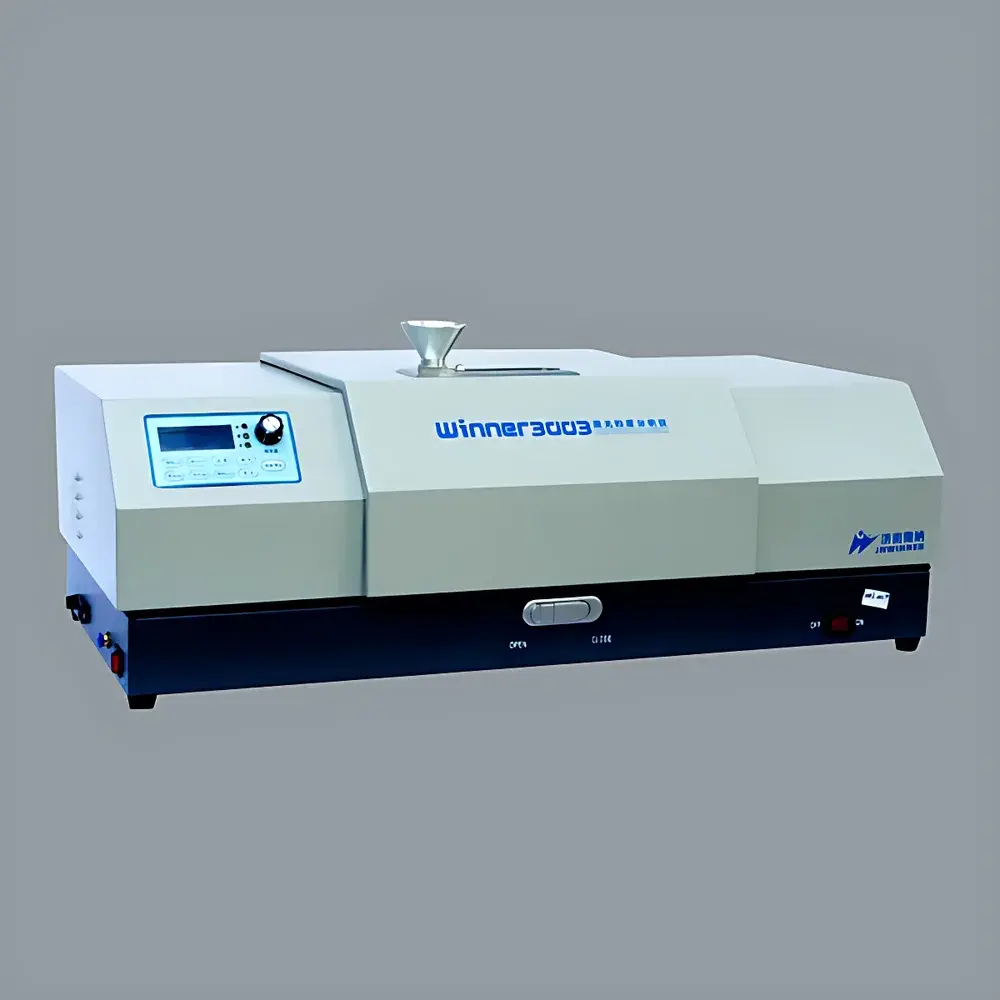
Winner 3003 Dry-Dispersion Laser Particle Size Analyzer by Jinan Winner
| Brand | Jinan Winner |
|---|---|
| Origin | Shandong, China |
| Manufacturer Type | Direct Manufacturer |
| Regional Classification | Domestic (China) |
| Model | Winner 3003 |
| Price Range | USD $0–14,500 |
| Dispersion Method | Dry Dispersion (Air-Based) |
| Instrument Type | Laboratory-Grade Laser Diffraction Particle Size Analyzer |
| Measurement Range | 0.1–500 µm |
| Repeatability | <1% RSD (D50 of NIST-traceable standard reference material) |
| Measurement Time | <60 seconds per analysis |
Overview
The Winner 3003 Dry-Dispersion Laser Particle Size Analyzer is a laboratory-grade instrument engineered for precise, rapid, and reproducible particle size distribution (PSD) analysis of free-flowing dry powders. It operates on the principle of laser diffraction—specifically, forward- and side-scattered light detection within a convergent-beam Fourier optical configuration. This optical architecture enhances angular resolution at small scattering angles, thereby improving sensitivity to submicron particles (down to 0.1 µm) without requiring liquid carriers. The system uses compressed air as the sole dispersion medium, eliminating risks associated with aqueous or organic solvents—making it ideal for moisture-sensitive, hygroscopic, reactive, or phase-unstable materials such as active pharmaceutical ingredients (APIs), metal alloys, cement clinker, magnetic oxides, and food-grade starches.
Key Features
- Dry dispersion with patented turbulent flow technology: Integrated dispersion module employs a proprietary turbulent jet design (Patent No. ZL.2007 2 0018648.7) combined with normal shock wave shear forces to fully de-agglomerate dry powders without mechanical grinding or vibration.
- Ceramic wear-resistant components: Critical dispersion nozzles and sample pathways are fabricated from high-purity alumina ceramic, ensuring long-term dimensional stability and resistance to abrasion from hard powders including carbides, silicon carbide, and tungsten powders.
- Convergent-beam Fourier transform optical path: Optimized lens geometry increases signal-to-noise ratio for fine particles, enabling reliable quantification of the D10, D50, and D90 values across the full 0.1–500 µm range with enhanced submicron resolution.
- Unconstrained distribution fitting algorithm: Proprietary non-parametric inversion method applies no pre-assumed distribution shape (e.g., log-normal or Rosin-Rammler), preserving true multimodal characteristics and avoiding artificial smoothing or bias in bimodal or broad distributions.
- Compact benchtop footprint: Dimensions of 880 × 400 × 300 mm and net weight of 36 kg enable seamless integration into QC labs, R&D cleanrooms, and university teaching laboratories without dedicated floor space or structural reinforcement.
Sample Compatibility & Compliance
The Winner 3003 is validated for use with thermally stable, non-volatile dry powders exhibiting bulk densities between 0.2–5 g/cm³ and flowability indices (Hausner ratio) ≤1.8. It complies with ISO 13320:2009 (Particle size analysis — Laser diffraction methods), GB/T 19077–2016 (Chinese national standard equivalent to ISO 13320), and internal enterprise specification Q/0100JWN001–2013. While not FDA 21 CFR Part 11–compliant out-of-the-box, raw data export (CSV, TXT) supports traceable audit trails when integrated into validated LIMS or ELN environments under GLP/GMP frameworks. Calibration verification is performed using NIST-traceable silica and polystyrene latex standards (e.g., NIST SRM 1963, SRM 2800).
Software & Data Management
The instrument is controlled via Windows-based WinMAS software (v4.2+), supporting real-time scatter pattern visualization, batch processing of up to 99 measurements, and customizable reporting templates compliant with ISO 9001 documentation requirements. All raw intensity data, Mie theory parameters (refractive index input optional), and inversion matrices are stored in binary format with timestamped metadata. Export formats include CSV (for Excel or Python pandas ingestion), PDF reports with embedded histograms and cumulative curves, and XML for interoperability with enterprise QA systems. Software permits user-defined pass/fail criteria based on D50 tolerance bands, enabling automated go/no-go decisions during incoming inspection or release testing.
Applications
The Winner 3003 serves critical roles across regulated and industrial sectors where dry-state characterization is mandatory. In pharmaceutical development, it monitors milling endpoints for inhalable dry powder formulations and verifies granule uniformity prior to tablet compression. In metallurgy, it tracks particle size evolution during gas atomization of Ni-based superalloys and assesses sintering readiness of Ti-6Al-4V powders. Cement manufacturers employ it for clinker fineness control per ASTM C114, while food processors validate spray-dried dairy powder consistency against Codex Alimentarius guidelines. Additional applications include quality assurance of abrasive grains (SiC, Al₂O₃), catalyst support materials (γ-Al₂O₃, zeolites), and battery cathode precursors (LiCoO₂, NMC).
FAQ
What types of samples are incompatible with the Winner 3003?
Samples that are highly electrostatic, fibrous (e.g., cellulose nanofibers), or prone to airborne ignition (e.g., aluminum flake, magnesium powder) require prior risk assessment and may necessitate inert gas purging or alternative dispersion protocols.
Can the instrument measure nanoparticles below 0.1 µm?
No—the optical design and detector angular range limit reliable quantification to ≥0.1 µm; sub-100 nm analysis requires complementary techniques such as dynamic light scattering (DLS) or transmission electron microscopy (TEM).
Is refractive index input required for accurate results?
Yes—Mie theory-based inversion requires both real and imaginary components of the sample’s complex refractive index; default values are provided for common materials (e.g., SiO₂: 1.54 + 0i), but empirical calibration is recommended for novel or composite powders.
How is instrument performance verified between calibrations?
Daily verification uses a certified reference material (CRM) with known D50; repeatability must remain within ±0.5% RSD over five consecutive runs to maintain analytical validity.
Does the system support automated sample feeding?
The base model includes manual powder loading via vibratory feeder; optional accessories include programmable volumetric feeders and hopper-based continuous feed modules for high-throughput production line monitoring.



