
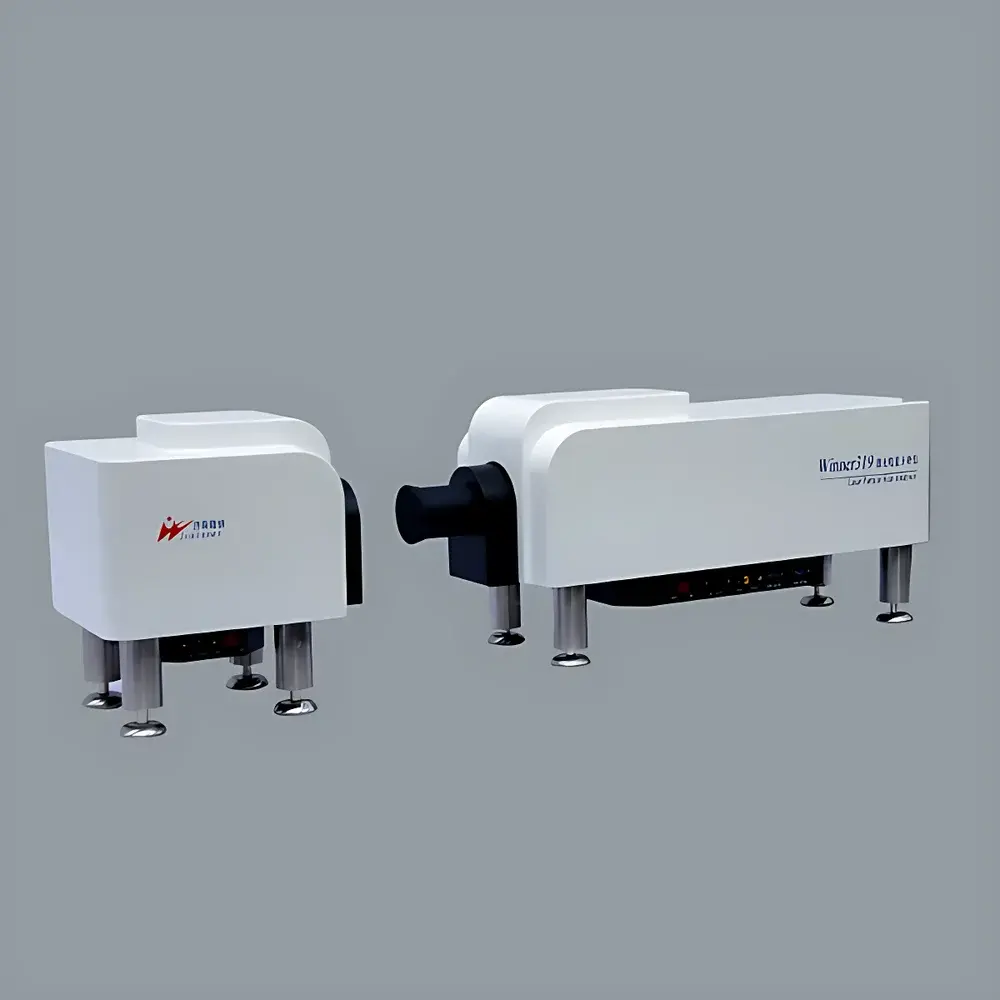
Winner319 Industrial Spray Laser Particle Size Analyzer
| Brand | Jinan Winner |
|---|---|
| Origin | Shandong, China |
| Manufacturer Type | Direct Manufacturer |
| Regional Classification | Domestic (China) |
| Model | Winner319 |
| Price Range | USD 14,000 – 21,000 |
| Dispersion Method | Dry & Wet Dispersion |
| Instrument Type | Laboratory-Grade Laser Diffraction Particle Size Analyzer |
| Measurement Range | 1–2000 µm |
| Repeatability | < 3% (D50 of NIST-traceable standard reference material) |
| Measurement Time | < 60 s per analysis |
Overview
The Winner319 Industrial Spray Laser Particle Size Analyzer is a modular, non-intrusive laser diffraction instrument engineered for real-time, in-situ characterization of atomized droplets and aerosol sprays. Based on Mie scattering theory and employing a collimated parallel-beam optical architecture, the system delivers high-fidelity particle size distribution (PSD) data across an extended dynamic range—from 1 µm to 2000 µm—with minimal flow-field disturbance. Its split-body configuration enables flexible deployment in industrial test benches, spray chambers, wind tunnels, or combustion rigs, where spatial constraints and environmental complexity demand robust optical access and operational adaptability. Unlike conventional benchtop diffraction analyzers, the Winner319 integrates an active dual-air-curtain lens protection system and field-adjustable measurement path lengths (0.1–10 m), making it uniquely suited for high-humidity, high-velocity, or particulate-laden spray environments typical in aerospace fuel injection, agricultural nozzle calibration, fire suppression R&D, and pharmaceutical inhaler development.
Key Features
- Modular split-body design: Transmitter and receiver units are physically decoupled, enabling independent alignment and installation in confined or hazardous zones.
- Adjustable optical path length: Precisely tunable from 0.1 m to 10 m via calibrated linear stage, supporting both near-field nozzle characterization and far-field plume dispersion analysis.
- Dual-air-curtain optical protection: Two concentric laminar air streams isolate the receiving optics from droplet impingement, eliminating lens fouling without mechanical shutters or consumable filters.
- High-power tunable green laser source: LD-pumped 532 nm diode laser (1–40 mW output, continuously adjustable) enhances signal-to-noise ratio for sub-5 µm droplets and improves detection sensitivity in low-concentration sprays.
- Automated beam alignment system: Motorized optical centering completes full alignment in < 10 seconds—no manual micrometer adjustment required—ensuring long-term measurement stability across thermal or mechanical drift.
- Multi-detector angular array: Configurable detector layouts (72/76/80 channels depending on model variant) cover forward to wide-angle scattering with optimized solid-angle resolution, ensuring accurate capture of coarse-mode and fine-mode peaks simultaneously.
Sample Compatibility & Compliance
The Winner319 supports open-path, non-contact measurement of liquid sprays, gas-phase aerosols, and transient mist clouds without sampling probes or dilution—preserving native droplet dynamics and avoiding evaporation artifacts. It complies with ISO 13320:2009 (Particle size analysis — Laser diffraction methods), GB/T 19077–2016 (Chinese national standard equivalent), and Q/0100JWN001–2013 (manufacturer’s validated performance specification). All measurement protocols adhere to GLP-aligned documentation practices; raw scattering intensity matrices and metadata are timestamped and stored with instrument ID, operator ID, and environmental sensor logs (optional ambient temperature/humidity input). The system is compatible with 21 CFR Part 11-compliant software configurations when paired with validated LIMS integration modules.
Software & Data Management
The proprietary WinPAS v4.2 software provides real-time scatter pattern visualization, automated PSD calculation using Mie theory (refractive index input supported), and multi-model fitting—including standard Rosin-Rammler (RR), log-normal, and volume/number distribution conversion. Batch analysis mode supports time-series profiling (e.g., spray start-up transients), statistical trend reporting (D10/D50/D90, span, relative width), and export to CSV, Excel, or ASTM E2917-compliant XML formats. Audit trails record all parameter changes, calibration events, and user actions. Optional cloud synchronization enables remote monitoring and cross-site method harmonization for multinational R&D teams.
Applications
- Fuel injector and combustion chamber spray characterization in internal combustion engines and gas turbines
- Nozzle design validation for agricultural sprayers, pesticide delivery systems, and fogging disinfection units
- Aerosol generation studies in inhalation toxicology, respiratory drug delivery (MDIs/DPIs), and HVAC filtration testing
- Fire suppression system optimization (water mist, CO₂, and clean-agent nozzles)
- Industrial spray drying and granulation process control in food, chemical, and battery cathode material manufacturing
- Environmental monitoring of dust suppression systems (e.g., fog cannons), stack emissions, and volcanic ash dispersion modeling
- Aerospace propulsion research—including cryogenic propellant atomization and supersonic spray breakup analysis
FAQ
What distinguishes the Winner319 from traditional laboratory laser diffraction analyzers?
Unlike closed-cell benchtop instruments, the Winner319 operates in open-path mode with modular optical separation, enabling direct integration into spray test rigs without sample extraction or dilution.
Does the system support refractive index correction for non-aqueous liquids?
Yes—WinPAS software accepts user-defined real and imaginary components of complex refractive index, critical for accurate sizing of hydrocarbon fuels, silicone oils, or pharmaceutical suspensions.
Can the Winner319 be used for continuous online monitoring?
While designed primarily for R&D and QA batch analysis, its <60 s cycle time and Ethernet/RS-485 interface support semi-automated periodic monitoring when integrated with PLC-triggered acquisition sequences.
Is calibration traceable to international standards?
Instrument calibration uses NIST-traceable PSL and glass microsphere reference materials; factory calibration reports include uncertainty budgets per ISO/IEC 17025 guidelines.
How is data integrity ensured during long-duration spray tests?
Each measurement file embeds embedded SHA-256 checksums, hardware-timestamped acquisition triggers, and optional digital signature verification for regulatory submission readiness.



