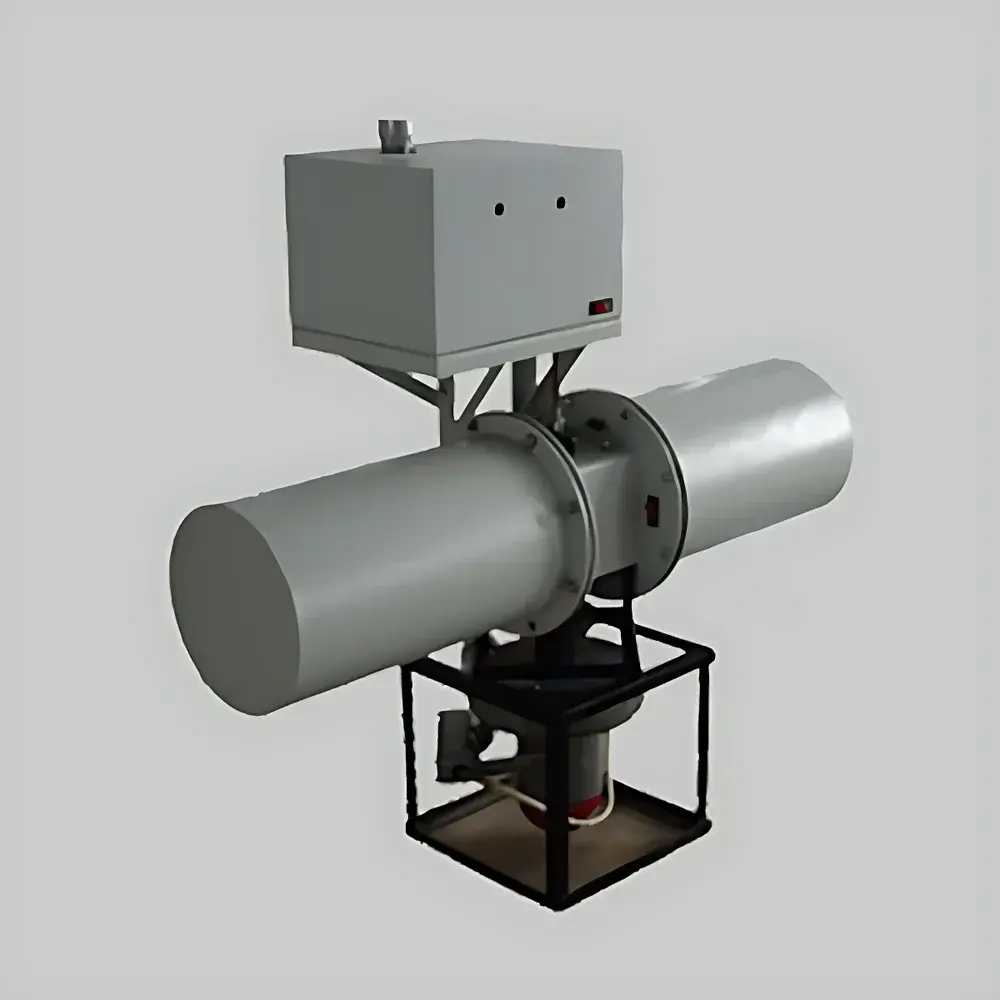
Winnova Winner7000 Online Laser Diffraction Particle Size Analyzer
| Brand | Winnova |
|---|---|
| Origin | Shandong, China |
| Manufacturer Type | Direct Manufacturer |
| Product Origin | Domestic (China) |
| Model | Winner7000 |
| Price Range | USD 14,000 – 70,000 |
| Measurement Principle | Mie Scattering Theory |
| Laser Source | He-Ne, 632 nm, 2 mW |
| Particle Size Range | 0.1–300 µm or 0.1–800 µm (configurable) |
| Sampling Methods | Mechanical / Pneumatic / Venturi |
| Return Methods | Mechanical / Pneumatic / Auto-Return |
| Dispersion Method | Turbulent Flow Dispersion |
| Lens Protection | Air Curtain |
| Cleaning Method | Timed High-Pressure Air Purge |
| IP Rating | IP54 |
| Operating Temperature | −15°C to +45°C |
| Operating Humidity | 0–60% RH (non-condensing) |
| Accuracy | < ±3% |
| Repeatability | < ±3% |
| Dimensions | 1000 × 600 × 1500 mm |
| Weight | 80 kg |
| Continuous Operation | 24/7 |
| Data Output Interface | Standard Modbus TCP, OPC UA, 4–20 mA, Ethernet |
| Cloud Integration | Optional cloud-based monitoring platform with TLS-secured data transmission |
Overview
The Winnova Winner7000 Online Laser Diffraction Particle Size Analyzer is an industrial-grade in-line particle characterization system engineered for continuous, real-time monitoring of particle size distribution (PSD) in dynamic process streams. Based on first-principles Mie scattering theory, the instrument illuminates a representative sample stream with a stabilized 632 nm He-Ne laser and captures angular light intensity patterns via a high-resolution multi-channel photodetector array (38 detection channels). These raw scattering profiles are converted into volumetric PSD data using rigorous optical inversion algorithms compliant with ISO 13320:2020. Designed specifically for integration into cement, carbon, abrasives, chemical, and mineral processing lines, the Winner7000 delivers traceable, reproducible measurements without interrupting production—enabling closed-loop process control, early deviation detection, and statistically robust quality assurance.
Key Features
- Modular architecture: Independent sampling, measurement, return, and cleaning modules allow field-adaptive configuration for diverse pipeline geometries, pressure regimes, and material flow states.
- True in-situ operation: Integrated turbulent-flow dispersion ensures homogeneous particle presentation without dilution or solvent addition—preserving native particle morphology and agglomeration state.
- Robust optical protection: Air-curtain lens shielding prevents deposition of airborne fines or sticky particulates on critical optical surfaces during extended unattended operation.
- Zero-waste material handling: Fully automated sample return—via mechanical auger, pneumatic conveyance, or gravity-assisted auto-return—maintains mass balance and eliminates off-spec discard.
- Industrial-grade reliability: IP54-rated enclosure; vibration-, dust-, and EMI-resistant design; built-in fault diagnostics with relay-triggered alarms and event logging.
- Configurable temporal resolution: Adjustable measurement cycle intervals (from seconds to minutes) synchronized with DCS/PLC scan cycles via hardwired or networked I/O.
Sample Compatibility & Compliance
The Winner7000 accommodates dry powders, slurries, and aerosolized solids across bulk densities from 0.2 g/cm³ to 3.5 g/cm³ and particle hardness up to Mohs 7. Its non-contact optical measurement principle avoids sensor wear, clogging, or calibration drift associated with mechanical sieving or electrozone sensing. System validation adheres to ASTM E2927-21 (Standard Test Method for Particle Size Distribution Analysis of Suspensions Using Laser Light Scattering) and supports audit-ready documentation for GLP and GMP environments. All firmware and data handling comply with FDA 21 CFR Part 11 requirements when deployed with optional electronic signature and audit trail modules.
Software & Data Management
Local HMI provides real-time visualization of D10/D50/D90, span, and full PSD histograms. Raw and processed data export via CSV, XML, or SQL-compatible formats. Native support for Modbus TCP and OPC UA enables seamless integration into Siemens PCS7, Emerson DeltaV, Honeywell Experion, or Rockwell FactoryTalk systems. Optional cloud gateway transmits time-stamped metrics—including statistical process control (SPC) indices—to encrypted AWS or Azure-hosted dashboards with role-based access control, configurable alert thresholds, and long-term trend archiving compliant with ISO/IEC 17025 data integrity standards.
Applications
The Winner7000 is deployed in cement kiln feed optimization, carbon black reactor endpoint control, silicon carbide micronization feedback loops, pharmaceutical wet granulation monitoring, and pigment dispersion consistency verification. In abrasive manufacturing, it detects premature mill wear by tracking sub-10 µm fines generation. In flue gas desulfurization (FGD) slurry lines, it verifies limestone particle reactivity prior to injection—directly correlating with SO₂ removal efficiency. Case studies demonstrate 12–18% reduction in specific energy consumption and 30–40% decrease in out-of-spec batch frequency following implementation.
FAQ
Does the Winner7000 require periodic recalibration with reference standards?
No. The optical path is sealed and thermally stabilized; calibration is factory-performed against NIST-traceable polystyrene latex standards. Field verification uses built-in diagnostic scatter checks—not user-replaceable reference materials.
Can the system operate in explosive atmospheres (ATEX Zone 21)?
Not natively. Explosion-proof variants (ATEX II 2D T135°C) are available as custom-engineered configurations with purge-certified enclosures and intrinsically safe sampling actuators.
What maintenance intervals are recommended for continuous operation?
Filter elements in the air curtain and purge system require replacement every 6 months under typical plant conditions; no optical alignment or detector servicing is required within 5 years of commissioning.
Is raw scattering pattern data accessible for third-party algorithm development?
Yes. Full 38-channel intensity vectors are available via Ethernet API with timestamp synchronization to ±1 ms, supporting proprietary inversion models or machine learning training pipelines.
How does the system handle high-concentration or highly absorbing samples?
Turbulent dispersion reduces local concentration gradients; optional dual-range detection mode (high-gain/low-gain channel switching) maintains linearity across optical density ranges up to OD 3.0.
Related Products