
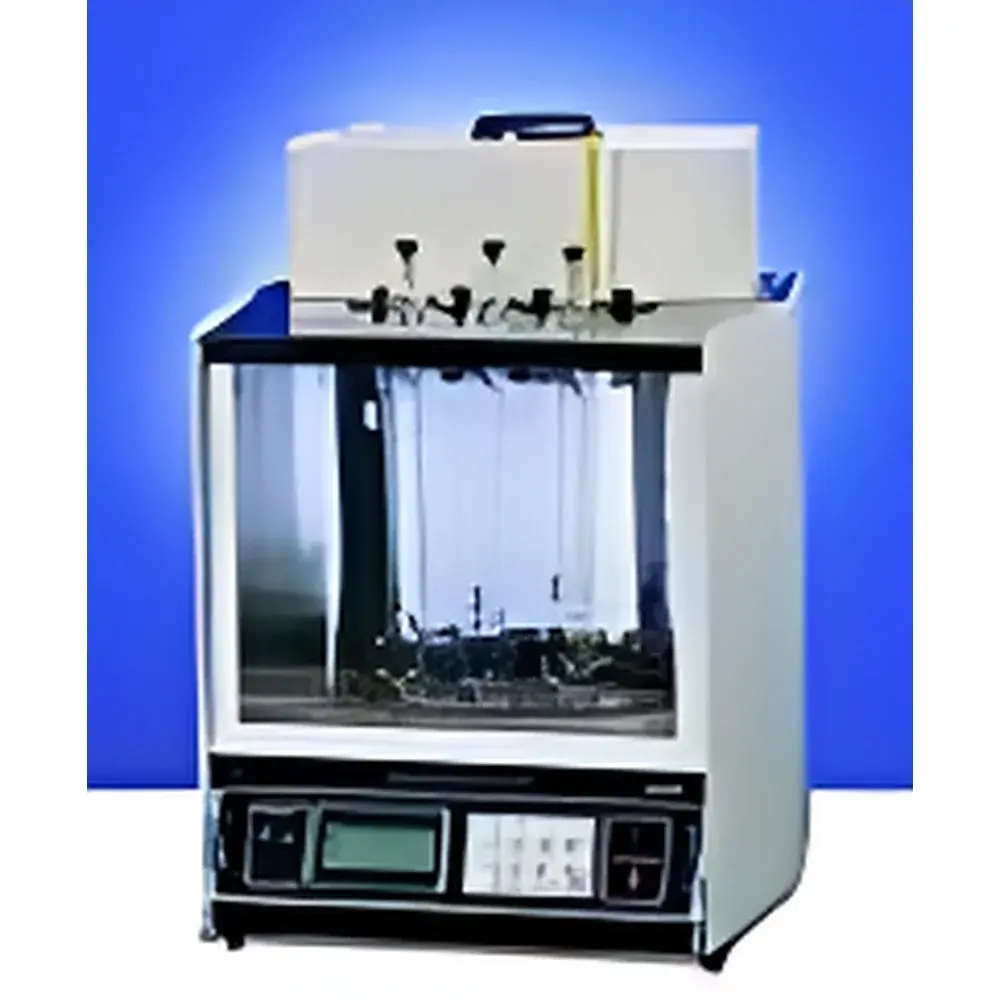
CANNON CT-2000 High-Temperature Constant-Temperature Bath for Capillary Viscometry
| Brand | CANNON |
|---|---|
| Origin | USA |
| Model | CT-2000 |
| Temperature Control Range | 20 °C to 150 °C |
| Temperature Stability | ±0.01 °C |
| Compliance | ASTM D445, ISO 3104 |
| Communication Interfaces | RS-232, RS-485 |
| Bath Capacity | 7 × 51 mm viscometer ports + 2 auxiliary thermometer ports |
| Display | 4-line LCD with digital setpoint & actual temperature readout |
| Input Method | Keypad entry of two-digit decimal setpoints |
| Temperature Unit Toggle | °C / °F |
| Self-Diagnostic Function | Power-on system check |
| Calibration Offset Entry | Manual mercury thermometer correction via keypad |
| Cooling Option | External tap water or chiller connection |
Overview
The CANNON CT-2000 High-Temperature Constant-Temperature Bath is an engineered thermal platform designed explicitly for precision kinematic viscosity measurements using glass capillary viscometers—primarily in accordance with ASTM D445 and ISO 3104. It operates on the principle of controlled convective heat transfer within a thermally homogeneous silicone oil or high-stability bath fluid medium, maintaining uniform temperature distribution across multiple viscometer positions. Unlike generic heating baths, the CT-2000 integrates microprocessor-based proportional-integral-derivative (PID) temperature regulation with dual electric heating elements and optional external cooling integration, enabling stable operation from ambient +5 °C up to 150 °C. Its design prioritizes metrological integrity: the ±0.01 °C temperature stability over time ensures repeatability required for regulatory-grade testing in asphalt, lubricant, and petroleum product laboratories. The bath’s transparent front panel and rigid structural housing support visual monitoring while minimizing thermal drift from ambient air currents.
Key Features
- Microprocessor-controlled PID temperature regulation with real-time digital display of both setpoint and actual bath temperature across four LCD lines
- Temperature range of 20 °C to 150 °C, with stability maintained at ±0.01 °C—validated against NIST-traceable reference thermometers
- Seven standardized 51 mm-diameter ports for simultaneous mounting of Ubbelohde, Cannon-Fenske, or suspended-level capillary viscometers; two additional ports reserved for calibrated reference thermometers
- RS-232 and RS-485 serial interfaces compliant with Modbus RTU protocol, enabling bidirectional communication with LIMS or custom data acquisition software
- Onboard self-diagnostic routine executed at power-up, verifying sensor integrity, heater function, and controller responsiveness
- User-configurable calibration offset entry for manual mercury-in-glass thermometer correction, stored non-volatile memory to preserve traceability
- Front-accessible control keypad supporting direct two-digit decimal input (e.g., “135.0” for 135.0 °C), eliminating reliance on rotary dials or analog scaling
- Dual-mode temperature unit display (°C/°F) with seamless toggle, supporting multinational laboratory documentation standards
Sample Compatibility & Compliance
The CT-2000 accommodates all standard ASTM/ISO-compliant glass capillary viscometers used in kinematic viscosity determination—including those specified in ASTM D2161 (asphalt), D445 (petroleum products), and D7042 (high-shear rate modified methods). Its bath geometry and fluid dynamics ensure laminar flow conditions around vertically mounted capillaries, minimizing convection-induced timing errors. The instrument is validated for use with silicone oils (e.g., Dow Corning 200 Fluid, 50 cSt) and other low-volatility, high-thermal-stability bath media. Regulatory alignment includes full support for GLP and GMP environments: audit trails for temperature setpoint changes, calibration offset logs, and firmware version reporting are accessible via serial interface. Data export formats comply with ASTM E1382 and ISO/IEC 17025 documentation requirements.
Software & Data Management
While the CT-2000 operates autonomously, its RS-232/RS-485 interfaces enable integration into enterprise-level laboratory informatics systems. Raw temperature telemetry—including timestamped setpoint, measured value, and deviation—is transmitted at user-defined intervals (1–60 seconds). Third-party software packages such as LabVIEW, MATLAB, or custom Python-based DAQ scripts can parse ASCII-formatted responses (e.g., “TSET=135.00;TACT=134.98;STAT=OK”). Firmware supports SCPI-like command syntax for remote configuration, eliminating manual intervention during unattended overnight runs. All communication adheres to electrical noise immunity standards per EN 61326-1, ensuring reliability in electromagnetically dense QC lab environments.
Applications
- High-temperature kinematic viscosity testing of paving-grade and polymer-modified asphalts per AASHTO T201 and ASTM D2170
- Quality control of base oils, gear oils, and hydraulic fluids under shear-thin conditions where thermal history affects flow behavior
- Research-scale rheological screening of bituminous binders prior to dynamic shear rheometer (DSR) analysis
- Calibration verification of secondary temperature sensors used in automated viscometry stations
- Method development for viscosity-temperature correlation modeling (e.g., ASTM D341 Arrhenius plots)
FAQ
Does the CT-2000 meet ASTM D445 temperature stability requirements?
Yes—the ±0.01 °C stability over 30 minutes satisfies the maximum allowable fluctuation specified in Section 7.2 of ASTM D445-23.
Can the bath be cooled below ambient temperature?
It supports active cooling via external tap water or a recirculating chiller connected to the integrated coolant inlet/outlet ports, enabling operation down to approximately 5 °C above ambient.
Is firmware upgrade capability available?
Firmware updates are performed via RS-232 using CANNON-provided utility software; version history and checksum validation are logged internally.
What bath fluids are recommended for operation above 100 °C?
Silicone oils with flash points exceeding 300 °C (e.g., Dow Corning 200 Fluid, 100 cSt) are validated for continuous use up to 150 °C.
How is traceability maintained for temperature calibration?
Users enter mercury thermometer correction values via keypad; these offsets are retained in non-volatile memory and applied in real time to all displayed and transmitted temperature values.



