
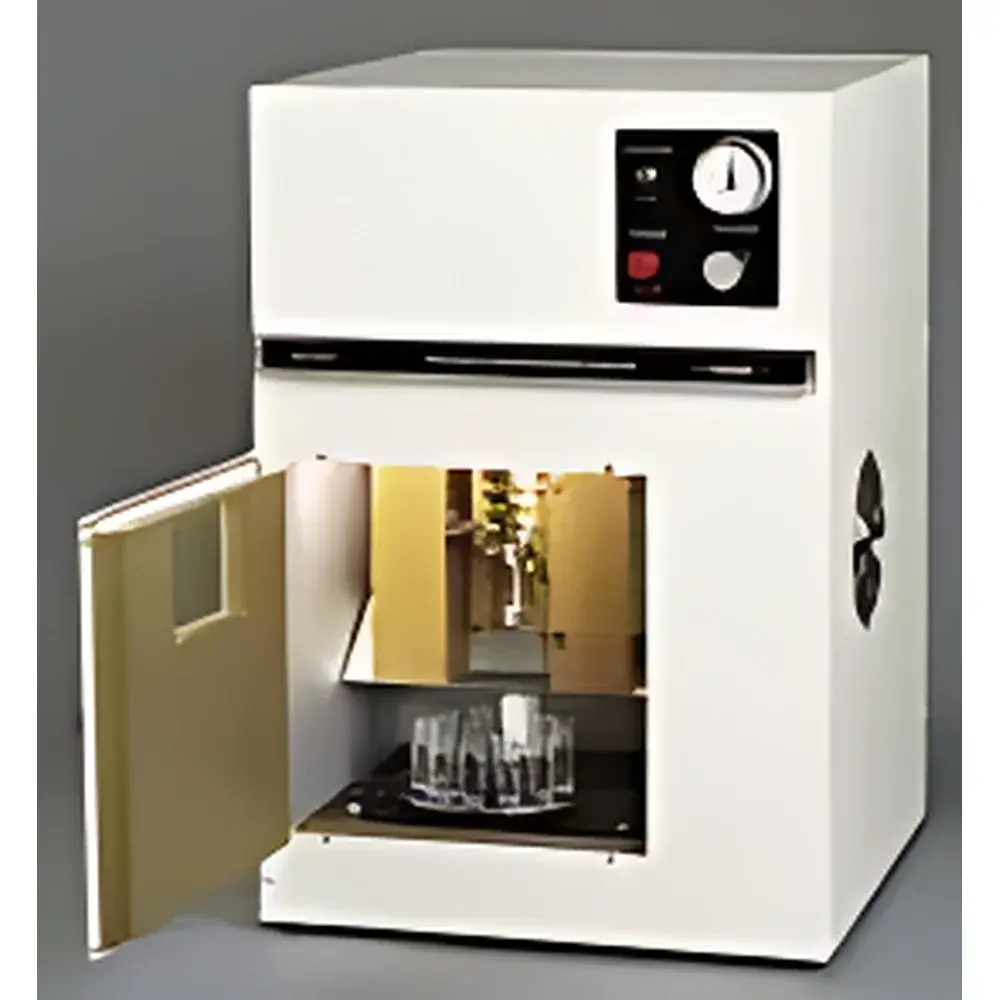
CANNON PolyVISC Advanced Automated Capillary Viscometer
| Brand | CANNON |
|---|---|
| Origin | USA |
| Model | PolyVISC |
| Instrument Type | Capillary Viscometer |
| Temperature Range | 20–100 °C (optional 135 °C) |
| Temperature Stability | ±0.01 °C |
| Efflux Time Resolution | ±0.01 s |
| Viscosity Range | 0.3–20,000 cSt |
| Solvent Compatibility | Broad (including chlorinated, phenolic, and high-boiling solvents) |
| Compliance | ASTM D2857, ASTM D4603, ISO 307, USP <911>, FDA 21 CFR Part 11 (audit trail enabled in VISCPRO) |
Overview
The CANNON PolyVISC Advanced Automated Capillary Viscometer is a fully automated, precision-engineered instrument designed specifically for intrinsic, inherent, specific, and relative viscosity determination of polymer dilute solutions. Based on the fundamental principle of capillary flow viscometry—governed by the Hagen–Poiseuille equation—the PolyVISC measures efflux time of a defined volume of solution through a calibrated glass capillary under gravity-driven laminar flow. Its architecture implements ASTM D2857-95 (Standard Practice for Dilute Solution Viscosity of Polymers) as its primary operational framework, ensuring strict adherence to internationally recognized methodology for polymer characterization in QC, R&D, and regulatory environments. Unlike semi-automated or manual systems, the PolyVISC eliminates operator intervention during sample handling, thermal equilibration, timing, cleaning, and data calculation—enabling unattended operation across multi-hour test sequences with metrological traceability.
Key Features
- Fully automated sample handling via motorized rotating sample carousel with integrated solvent wash and air-dry stations—each capillary undergoes full post-measurement cleaning using precisely metered 10 mL solvent aliquots.
- AIRBATH™ air-heated thermal enclosure provides uniform, vibration-free temperature control from 20 °C to 100 °C (±0.01 °C stability); optional high-temperature module extends range to 135 °C for PET, PEEK, and polyimide applications.
- Thermoelectric cooling (Peltier-based) enables sub-ambient operation down to 15 °C—critical for thermally sensitive biopolymers or low-Tg elastomers requiring precise cold-point measurement.
- High-reproducibility timing system with ±0.01 s resolution ensures compliance with ASTM D2857’s repeatability clause (Section 12), validated across inter-laboratory round-robin studies.
- SOLVENT-STURDY™ configuration features chemically resistant fluid paths, corrosion-resistant valves, and enhanced sealing—optimized for aggressive solvents such as o-chlorophenol, trifluoroacetic acid, and hexafluoroisopropanol.
- Modular hardware design supports field-upgradable options including extended temperature modules, dual-capillary parallel measurement, and LIMS-integrated barcode sample tracking.
Sample Compatibility & Compliance
The PolyVISC accommodates standard Ubbelohde, Cannon–Fenske, and suspended-level capillaries (ASTM D445-compliant geometries), with compatibility confirmed for >95% of polymer-solvent systems used in industrial QA/QC—including nylon 6/6 (formic acid), PET (phenol/1,1,2,2-tetrachloroethane), PVC (cyclohexanone), cellulose acetate (acetone/water), and ethylene copolymers (trichlorobenzene). All configurations meet CE marking requirements per EMC Directive 89/336/EEC and Low Voltage Directive 73/23/EEC, with dielectric strength certified at 1900 VDC for 60 seconds. Method validation documentation supports GLP and GMP audit readiness, including full 21 CFR Part 11 compliance in VISCPRO software (electronic signatures, audit trails, user access controls, and immutable raw data archiving).
Software & Data Management
VISCPRO v5.x—Windows-based control and analysis suite—orchestrates all instrument functions, from method setup and calibration management to real-time efflux monitoring and multi-formula viscosity computation. It natively calculates relative viscosity (ηrel), specific viscosity (ηsp), inherent viscosity ([η]inh), and intrinsic viscosity ([η]) using up to eight standardized algorithms (e.g., Huggins, Kraemer, Schulz–Blaschke), each configurable per polymer class. Raw efflux times, temperature logs, and cleaning cycle metadata are stored in an encrypted SQL database with timestamped revision history. Export modules support direct integration into LIMS platforms via ASTM E1384-compliant HL7 or CSV/Excel formats; PDF report generation includes full traceability headers, calibration certificates, and deviation flags per ISO/IEC 17025 requirements.
Applications
The PolyVISC serves as a reference-grade tool in polymer manufacturing quality control laboratories for batch release testing of synthetic fibers (nylon, polyester), engineering resins (PBT, PC), biomedical polymers (PLA, PCL), and specialty elastomers. Its robustness and reproducibility make it suitable for regulatory submissions to USP, EP, and JP monographs requiring intrinsic viscosity verification (e.g., USP for hyaluronic acid). Academic research groups employ it for structure–property correlation studies—linking [η] values to molecular weight distributions derived from SEC-MALS. In contract testing labs, its 24/7 unattended operation reduces labor cost per sample by >65% versus manual viscometry, while maintaining ASTM-defined precision thresholds.
FAQ
Which capillary types are supported?
Ubbelohde, Cannon–Fenske, and suspended-level viscometers conforming to ASTM D445 dimensional tolerances; custom capillary calibration files can be imported.
Can the PolyVISC operate below ambient temperature?
Yes—thermoelectric cooling enables stable operation from 15 °C to 100 °C (standard) or 135 °C (with high-temp option).
Is method validation support provided?
CANNON supplies IQ/OQ documentation packages, ASTM cross-reference matrices, and protocol templates aligned with ISO/IEC 17025 and FDA guidance.
How is solvent residue managed between samples?
Each capillary undergoes three-stage cleaning: solvent rinse (10 mL), compressed air purge, and thermal stabilization—all executed automatically before next measurement.
Does VISCPRO support multi-user environments with role-based access?
Yes—administrator, analyst, and reviewer roles enforce separation of duties; all actions generate time-stamped, non-erasable audit entries compliant with 21 CFR Part 11.



