
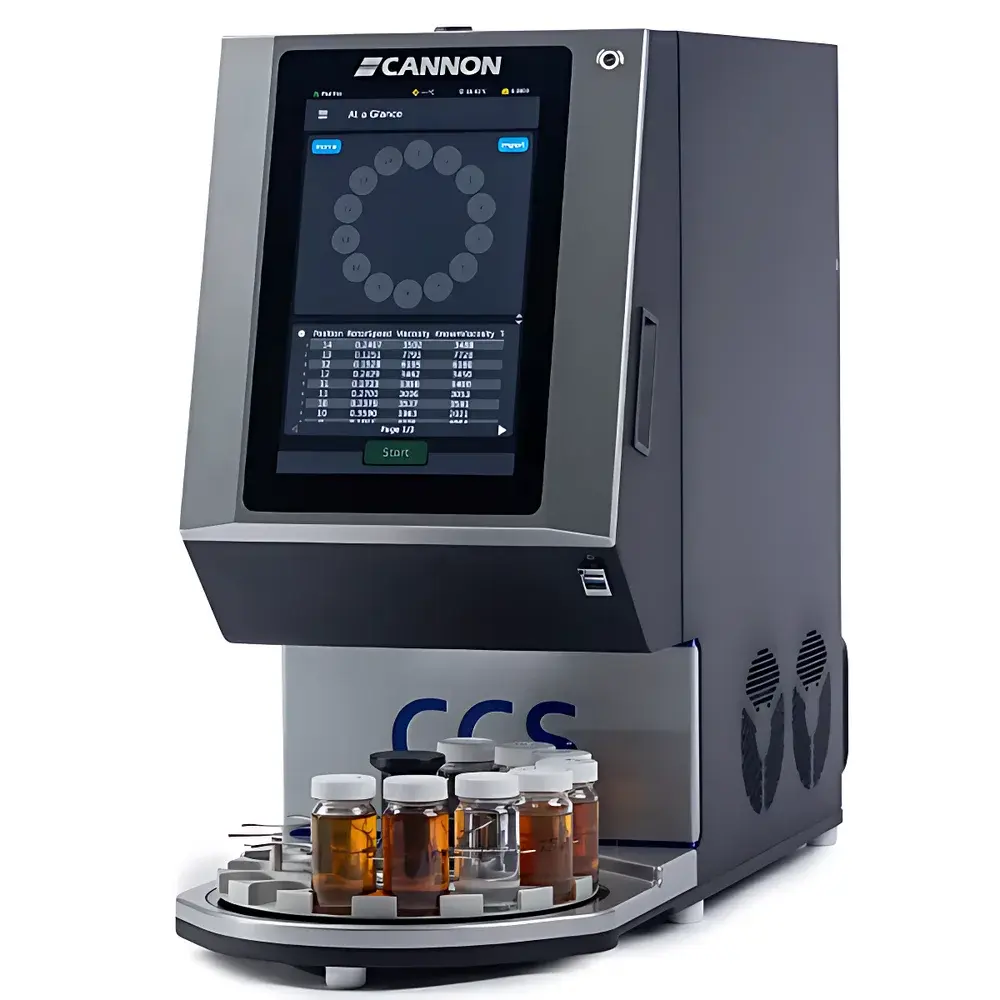
CANNON CCS2100-G6 Automated Cold-Cranking Simulator (CCS) Viscometer
| Brand | CANNON |
|---|---|
| Origin | USA |
| Model | CCS2100-G6 |
| Instrument Type | Rotational Viscometer (Fixed-Base, Low-Temperature CCS) |
| Temperature Range | −40 °C to −5 °C |
| Temperature Accuracy | ±0.05 °C |
| Temperature Resolution | ±0.05 °C |
| Viscosity Range | 900–25,000 mPa·s (cP) |
| Compliance | ASTM D5293, SAE J300, GB/T 6538 |
| Sample Capacity | 14 samples (unattended) |
| Cleaning Method | Solvent-Free In-Situ Sample Flush |
| Calibration | Auto-Rotational Speed Calibration & User-Verifiable Temperature Calibration |
| Software | FlowHub™ Data Management Platform |
Overview
The CANNON CCS2100-G6 Automated Cold-Cranking Simulator (CCS) Viscometer is an engineered solution for determining the low-temperature apparent viscosity of engine oils and other petroleum-based lubricants under simulated cold-start conditions. Based on the principle of rotational viscometry in a controlled Couette flow geometry—where torque is measured on a rotating spindle immersed in a sample held at precisely regulated sub-zero temperatures—the CCS2100-G6 replicates the shear stress experienced by crankcase oil during engine cranking at low ambient temperatures. Its design conforms strictly to the hydrodynamic boundary conditions specified in ASTM D5293 and SAE J300, enabling direct correlation with cold-cranking performance metrics such as cranking time and starter motor load. The instrument operates within a rigorously stabilized thermal environment from −40 °C to −5 °C, with temperature accuracy and resolution maintained at ±0.05 °C—critical for reproducible determination of viscosity inflection points near pour point transitions.
Key Features
- Full automation for unattended operation: accommodates up to 14 samples per sequence with robotic sample handling, eliminating operator-induced variability and supporting high-throughput laboratory workflows.
- Solvent-free cleaning protocol: leverages residual volume of the subsequent test sample to purge the measurement cell and spindle assembly, removing cross-contamination risk while eliminating hazardous solvent disposal requirements and associated regulatory overhead.
- Integrated thermal calibration verification: users may perform on-site temperature accuracy validation using traceable reference standards, satisfying internal QA protocols and external audit requirements (e.g., ISO/IEC 17025).
- Automated rotational speed calibration: eliminates manual iterative adjustment; system self-verifies spindle angular velocity against NIST-traceable timing references prior to each test cycle.
- Modular calibration verification kit (optional): includes four certified reference oils spanning the full operational viscosity range (900–25,000 mPa·s), enabling rapid multi-point calibration verification without reliance on external service visits.
- Rigid mechanical architecture: precision-machined stainless-steel housing and thermally isolated measurement chamber ensure long-term dimensional stability and minimal thermal drift across repeated thermal cycling.
Sample Compatibility & Compliance
The CCS2100-G6 is validated for use with mineral, synthetic, and semi-synthetic engine oils—including SAE 0W, 5W, and 10W grades—as well as gear oils and hydraulic fluids meeting low-temperature pumpability specifications. All measurement routines comply with ASTM D5293 (Standard Test Method for Apparent Viscosity of Engine Oils and Other Fluids Using a Cold-Cranking Simulator [CCS]) and SAE J300 (Engine Oil Viscosity Classification). It also supports GB/T 6538, the Chinese national standard aligned with ASTM D5293 methodology. Instrument design incorporates fail-safe thermal interlocks and pressure-relief pathways compliant with IEC 61010-1 for laboratory electrical equipment safety. Data integrity features—including electronic audit trails and user-access logging—are configurable to align with GLP and GMP documentation frameworks.
Software & Data Management
Controlled via FlowHub™ software, the CCS2100-G6 supports centralized management of multiple instruments from a single workstation. FlowHub enables secure data export in CSV, PDF, and XML formats compliant with LIMS integration standards. Calibration data—including temperature sensor offsets, spindle torque coefficients, and reference oil viscosity certificates—can be imported, versioned, and digitally signed. All test sessions are timestamped, user-attributed, and archived with immutable metadata (e.g., ambient lab temperature, refrigeration unit status, thermal soak duration). Optional 21 CFR Part 11 compliance packages provide electronic signature enforcement, role-based access control, and automated backup to network-attached storage or cloud repositories.
Applications
- Determination of CCS apparent viscosity for SAE W-grade classification per SAE J300.
- Formulation development and quality control of low-temperature engine oils in OEM and additive package laboratories.
- Verification of batch-to-batch consistency in commercial lubricant manufacturing.
- Supporting regulatory submissions requiring ASTM D5293-compliant viscosity data (e.g., API licensing, ACEA certification).
- Research into wax crystallization kinetics and gelation onset temperatures in paraffinic base stocks.
- Correlation studies between CCS viscosity, MRV (Mini-Rotary Viscometer) yield stress, and engine cranking simulation models.
FAQ
What standards does the CCS2100-G6 fully support?
ASTM D5293, SAE J300, and GB/T 6538—all implemented with hardware-level adherence to specified spindle geometry, thermal ramp rates, and torque sampling intervals.
Can the instrument operate without dedicated solvent disposal infrastructure?
Yes. Its solvent-free flush mechanism uses the next sample’s volume to clear the measurement path, eliminating need for chlorinated or aromatic solvents.
Is temperature calibration traceable to national standards?
User-performed temperature verification can be executed using NIST-traceable calibrated thermometers or PRTs; certificate templates are included in FlowHub for record retention.
How is data integrity ensured during unattended operation?
Each test log contains embedded cryptographic hashes, real-time environmental monitoring, and dual-write archival to local SSD and network storage—configurable for 21 CFR Part 11 compliance.
Does the system require periodic factory recalibration?
No. Field-verifiable calibration routines enable labs to maintain metrological confidence internally; annual verification by an accredited third party is recommended but not mandatory for routine use.



