
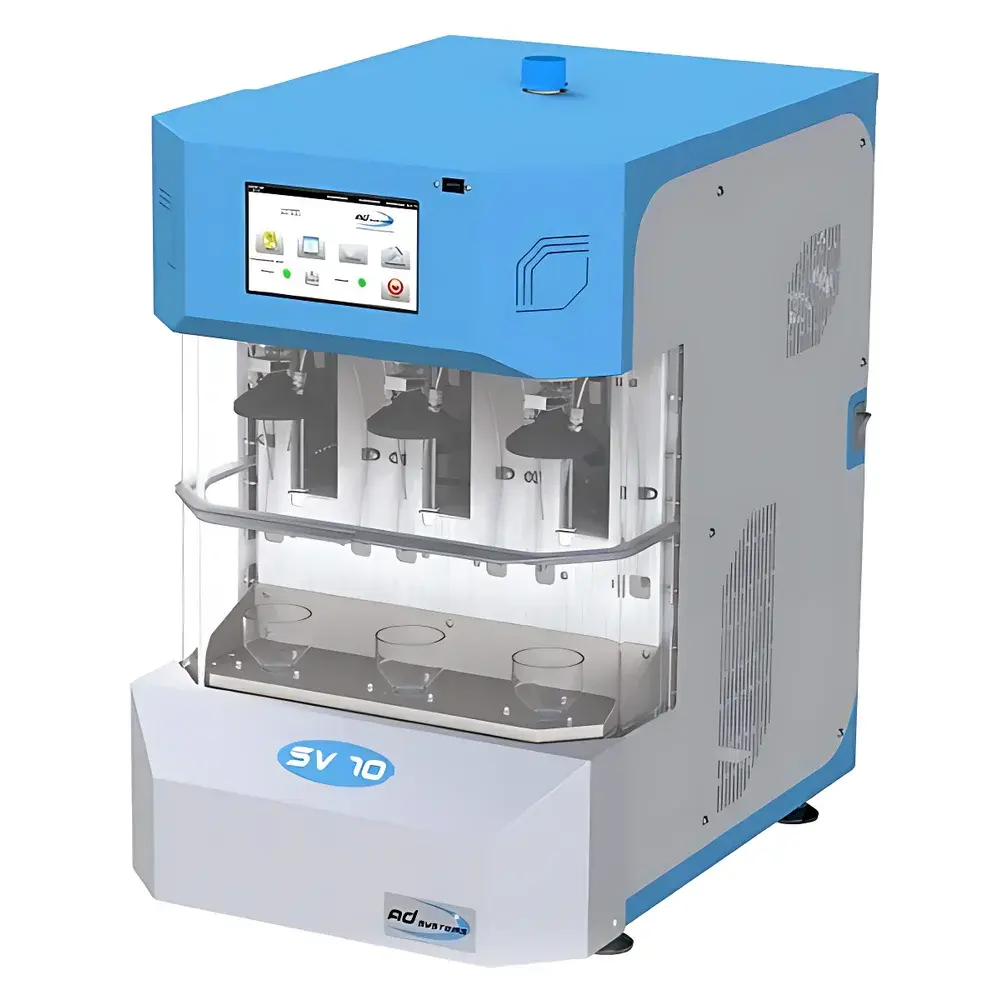
SV10 Automated S-Value Analyzer for Intrinsic Stability of Asphaltenes in Crude Oil and Heavy Fuels
| Brand | AD System |
|---|---|
| Origin | France |
| Model | SV10 |
| Compliance | ASTM D7157 |
| Automation | Fully Automated Dilution, Titration & Cleaning |
| Temperature Control | High-Precision Patented Thermal Regulation |
| Sample Throughput | 3 Parallel Measurement Positions |
| Solvent Handling | Sealed Enclosure, Operator-Solvent Isolation |
| Application Scope | Crude Oil, Residua, Heavy Fuel Oils, Marine Bunker Fuels |
Overview
The SV10 Automated S-Value Analyzer is a dedicated laboratory instrument engineered for the quantitative assessment of asphaltene intrinsic stability in petroleum-based feedstocks. It implements the standardized titration methodology defined in ASTM D7157 — “Standard Test Method for Determining the S-Value (Solubility Parameter) of Asphaltenes in Crude Oil and Related Materials” — to evaluate the propensity of asphaltenes to flocculate under controlled solvent addition. The S-value represents the volume (mL) of n-heptane required to induce the onset of asphaltene precipitation when added incrementally to a fixed mass of oil dissolved in toluene. This thermodynamic parameter serves as a critical indicator of colloidal stability, process operability in refining units (e.g., cokers, hydrotreaters), and compatibility during crude blending. The SV10 operates on a robust fluidic architecture integrating gravimetric sample dosing, precision syringe-driven titrant delivery, optical endpoint detection, and closed-loop thermal management — eliminating manual intervention while maintaining metrological traceability to reference methods.
Key Features
- Fully automated workflow: Integrated control of toluene dissolution, n-heptane titration, endpoint detection, system rinsing, and waste handling — enabling unattended operation for up to 3 samples simultaneously.
- Patented high-stability temperature regulation system: Maintains ±0.1 °C uniformity across all reaction vessels during dissolution and titration phases, minimizing thermal drift effects on solubility equilibrium.
- Three independent measurement stations: Allows parallel processing without cross-contamination; each station features dedicated fluid paths, optical sensors, and thermal jackets.
- Hermetically sealed operational enclosure: Prevents operator exposure to volatile organic solvents (toluene, n-heptane) and eliminates ambient humidity or draft interference with gravimetric steps.
- Automated mass calibration and solvent density compensation: Ensures accurate volumetric conversion from dispensed mass, supporting compliance with ASTM D7157’s mass-based protocol requirements.
- Modular reagent cartridge design: Pre-filled, barcode-scanned toluene and n-heptane reservoirs reduce preparation time and support audit-ready reagent tracking.
Sample Compatibility & Compliance
The SV10 is validated for use with undiluted crude oils, atmospheric and vacuum residues, heavy fuel oils (ISO 8217 RMK/RML grades), and marine bunker fuels. It accommodates sample viscosities up to 1,500 cSt at 40 °C and asphaltene contents ranging from 0.5 wt% to 25 wt%. All analytical procedures adhere strictly to ASTM D7157, including specified solvent purity grades (ACS reagent grade), temperature ramp profiles, mixing intensity, and optical turbidity threshold criteria (ΔAbs ≥ 0.02 at 550 nm). Instrument firmware supports GLP-compliant data integrity: electronic signatures, full audit trail (user actions, method version, environmental logs), and exportable raw data files compliant with FDA 21 CFR Part 11 requirements.
Software & Data Management
Control and analysis are executed via SV10 Control Suite v3.x — a Windows-based application featuring role-based access control, customizable method templates, and real-time titration curve visualization. Each assay generates a timestamped report containing initial mass, cumulative titrant volume, first-derivative inflection point, final S-value, and pass/fail status against user-defined specification limits. Data export formats include CSV (for LIMS integration), PDF (signed analytical reports), and XML (structured metadata per ASTM E1461). Raw absorbance vs. volume datasets are retained with instrument calibration history and environmental sensor logs (temperature, humidity), ensuring full traceability during internal audits or regulatory inspections.
Applications
- Crude assay laboratories: Screening S-value trends across blended crudes to predict fouling risk in desalters and preheat trains.
- Refinery process engineering: Correlating S-values with coke drum cycle length, hydroprocessing catalyst deactivation rates, and slurry-phase reactor stability.
- Fuel specification verification: Confirming compliance of marine residual fuels with ISO 8217 Annex A stability indices.
- R&D studies: Investigating asphaltene stabilization mechanisms via chemical inhibitors, nanomaterials, or thermal pretreatment protocols.
- Trading and custody transfer: Providing standardized stability metrics for contractual crude valuation and compatibility declarations.
FAQ
What standards does the SV10 comply with?
ASTM D7157 is the primary standard supported; method parameters are locked to its procedural constraints, including solvent selection, temperature setpoints, and endpoint detection logic.
Can the SV10 analyze samples with high wax content?
Yes — the integrated heating module maintains toluene dissolution at 60 °C, ensuring complete solubilization of waxy fractions prior to titration; optional cold-stage add-on available for low-temperature stability profiling.
Is method validation documentation provided?
AD System supplies IQ/OQ documentation packages, ASTM D7157 conformance reports, and a certified reference material (CRM) verification protocol using NIST-traceable asphaltene standards.
How is carryover prevented between runs?
Each station executes a multi-step cleaning sequence: toluene flush, air purge, and vacuum dry; fluid path validation is performed automatically before each new assay via pressure decay testing.
Does the system support remote monitoring?
Yes — SV10 Control Suite includes secure HTTPS API endpoints for integration with plant-wide SCADA or MES systems; live status dashboards and alarm notifications are configurable via email or SNMP traps.





