
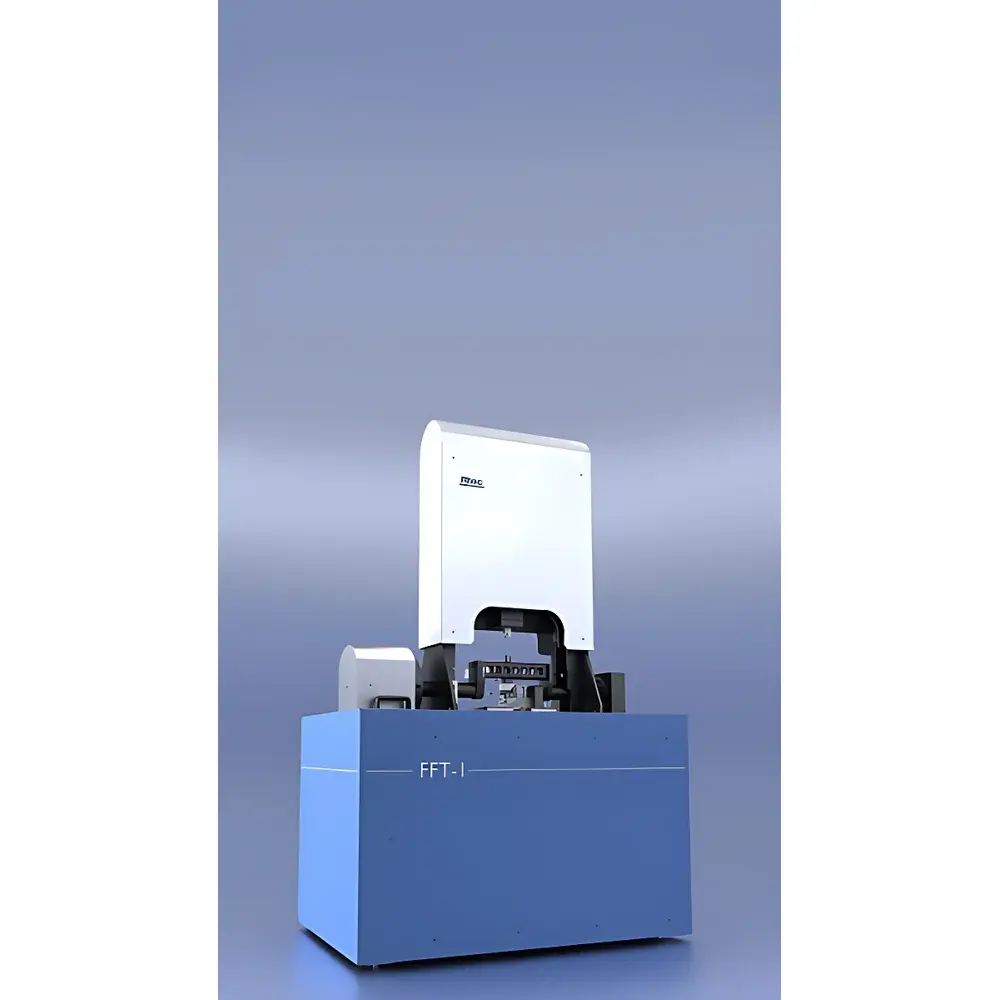
Rtec SRV-FT TriboTester (Model FFT-1)
| Brand | Rtec |
|---|---|
| Origin | USA |
| Type | Electromagnetic Oscillating Tribometer |
| Load Range | 1–3000 N |
| Frequency Range | 1–500 Hz |
| Oscillation Amplitude | 0.005–4 mm |
| Temperature Range | Ambient to +400 °C (optional up to +1000 °C) |
| Force Sensing | High-accuracy piezoelectric tribosensors |
| Displacement Monitoring | LVDT-based real-time closed-loop control |
| Compliance Standards | ASTM D5706, D5707, D6425, D7421, D7594, E2789 |
Overview
The Rtec SRV-FT TriboTester (Model FFT-1) is a high-precision electromagnetic oscillating friction and wear testing system engineered for fundamental and applied tribological research under controlled mechanical, thermal, and environmental conditions. Operating on the principle of reciprocating oscillation in a controlled-contact configuration, the instrument applies precisely regulated normal load and dynamic shear excitation to simulate real-world sliding, fretting, and micro-motion interfaces. Its core architecture integrates electromagnetic actuation with closed-loop servo control, enabling repeatable, low-noise motion profiles across a wide frequency spectrum (1–500 Hz) and sub-micron displacement resolution. Designed specifically for advanced tribology laboratories in lubricant formulation, surface engineering, and materials science, the SRV-FT delivers quantitative data on coefficient of friction (COF), wear volume, wear track morphology, and time-dependent tribological evolution — all traceable to internationally recognized test protocols.
Key Features
- Electromagnetic linear drive system with zero mechanical backlash, delivering high-fidelity sinusoidal, triangular, or user-defined waveforms at frequencies from 1 Hz to 500 Hz.
- Closed-loop load control via servo-hydraulic or electromechanical actuators (1–3000 N range), ensuring stable normal force application independent of sample deformation or thermal drift.
- Real-time displacement monitoring using calibrated LVDT sensors with ±0.1 µm resolution, synchronized with force acquisition at up to 100 kHz sampling rate.
- High-sensitivity piezoelectric tribosensors for simultaneous measurement of tangential friction force and normal load, with noise floor 0.1% FS.
- Modular temperature chamber supporting ambient-to-400 °C operation (upgradable to 1000 °C with ceramic heating elements and inert gas purge capability).
- Interchangeable test configurations: ball-on-flat, pin-on-disk, crossed-cylinder, and custom fixtures compatible with thin films, PVD/CVD coatings, bulk alloys, polymers, and greases.
Sample Compatibility & Compliance
The SRV-FT accommodates diverse sample geometries and material classes — including metallic substrates, ceramic coatings, DLC films, polymer composites, and liquid/solid lubricants — without requiring extensive sample preparation. Its modular fixture design supports standardized test specimens per ASTM, ISO, and DIN specifications. The system is fully compliant with ASTM D5706 (fretting wear of lubricated surfaces), ASTM D5707 (wear testing of automotive gear oils), ASTM D6425 (high-frequency reciprocating rig testing), ISO 19291 (tribological testing of engine oils), and multiple Chinese petroleum standards (SH/T 0721, 0784, 0847). All test sequences can be configured to meet GLP-compliant audit trails, with timestamped metadata, sensor calibration logs, and operator authentication integrated into the software architecture.
Software & Data Management
Rtec’s proprietary Tribometer Control Suite provides intuitive test setup, real-time visualization, and post-processing analytics. Users define multi-step test programs with variable load, frequency, amplitude, and dwell time parameters. Raw data streams — including COF, wear depth, temperature, and acoustic emission — are recorded synchronously at user-selectable rates. Built-in analysis modules calculate wear volume via profilometry integration, generate Stribeck curves, and export results in CSV, HDF5, or XML formats. The software supports 21 CFR Part 11-compliant electronic signatures, audit logging, and role-based access control — essential for regulated environments in lubricant OEM validation and API-certified testing labs.
Applications
- Development and qualification of engine oils, gear oils, greases, and solid lubricants under boundary, mixed, and elastohydrodynamic lubrication regimes.
- Evaluation of coating adhesion, fatigue resistance, and interfacial shear strength for TiN, CrN, MoS₂, and diamond-like carbon (DLC) thin films.
- Quantitative assessment of wear mechanisms (adhesive, abrasive, oxidative, tribochemical) in aerospace bearing steels, biomedical implants, and additive-manufactured alloys.
- Correlation of tribological performance with surface topography (via optional in situ white-light interferometry) and chemical state (via integrated Raman or XPS coupling ports).
- Accelerated life testing of seals, bushings, and MEMS components subjected to oscillatory motion and thermal cycling.
FAQ
What types of lubricants can be tested on the SRV-FT?
The system supports liquid oils, greases, pastes, and solid lubricant dispersions — with optional heated reservoirs and controlled atmosphere chambers for oxidation-sensitive formulations.
Is the SRV-FT compatible with third-party profilometers or optical microscopes?
Yes — standardized mounting interfaces and programmable trigger outputs enable seamless synchronization with white-light interferometers, confocal microscopes, and SEM-EDS systems for correlative wear analysis.
How is calibration traceability maintained for force and displacement measurements?
All primary sensors are factory-calibrated against NIST-traceable standards; annual recalibration kits and documentation templates are provided to support ISO/IEC 17025 accreditation requirements.
Can test data be exported directly into LIMS or ERP platforms?
Yes — the software includes configurable RESTful API endpoints and ODBC drivers for automated ingestion into laboratory information management systems and enterprise databases.
Does the system support automated pass/fail decision logic based on ASTM thresholds?
Yes — custom evaluation rules can be scripted within the software to classify test outcomes against predefined COF limits, wear volume tolerances, or failure event detection criteria.
Related Products





