
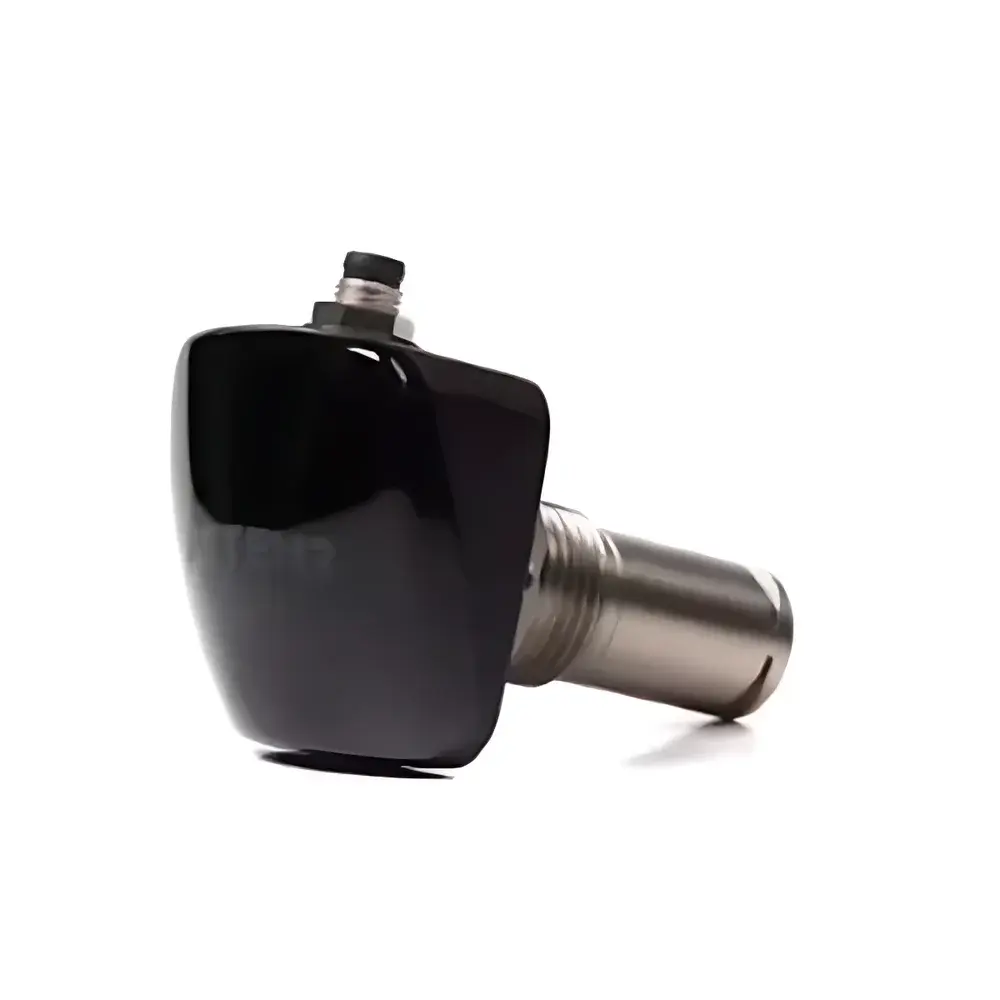
Atten2 OilHealth Online Oxidation State Monitoring Sensor
| Brand | Atten2 |
|---|---|
| Origin | Spain |
| Model | OilHealth |
| Type | Online Lubricant Oxidation Sensor |
| Compliance | CE, RoHS, ATEX Zone 2 (optional), IP67-rated housing |
| Communication | 4–20 mA analog output, Modbus RTU (RS-485), optional CAN bus or Ethernet/IP integration |
| Operating Temperature | −25 °C to +120 °C |
| Pressure Rating | Up to 10 bar (static) |
| Material | 316L stainless steel wetted parts, PEEK sensor body |
| Response Time | < 30 s (t₉₀) |
| Calibration | Factory-calibrated for mineral, PAO, and ester-based lubricants |
| Lifetime | ≥ 5 years in continuous operation (MTBF > 40,000 h) |
Overview
The Atten2 OilHealth Online Oxidation State Monitoring Sensor is an electrochemical-optical hybrid sensor engineered for real-time, in-situ quantification of lubricant oxidative degradation during active machine operation. Unlike offline laboratory methods (e.g., RPVOT, FTIR, or RULER), OilHealth employs a proprietary dual-signal transduction architecture—combining stabilized potentiometric redox potential measurement with UV-Vis absorbance tracking at 235 nm and 270 nm—to generate a dimensionless Oxidation State Index (OSI) that correlates linearly with cumulative oxidation products (hydroperoxides, carbonyls, conjugated dienes) across the full service life of the oil. This index is not a surrogate proxy but a physics-based metric derived from first-principles reaction kinetics, enabling predictive remaining useful life (RUL) estimation with ±8 % uncertainty (k = 2) under ISO 4406:2017-compliant operating conditions. Designed for permanent installation in circulating lube oil systems—including gearboxes, hydraulic circuits, turbine reservoirs, and compressor sumps—the sensor operates continuously without sampling, bypass loops, or consumables, delivering metrologically traceable data directly into asset integrity management workflows.
Key Features
- Real-time oxidation state monitoring with <30 s response time (t₉₀), eliminating analytical lag inherent in periodic lab testing
- Multi-chemistry compatibility: validated across Group I–III mineral oils, polyalphaolefins (PAOs), polyol esters, and phosphate esters per ASTM D7842 and ISO 13309
- Modular architecture: field-replaceable sensing module (316L SS + PEEK) with standardized M20 × 1.5 thread and integrated temperature compensation (PT1000)
- Dual communication interface: simultaneous 4–20 mA analog output (HART-enabled) and Modbus RTU over RS-485 for seamless SCADA/DCS/PLC integration
- Robust environmental rating: IP67 ingress protection, ATEX-certified variants available for Zone 2 hazardous locations (EN 60079-0, -11)
- Long-term stability: drift <0.5 % OSI/year under continuous operation at 80 °C; no recalibration required for 24 months post-installation
- FDA 21 CFR Part 11–compliant data logging option with audit trail, electronic signatures, and secure user role management
Sample Compatibility & Compliance
OilHealth is validated for use with industrial lubricants meeting ISO 6743-4 (gear oils), ISO 6743-5 (turbine oils), and ISO 6743-12 (hydraulic fluids) specifications. It has undergone third-party verification per ASTM D7883 (standard practice for in-service oil condition monitoring sensors) and demonstrates linearity (R² > 0.992) against reference degradation curves established using ASTM D2272 (RPVOT) and ASTM D7414 (FTIR carbonyl index). The sensor complies with electromagnetic compatibility requirements per EN 61000-6-2/-4, functional safety per IEC 61508 SIL 2, and meets GLP/GMP data integrity expectations when paired with Atten2’s certified EdgeLogger firmware (v3.2+). All calibration certificates are NIST-traceable and include uncertainty budgets per ISO/IEC 17025.
Software & Data Management
The sensor interfaces natively with Atten2’s OilInsight™ Platform—a web-based, cloud-hosted analytics suite supporting time-series OSI trend analysis, automated RUL forecasting via Weibull-based degradation modeling, and integration with CMMS (e.g., IBM Maximo, SAP PM) via RESTful API. Raw data streams support ISO 13374-2 compliant health indicator formatting and can be exported in CSV, OPC UA, or Parquet formats. On-premise deployment options include Dockerized containerization with TLS 1.3 encryption and FIPS 140-2 validated cryptographic modules. Audit logs record all configuration changes, calibration events, and user access per FDA 21 CFR Part 11 Annex 11 requirements.
Applications
OilHealth is deployed in mission-critical rotating equipment where unplanned downtime carries high consequence: offshore wind turbine gearboxes (IEC 61400-25 compliant), combined-cycle gas turbine lube systems (ISO 8573-1 Class 2), mining conveyor drive trains, marine main engine crankcase monitoring, and pharmaceutical-grade hydraulic systems requiring USP analytical instrument qualification. Field studies conducted by TÜV SÜD confirm average oil drain interval extension of 37–62 % across 127 installations, with corresponding reductions in used oil disposal volume (−51 % median), maintenance labor hours (−29 %), and bearing failure rates linked to lubricant-related root causes (−83 % per ISO 15243 failure mode taxonomy).
FAQ
How does OilHealth differ from conventional acid number (AN) or FTIR-based online monitors?
OilHealth measures oxidation state directly—not indirectly via acid accumulation or spectral band intensity—enabling earlier detection of incipient degradation (Stage I oxidation) before AN rises significantly or carbonyl peaks become resolvable.
Is sensor calibration required after installation?
No field calibration is needed; factory calibration is stable for 24 months. Optional annual verification against Atten2’s certified reference oil kit (Cat. #OH-CAL-REF) is recommended for GxP-regulated environments.
Can OilHealth be installed in high-pressure hydraulic systems?
Yes—rated for static pressures up to 10 bar; for pulsating systems >3 bar, use with Atten2’s pressure-dampening adapter (PN: OH-DAMP-HP) to prevent mechanical resonance-induced signal noise.
Does the sensor require oil flow or minimum velocity?
No—designed for static or dynamic oil environments; performance is independent of flow rate, though laminar flow >0.3 m/s ensures optimal thermal equilibration in high-temperature sumps.
What cybersecurity protocols are supported?
Firmware v3.2+ supports TLS 1.3, certificate-based mutual authentication, role-based access control (RBAC), and secure boot with signed firmware updates compliant with IEC 62443-4-2 SL2.




