
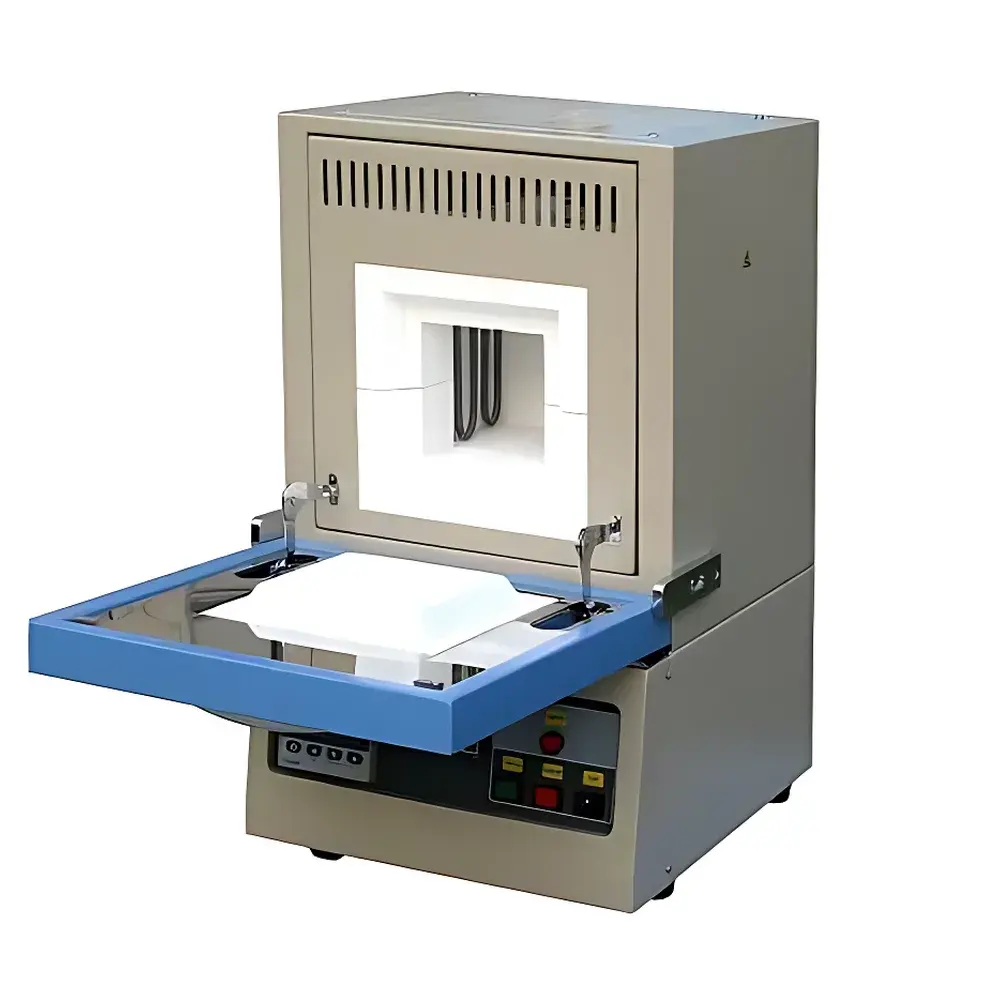
Hefei Kejing KSL-1800X-S Mini High-Temperature Box Furnace
| Brand | Hefei Kejing |
|---|---|
| Origin | Anhui, China |
| Model | KSL-1800X-S |
| Furnace Type | Box-type Muffle Furnace |
| Max Temperature | 1800 °C (≤2 h) |
| Continuous Operating Temperature | ≤1750 °C |
| Temperature Uniformity | ±1 °C |
| Max Power | 2.5 kW |
| Heating Rate to Max Temp | 10 °C/min |
| Heating Element | Kanthal Super-1900 MoSi₂ Rods |
| Internal Chamber Dimensions | 120 × 120 × 120 mm |
| Chamber Lining | Zirconia-Stabilized Alumina Fiber |
| Thermocouple Type | Type B Dual Platinum-Rhodium (Pt–30%Rh / Pt–6%Rh) |
| Control System | 30-Stage Programmable PID Controller |
| Power Supply | AC 220 V, 50 Hz |
| External Dimensions | 380 × 410 × 620 mm |
| Net Weight | 30 kg |
| Safety Certifications | CE, UL/MET/CSA (components >24 V), optional TÜV or CSA single-unit certification available upon request |
Overview
The Hefei Kejing KSL-1800X-S Mini High-Temperature Box Furnace is a compact, high-performance laboratory furnace engineered for precision thermal processing in materials science, ceramics, metallurgy, and advanced chemistry applications. Designed around a robust dual-shell housing and an optimized internal geometry, this furnace delivers exceptional thermal stability and energy efficiency without compromising maximum operating capability. Its core heating mechanism relies on Kanthal Super-1900 molybdenum disilicide (MoSi₂) heating elements—known for excellent oxidation resistance and long-term structural integrity at elevated temperatures—combined with a proprietary zirconia-stabilized alumina fiber chamber lining. This refractory architecture enables continuous operation up to 1750 °C and short-duration excursions to 1800 °C (≤2 hours), conforming to standard thermal cycling protocols used in sintering, annealing, ashing, and pre-oxidation studies. The furnace operates on a convection-free radiant heating principle, minimizing temperature gradients across the 120 × 120 × 120 mm usable chamber volume. A Type B dual platinum-rhodium thermocouple provides direct, high-fidelity temperature feedback to the 30-segment programmable PID controller, ensuring repeatable thermal profiles under both ambient and controlled-atmosphere conditions.
Key Features
- Compact footprint (380 × 410 × 620 mm) and lightweight design (30 kg) ideal for space-constrained labs or multi-furnace setups
- Downward-sliding door mechanism enabling rapid, ergonomic sample loading and unloading—critical for high-throughput thermal treatments
- Dual-layer insulated shell maintains external surface temperature below 60 °C during full-power operation, enhancing operator safety and reducing ambient heat load
- Integrated gas inlet/outlet ports (with removable plug) support inert (Ar, N₂), oxidizing (air, O₂), or reducing (H₂/N₂ mix) atmospheres—compatible with standard gas manifolds and mass flow controllers
- 30-stage programmable temperature ramp/soak profile capability with independent rate and dwell settings per segment
- MoSi₂ heating elements mounted in vertical orientation ensure uniform radial heat distribution and extended service life under cyclic thermal stress
- Zirconia-enhanced alumina fiber insulation offers low thermal conductivity (<0.15 W/m·K at 1000 °C) and minimal outgassing—suitable for ultra-high-purity processing
Sample Compatibility & Compliance
The KSL-1800X-S accommodates standard ceramic crucibles (Al₂O₃, ZrO₂, graphite), metal holders, and custom fixtures within its cubic chamber. It is not vacuum-rated and must not be operated with flammable, explosive, or highly corrosive gases (e.g., Cl₂, HF, NH₃, SO₂) unless pre-approved and modified with chemically resistant chamber coatings—a service available upon technical consultation. All electrical components rated above 24 V comply with UL 61010-1, MET Labs, and CSA C22.2 No. 61010-1 safety standards. CE marking confirms conformity with EU Machinery Directive 2006/42/EC and Electromagnetic Compatibility Directive 2014/30/EU. Optional third-party certification—including TÜV Rheinland (Germany) or CSA Group (Canada)—can be arranged for individual units to meet site-specific regulatory or audit requirements (e.g., GLP-compliant thermal validation).
Software & Data Management
While the furnace operates via standalone hardware-based control, its 30-segment programmable interface supports RS485 communication (Modbus RTU protocol) for integration into centralized lab automation systems. Users may log temperature setpoints, actual readings, and event timestamps using external data acquisition software compliant with FDA 21 CFR Part 11 (when paired with validated electronic signatures and audit trail modules). The controller retains all programmed profiles after power loss and supports manual override with password-protected access levels. Firmware updates are delivered via USB interface; version history and calibration logs are exportable for quality documentation purposes.
Applications
- Sintering of advanced ceramics (e.g., SiC, AlN, YSZ) and oxide-based battery cathode materials (NMC, LFP)
- High-temperature annealing of thin-film substrates and semiconductor precursors
- Thermal gravimetric analysis (TGA) pre-conditioning and residue quantification
- Oxidation kinetics studies of refractory metals and alloys under controlled O₂ partial pressures
- Heat treatment of dental and biomedical implant-grade zirconia blanks
- Calibration reference source for secondary temperature sensors operating above 1500 °C
FAQ
What is the recommended maximum heating and cooling rate for optimal element longevity?
We recommend limiting ramp rates to ≤10 °C/min for both heating and cooling cycles to minimize thermal shock on MoSi₂ rods and fiber insulation.
Can this furnace be used under vacuum conditions?
No—the KSL-1800X-S lacks vacuum sealing capability and is not rated for sub-atmospheric operation. Vacuum-compatible variants require reinforced flanges, metallic gaskets, and differential pressure monitoring.
Is the observed micro-cracking in the furnace chamber normal?
Yes—fine surface fissures in the zirconia-stabilized alumina fiber lining are inherent to thermal cycling and do not impair performance or safety. These can be sealed with commercially available alumina-based refractory coating if desired.
Are replacement heating elements and thermocouples supplied with traceable calibration certificates?
Standard spare parts ship with manufacturer’s conformity statements. NIST-traceable calibration certificates for Type B thermocouples are available as a value-added option at time of order.
Does the furnace support remote monitoring via Ethernet or Wi-Fi?
The base model features RS485 only. Ethernet/Wi-Fi connectivity requires an external industrial gateway configured per ISA-95 or OPC UA specifications—integration support is provided upon request.



