
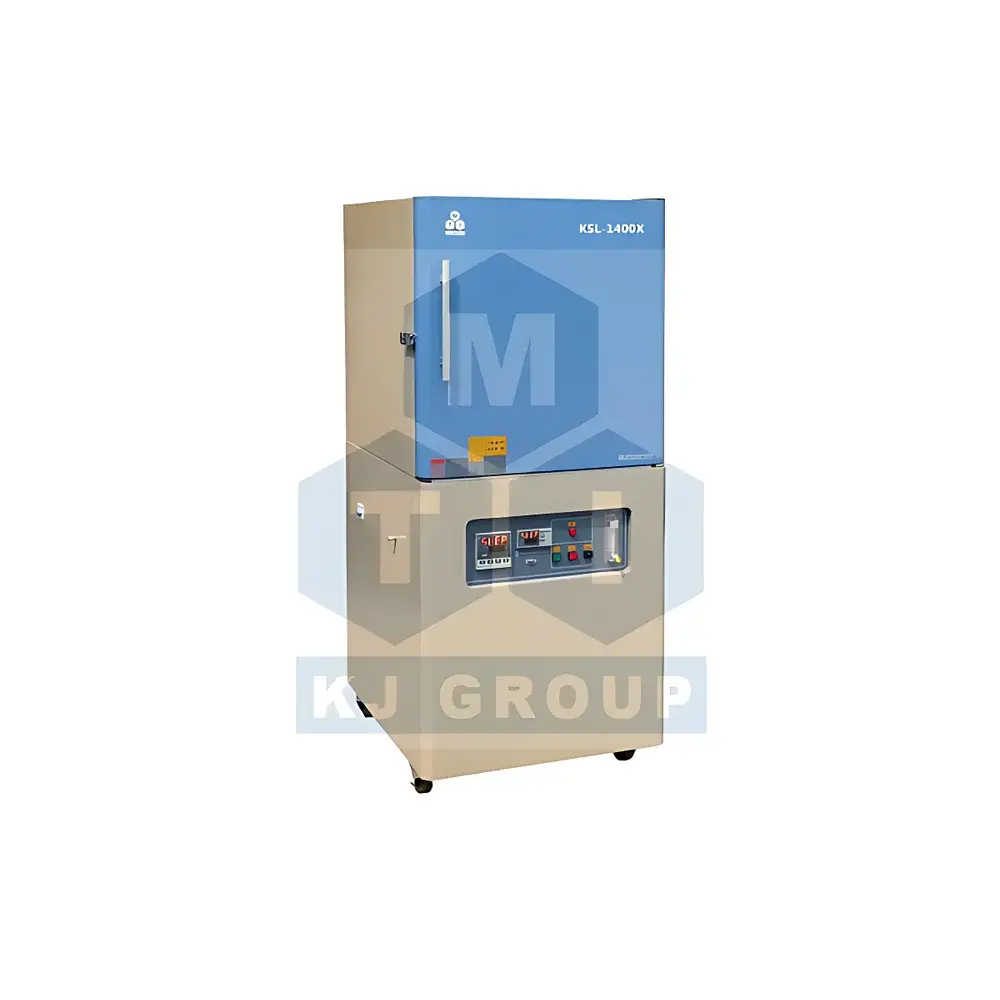
KSL-1400X-A4 High-Temperature Box Furnace (300 × 400 × 300 mm, 1400 °C)
| Brand | Hefei Kejing |
|---|---|
| Origin | Anhui, China |
| Model | KSL-1400X-A4 |
| Max Temperature | 1400 °C |
| Temperature Uniformity | ±1 °C |
| Max Power | 13 kW |
| Heating Rate (to max temp) | 10 °C/min |
| Internal Dimensions | 300 × 400 × 300 mm |
| Heating Element | Silicon Carbide Rods |
| Insulation | High-Purity Alumina Microfiber + US-Sourced 1750 °C Alumina Coating |
| Chamber Construction | Double-Wall Cooled Shell (Surface Temp < 60 °C) |
| Control System | PID-Based 30-Stage Programmable Controller |
| Power Supply | AC 220 V / 50 Hz |
| Net Weight | 140 kg |
| External Dimensions | 650 × 760 × 1550 mm |
| Certification | CE |
Overview
The KSL-1400X-A4 is a high-temperature laboratory box furnace engineered for precision thermal processing in materials science, ceramics, metallurgy, and advanced battery research. Operating on the principle of resistive heating via silicon carbide (SiC) rod elements, it delivers stable, uniform temperature distribution across its 300 × 400 × 300 mm alumina-fiber insulated chamber—capable of sustained operation up to 1400 °C. Its dual-shell structural design actively dissipates heat, ensuring external surface temperatures remain below 60 °C during full-load operation—a critical safety and energy-efficiency feature for shared lab environments. The furnace chamber is lined with high-purity α-alumina microcrystalline fiber insulation and coated with a proprietary, US-sourced alumina-based refractory layer rated to 1750 °C. This coating enhances infrared reflectivity, reduces thermal lag, and significantly extends service life by minimizing fiber degradation and particulate shedding. Unlike vacuum or inert-atmosphere tube furnaces, the KSL-1400X-A4 is designed for ambient-air or controlled-gas (non-flammable, non-corrosive) environments—making it ideal for sintering, ashing, calcination, annealing, and pre-oxidation protocols where atmospheric compatibility is required.
Key Features
- High-stability silicon carbide heating elements offering long-term resistance to thermal cycling and oxidation at temperatures up to 1400 °C
- 30-stage programmable PID temperature controller with ramp-soak capability, enabling reproducible multi-step thermal profiles for process development and GLP-compliant experiments
- Double-walled, air-cooled outer shell construction with integrated thermal shielding—meets IEC 61000-3-2 harmonic emission limits and ensures operator safety per EN 61000-6-3
- Alumina microfiber insulation (≥99.7% Al₂O₃) with high emissivity suppression and low thermal conductivity (< 0.08 W/m·K at 1000 °C)
- Side-opening door with ceramic fiber gasket and mechanical latch—designed for rapid sample loading while maintaining thermal integrity during repeated access
- Integrated Type S thermocouple (included) with cold-junction compensation and real-time digital display; optional calibration traceability to NIST standards available upon request
Sample Compatibility & Compliance
The KSL-1400X-A4 accommodates standard crucibles—including alumina, quartz, and silicon nitride—as well as custom fixtures up to 280 × 380 × 280 mm in footprint. It complies with CE marking requirements under the EU Machinery Directive 2006/42/EC and Low Voltage Directive 2014/35/EU. While not rated for vacuum or explosive atmospheres (per ATEX or IECEx), it supports continuous flow of inert gases (e.g., N₂, Ar) or weakly oxidizing mixtures when used with optional gas inlet/outlet ports. For applications involving halogenated or strongly acidic/corrosive gases (e.g., Cl₂, HF, NH₃, SOₓ), prior consultation is required; specialized alumina-zirconia composite linings or quartz-lined variants can be factory-installed. Note: Cracking of the internal coating after extended thermal cycling is a known, non-critical phenomenon consistent with ASTM C1475 and ISO 22454 guidelines for refractory coatings—it does not impair performance and may be refurbished using certified alumina slurry.
Software & Data Management
The standard controller includes RS485 Modbus RTU interface for integration into centralized lab automation systems. Optional PC-based software (Kejing FurnaceControl Pro v3.2) enables remote monitoring, data logging at ≤1 s intervals, alarm event tagging, and export to CSV/Excel formats compliant with 21 CFR Part 11 audit trail requirements. All temperature profiles are timestamped and stored with user ID, setpoint history, and deviation alerts—supporting ISO/IEC 17025 accreditation workflows. Firmware updates are delivered via secure HTTPS portal with SHA-256 signature verification.
Applications
- Sintering of oxide ceramics (Al₂O₃, ZrO₂, YSZ), ferrites, and solid-state electrolytes for solid oxide fuel cells (SOFCs)
- Thermal treatment of cathode/anode materials (e.g., LiCoO₂, NMC, Si/C composites) in battery R&D
- Ashing of biological, polymer, or environmental samples per EPA Method 3050B and ASTM D5630
- Calcination of metal-organic frameworks (MOFs) and precatalysts under controlled oxygen partial pressure
- Heat treatment of dental alloys, investment casting molds, and refractory tooling inserts
- Pre-oxidation of titanium alloys and Ni-based superalloys prior to hot isostatic pressing (HIP)
FAQ
Is this furnace suitable for vacuum or hydrogen atmosphere operation?
No. The KSL-1400X-A4 lacks vacuum-tight sealing and is not rated for flammable or reducing atmospheres. Hydrogen, syngas, or vacuum use requires a dedicated tube furnace with appropriate safety interlocks.
Can I achieve ±0.5 °C temperature stability at 1300 °C?
The specified control accuracy is ±1 °C over the full range. Achieving tighter stability requires optional high-resolution thermocouples, active chamber zoning, and third-party validation per ISO 9001 Clause 7.1.5.
What maintenance is required for the heating elements?
Silicon carbide rods degrade gradually above 1350 °C. Annual visual inspection and resistance testing are recommended. Replacement kits include matched-element pairs to preserve thermal symmetry.
Does the furnace support GLP/GMP documentation?
Yes—when paired with the optional software package, it provides electronic records, user access logs, and change history required for FDA-regulated laboratories conducting method validation or stability studies.
How should I handle minor cracks in the internal coating?
Surface microcracking is expected after >200 cycles above 1200 °C and does not affect performance. Refurbishment with KEJING-certified alumina repair paste restores emissivity and is documented in the maintenance log per ISO/IEC 17025 Section 6.4.



