
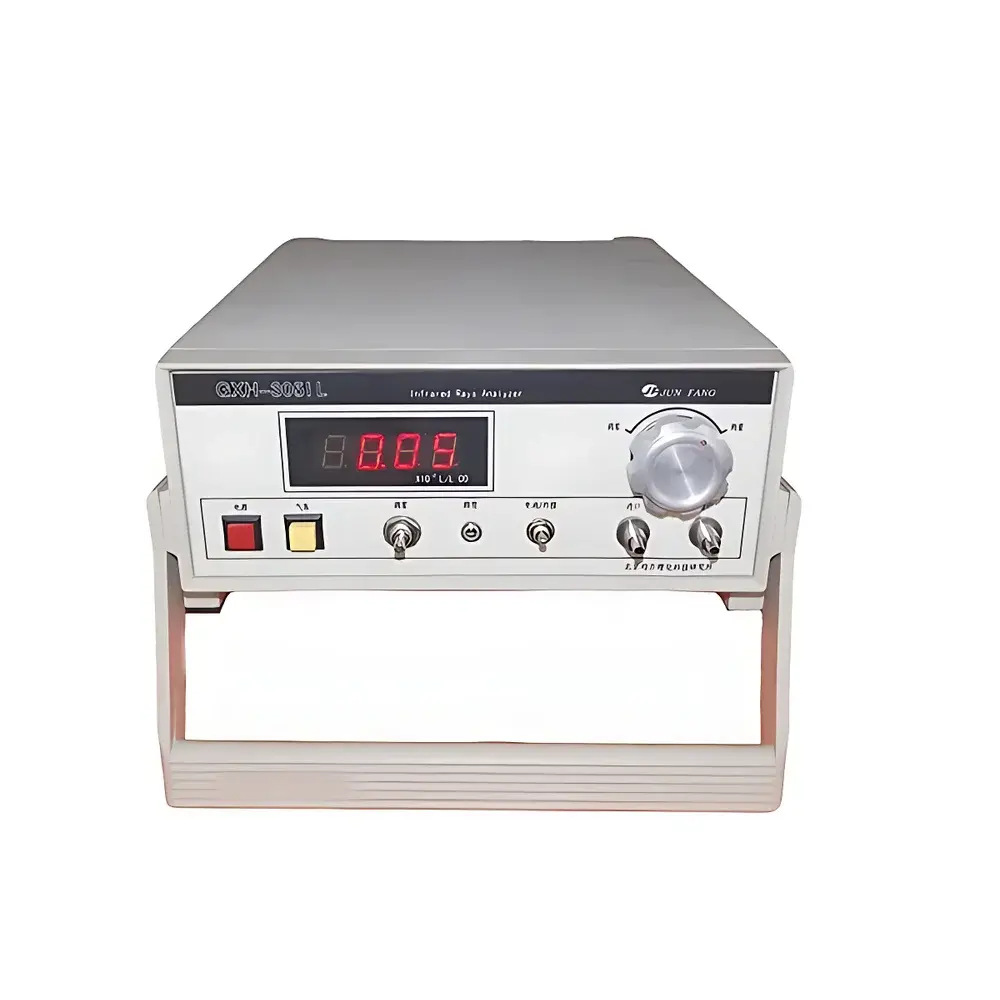
GXH-3051L Portable Carbon Monoxide (CO) Analyzer by Junfang Lihua
| Brand | Junfang Lihua |
|---|---|
| Origin | Beijing, China |
| Model | GXH-3051L |
| Instrument Type | Portable |
| Detection Target | Single-component CO |
| Measurement Range | 0–50 ppm |
| Repeatability | ±1% F.S. |
| Resolution | 0.1 ppm |
| Response Time | ≤15 s |
| Zero Drift | ≤±1% F.S./24 h |
| Span Drift | ≤±1% F.S./24 h |
| Linearity Error | ≤±2% F.S. |
Overview
The GXH-3051L Portable Carbon Monoxide (CO) Analyzer is an engineered field-deployable instrument designed for quantitative measurement of carbon monoxide concentration in ambient air, indoor environments, exhaust streams, and occupational safety zones. It operates on the principle of non-dispersive infrared (NDIR) spectroscopy—exploiting the characteristic absorption band of CO near 4.6 µm. This optical method ensures selective detection with minimal cross-sensitivity to common interferents such as CO₂, CH₄, NO, and water vapor, provided humidity compensation is applied per manufacturer guidelines. The analyzer integrates a thermoelectrically stabilized infrared source, dual-wavelength detector architecture (measurement/reference channel), and temperature-compensated signal processing to maintain metrological integrity under variable environmental conditions. Its compact, handheld form factor (dimensions: 220 × 110 × 65 mm; weight: <0.8 kg) supports battery-powered operation (rechargeable Li-ion, ≥8 h continuous use) and direct DC input (12 V), enabling extended deployment without grid dependency.
Key Features
- NDIR-based detection optimized for CO at 4.6 µm—no consumables, no chemical reagents, zero calibration gas dependency for routine operation
- High-resolution digital readout with 0.1 ppm resolution across the full 0–50 ppm range
- Fast response dynamics: T₉₀ ≤15 seconds from ambient to target concentration, validated per ISO 12039 Annex C protocols
- Thermal and electronic drift control: zero and span drift ≤±1% F.S. over 24 hours at 23 °C ±2 °C and 40–60% RH
- Integrated sampling probe (stainless steel, 0.8 m length) with particulate filter and hydrophobic membrane—suitable for duct, stack, and open-area sampling
- Onboard data logging (≥2,000 records) with time-stamped CO values, ambient temperature, and battery status
- Ruggedized ABS housing rated IP54 for dust and splash resistance—designed for field use in municipal, industrial, and emergency response settings
Sample Compatibility & Compliance
The GXH-3051L is validated for gaseous samples with particulate load <1 mg/m³ and dew point <5 °C. It meets the performance criteria outlined in GB/T 18204.2–2014 (Chinese Standard for Determination of CO in Ambient Air—NDIR Method) and aligns with technical requirements referenced in ISO 4037-3 (radiation protection instrumentation) for portable gas monitors. While not certified for intrinsic safety (e.g., ATEX/IECEx), its low-power design (<2.5 W average) and absence of ignition sources permit use in non-hazardous classified areas per NEC Class I, Division 2 guidelines. For regulatory reporting in China, the device supports traceability via factory calibration certificate (NIST-traceable reference gas, 10 ppm CO in N₂) and user-accessible calibration verification mode.
Software & Data Management
Data export is supported via USB-C interface using vendor-provided PC software (Windows 10/11 compatible). The application enables configuration of alarm thresholds (programmable high/low limits), calibration history review, and CSV-formatted report generation compliant with GLP documentation standards. Audit trail functionality logs all parameter changes, zero/span calibrations, and firmware updates—including operator ID, timestamp, and action type—to satisfy basic 21 CFR Part 11 readiness requirements for non-GMP field applications. Firmware updates are delivered via signed binary packages with SHA-256 checksum validation.
Applications
- Ambient air quality monitoring by municipal EPB (Environmental Protection Bureaus) and CDC laboratories
- Indoor air quality assessment in schools, hospitals, and residential buildings per GB 50325–2020
- Combustion efficiency evaluation and flue gas screening during HVAC commissioning
- Workplace exposure monitoring in garages, boiler rooms, and tunnel maintenance operations
- Emergency response triage for suspected CO poisoning incidents—used by fire departments and public health rapid-response units
- Field validation of fixed-site CO sensor networks and data reconciliation studies
FAQ
What calibration gases are required for routine verification?
A single-point verification gas (10 ppm CO in N₂, certified to ISO 6141) is recommended quarterly; zero air (hydrocarbon-free, <0.1 ppm CO) is used for zero check before each measurement session.
Can the instrument measure CO in high-humidity environments?
Yes—integrated humidity compensation corrects for spectral interference up to 90% RH; however, condensation must be prevented via heated sampling line or inline desiccant for sustained operation above 80% RH.
Is the GXH-3051L suitable for compliance reporting under Chinese environmental regulations?
It satisfies the instrumental requirements of GB/T 18204.2–2014 and is widely accepted for routine surveillance; formal accreditation (CMA) requires lab-specific validation per CNAS-CL01:2018.
How is measurement traceability maintained?
Each unit ships with a calibration certificate referencing NIST-traceable standard gases; users may perform field recalibration using optional external calibration kit (model CK-GXH3051L) with documented procedure.
Does the device support analog output or Modbus communication?
No—data transmission is exclusively via USB-C; no 4–20 mA or RS-485 interface is integrated. External data loggers require manual CSV import.
Related Products







