
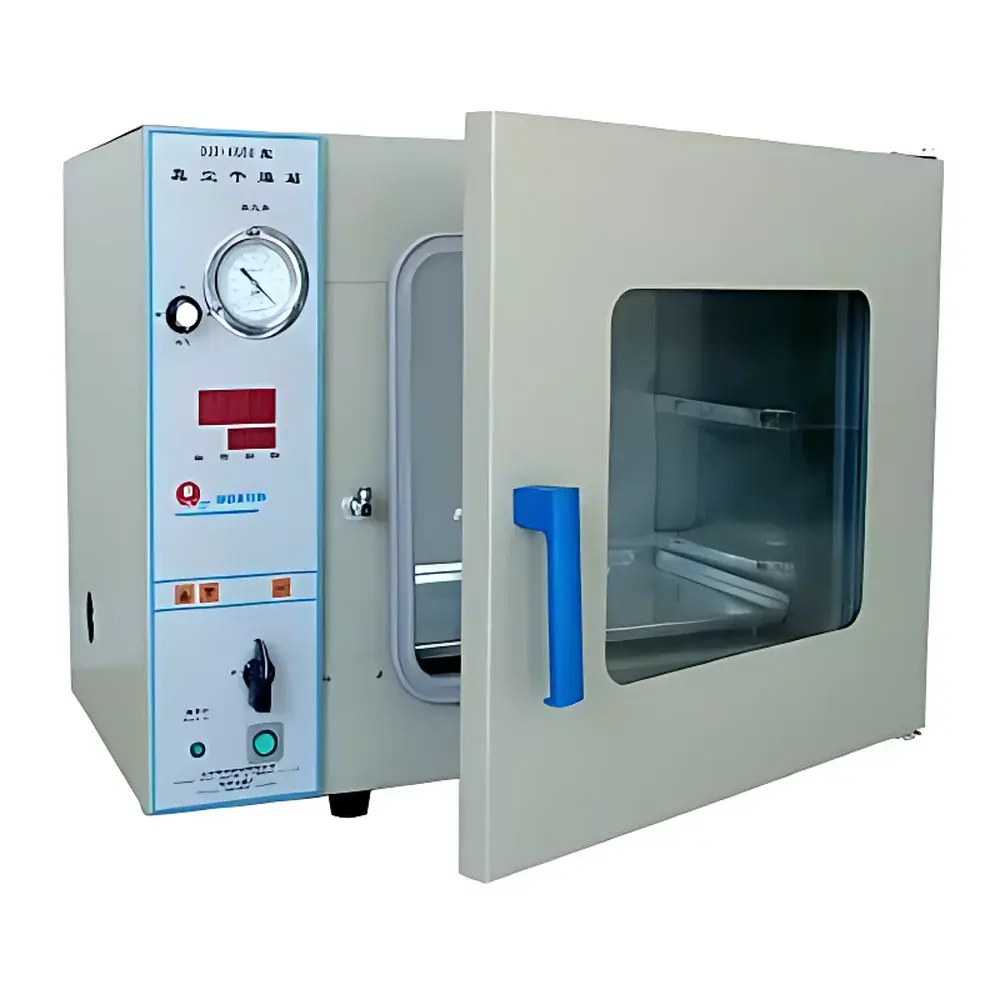
Brookfield DZF-6050MBE Vacuum Drying Oven
| Key | Origin: Beijing, China |
|---|---|
| Manufacturer Type | Authorized Distributor |
| Product Origin | Domestic (PRC) |
| Model | DZF-6050MBE |
| Price | Upon Request |
| Power Supply | AC 220 V ±10%, 50 Hz ±2% |
| Input Power | 1300 W |
| Temperature Range | Ambient +5 °C to 250 °C |
| Temperature Resolution | 1 °C |
| Temperature Uniformity | ±0.5 °C |
| Ultimate Vacuum | 133 Pa |
| Chamber Volume | 50 L |
| Interior Dimensions (W×D×H) | 400 × 400 × 350 mm |
| Exterior Dimensions (W×D×H) | 710 × 510 × 550 mm |
| Shelving | 2 stainless steel trays |
| Timer Range | 0–999 min |
Overview
The Brookfield DZF-6050MBE Vacuum Drying Oven is an engineered solution for precise, low-temperature moisture removal under controlled reduced-pressure conditions. Based on the fundamental principle of vapor pressure depression—where boiling points of solvents and volatile components decrease significantly under sub-atmospheric pressure—the DZF-6050MBE enables gentle, residue-free drying of thermolabile, oxidation-prone, or structurally complex samples without thermal degradation. Unlike forced-air convection ovens, this system operates in a sealed vacuum chamber where heat transfer occurs primarily via conduction, eliminating convective turbulence that may displace powders or compromise fragile specimens. Its design conforms to core laboratory requirements for reproducible drying protocols in regulated environments, supporting method development aligned with ISO 5725 (accuracy and precision), ASTM E145 (standard specification for gravity-convection and forced-ventilation ovens), and general GLP documentation practices.
Key Features
- Microprocessor-based temperature control system with dual high-brightness LED displays for simultaneous setpoint and real-time chamber temperature monitoring
- Intelligent power recovery function: automatically resumes pre-interruption settings—including temperature setpoint, timer status, and vacuum hold state—after power failure or system reset
- Chamber constructed from high-grade 304 stainless steel with seamless semi-circular corners for optimal cleanability and corrosion resistance
- Reinforced double-layer tempered glass door with integrated anti-explosion film, enabling full visual observation without compromising vacuum integrity
- Customizable silicone rubber door seal with multi-point tension adjustment, ensuring consistent leak-tight performance down to 133 Pa
- Ergonomic streamlined cabinet design fabricated from cold-rolled steel with electrostatic epoxy powder coating for mechanical durability and chemical resistance
- Two removable, load-rated stainless steel shelves included as standard; shelf positions are fixed to maintain uniform thermal distribution
Sample Compatibility & Compliance
The DZF-6050MBE accommodates diverse sample formats including lyophilized biological matrices, ceramic precursors, polymer composites, pharmaceutical granules, environmental soil extracts, and microfluidic device assemblies. Its inert vacuum environment mitigates oxidative decomposition pathways, making it suitable for handling metal-organic frameworks (MOFs), perovskite thin films, and redox-sensitive catalysts. The unit meets structural and operational benchmarks referenced in USP (Sterility of Pharmaceutical Products), ISO 14644-1 (cleanroom classification support), and ICH Q5C (stability testing of biotechnological products). While not certified for Class II biosafety or explosion-proof operation, its vacuum-sealed architecture inherently suppresses combustion risk during solvent removal—consistent with OSHA 1910.1200 (Hazard Communication Standard) guidance for low-flashpoint material handling.
Software & Data Management
This model operates as a standalone instrument with embedded firmware—no external PC interface or proprietary software required. All operational parameters (set temperature, dwell time, vacuum activation sequence) are stored in non-volatile memory with timestamped event logging capability. The system supports manual audit trail reconstruction via front-panel display history (last 20 cycles), satisfying basic FDA 21 CFR Part 11 readiness for laboratories implementing paper-based or hybrid electronic record systems. Optional RS-232 or USB data export modules (sold separately) enable integration into centralized LIMS platforms for automated report generation and long-term trend analysis of drying efficiency metrics.
Applications
- Routine dehydration of enzyme preparations, monoclonal antibodies, and plasmid DNA stocks prior to cold storage
- Residual solvent removal from API intermediates under GMP-aligned process validation protocols
- Post-cleaning drying of precision machined components, filtration membranes, and chromatographic columns
- Moisture conditioning studies for packaging material permeability assessment (ASTM F1249)
- Thermal stabilization of nanomaterial dispersions before TEM grid preparation
- Pre-analytical treatment of forensic evidence swabs and clinical tissue sections to prevent enzymatic autolysis
FAQ
What vacuum level does the DZF-6050MBE achieve, and how is it measured?
The chamber reaches a base pressure of ≤133 Pa (1 Torr), verified using an integrated analog vacuum gauge calibrated against NIST-traceable reference standards.
Can the oven be used for sterilization or depyrogenation?
No—it is not designed or validated for microbial kill or endotoxin inactivation; users requiring such functionality should consider dedicated steam autoclaves or dry-heat depyrogenation tunnels compliant with ISO 17665 or USP .
Is over-temperature protection hardware-based or software-controlled?
A redundant independent bimetallic cut-off switch is installed in series with the main heating circuit, providing fail-safe thermal shutdown at 270 °C regardless of controller status.
How frequently should the vacuum seal be inspected or replaced?
Under normal use (≤5 cycles/week), visual inspection every 6 months is recommended; replacement intervals average 24–36 months depending on ambient humidity and cleaning agent exposure.
Does the unit support nitrogen purging or inert gas backfilling?
Yes—optional inlet/outlet ports (M8 threaded) can be configured for controlled inert gas introduction prior to venting, minimizing post-drying rehydration or oxidation.



