
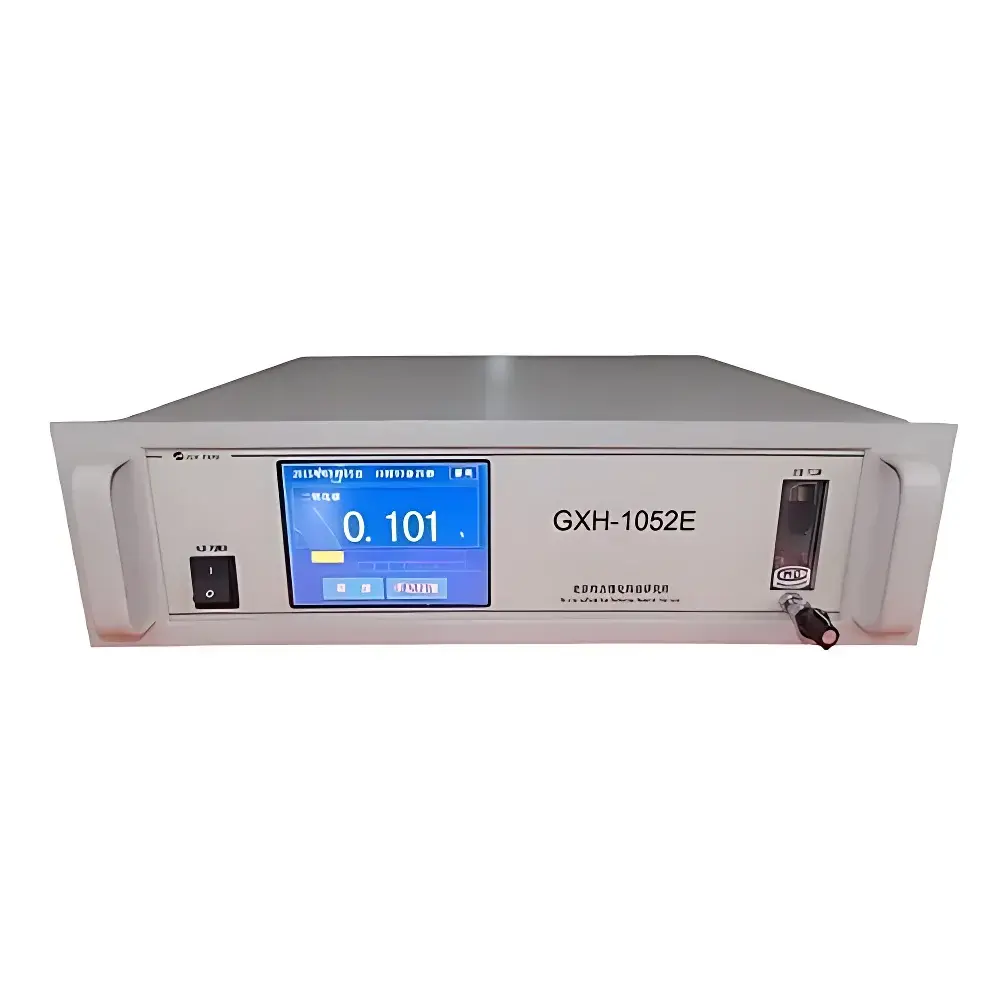
Junfang Lihua GXH-1052E Intelligent Infrared Carbon Dioxide (CO₂) Gas Analyzer
| Brand | Junfang Lihua |
|---|---|
| Model | GXH-1052E |
| Origin | Beijing, China |
| Instrument Type | Online Fixed-Mount Analyzer |
| Detection Principle | Non-Dispersive Infrared (NDIR) Absorption |
| Measured Gas | CO₂ (Single-Component) |
| Range | 0–500 ppm (standard) |
| Resolution | 0.1 ppm |
| Repeatability | ≤1% FS |
| Linearity Error | ≤±1% FS/24h |
| Zero Drift | ≤±2% FS/24h |
| Span Drift | ≤±2% FS/24h |
| Response Time (T₉₀) | ≤60 s |
| Power Supply | AC 220 V ±10%, 50 Hz ±5% |
| Output Signals | 4–20 mA analog + RS232 digital interface |
| Operating Humidity | ≤90% RH (non-condensing) |
| Warm-up Time | ≤60 min |
| Internal Sampling Pump | Integrated |
| Display | Backlit LCD with touch interface |
| Data Logging | Onboard memory + PC software export |
Overview
The Junfang Lihua GXH-1052E Intelligent Infrared Carbon Dioxide (CO₂) Gas Analyzer is an online, fixed-mount process analytical instrument engineered for continuous, real-time quantification of carbon dioxide concentration in gaseous streams. It operates on the principle of non-dispersive infrared (NDIR) absorption spectroscopy—exploiting the characteristic vibrational absorption band of CO₂ near 4.26 µm. This optical method delivers high selectivity against common interferents (e.g., CO, CH₄, H₂O vapor, and hydrocarbons), owing to spectral filtering and temperature-stabilized detector architecture. Designed for unattended operation in ambient, industrial, and laboratory environments, the GXH-1052E integrates a built-in sampling pump, thermostatically controlled optical path, and embedded signal processing to ensure measurement stability under variable pressure and humidity conditions. Its compliance with GB/T 15470–2002 (Chinese national standard for NDIR gas analyzers) and alignment with ISO 12039:2000 (determination of CO₂ in flue gases) support its use in regulatory monitoring, emissions verification, and process control applications where trace- to percent-level CO₂ detection is required.
Key Features
- NDIR optical module with dual-wavelength reference compensation to minimize drift from dust accumulation or window fouling
- Integrated sampling pump with adjustable flow rate (0.5–2.0 L/min) and particulate filter for direct duct or stack insertion
- Microprocessor-controlled internal temperature regulation (±0.1 °C stability) maintaining optical path integrity across ambient temperatures from 5–40 °C
- High-resolution 0.1 ppm detection limit within the 0–500 ppm range; extended ranges (e.g., 0–100% vol) available via optical path length customization
- Touch-enabled backlit LCD display supporting real-time concentration readout, calibration history, alarm status, and system diagnostics
- Dual-output architecture: isolated 4–20 mA analog output (HART-compatible) and RS232 serial interface for Modbus RTU or ASCII protocol communication
- Onboard data logger (up to 32,000 timestamped records) with automatic overwrite policy and USB/RS232 export capability
- Self-diagnostic routines including lamp intensity monitoring, detector responsivity check, and zero/span validation flagging
Sample Compatibility & Compliance
The GXH-1052E is validated for continuous analysis of CO₂ in clean to moderately dusty gas matrices—including ambient air, combustion flue gas, biogas streams, soil respiration effluents, and controlled-environment chamber exhausts. It is not intended for corrosive, condensing, or high-particulate streams without external conditioning (e.g., heated sample line, Teflon-coated filter, or Nafion dryer). The analyzer meets electromagnetic compatibility (EMC) requirements per GB/T 18268.1–2010 (equivalent to IEC 61326-1) and safety standards per GB 4793.1–2007 (IEC 61010-1). While not certified for SIL or ATEX zones, its robust enclosure (IP54-rated front panel) supports deployment in indoor industrial settings compliant with ISO 17025-accredited laboratories performing environmental gas testing.
Software & Data Management
A Windows-based configuration and data management software suite is supplied with each unit. The application enables remote parameter setup (zero/span calibration points, alarm thresholds, averaging time), firmware updates, and secure data retrieval—including raw sensor voltage, compensated concentration values, and diagnostic flags. All calibration events are time-stamped and logged with operator ID input, supporting audit trails required under GLP and ISO/IEC 17025 quality systems. Export formats include CSV and Excel-compatible .xlsx; data can be synchronized with SCADA or LIMS platforms via OPC UA or Modbus TCP gateways (external adapter required). No cloud connectivity or proprietary subscription services are embedded—ensuring full data sovereignty and long-term archival compliance.
Applications
- Continuous emissions monitoring (CEM) of CO₂ from coal-fired boilers, cement kilns, and waste incinerators per China’s HJ 75–2017 technical specification
- Indoor air quality (IAQ) assessment in schools, hospitals, and office buildings per GB/T 18883–2002
- Soil carbon flux studies using closed-chamber methodology with automated sequential sampling
- Bioreactor off-gas analysis for fermentation process optimization in pharmaceutical and biofuel production
- Greenhouse and growth chamber CO₂ enrichment control with feedback-loop integration
- Calibration verification of portable CO₂ meters using stable reference gas cylinders (NIST-traceable)
FAQ
What calibration gases are recommended for routine zero and span verification?
Zero calibration requires certified nitrogen (N₂ ≥99.999%) or synthetic air; span calibration requires CO₂-in-N₂ standard gas at 200 ppm or 500 ppm (certified to ISO 6141), with uncertainty ≤1% relative.
Can the GXH-1052E operate continuously without manual intervention?
Yes—the instrument supports unattended 24/7 operation with auto-zero functionality (optional interval-based zero cycle) and configurable alarm outputs for maintenance alerts (e.g., low lamp intensity, filter clogging).
Is the RS232 interface compatible with standard LabVIEW or Python serial libraries?
Yes—ASCII command protocol documentation is provided, supporting direct integration with Python (pySerial), MATLAB Serial Port Toolbox, or LabVIEW VISA drivers without proprietary drivers.
How does the analyzer handle water vapor interference in humid samples?
The optical design incorporates a narrow-band IR filter centered at 4.26 µm and a thermoelectrically cooled detector to suppress H₂O spectral overlap; for >90% RH applications, external chilled mirror or permeation dryer is advised.
What is the expected service life of the infrared source and detector?
The dual-beam NDIR module is rated for ≥5 years of continuous operation under specified ambient conditions; mean time between failures (MTBF) exceeds 15,000 hours per IEC 61508 reliability modeling.







