
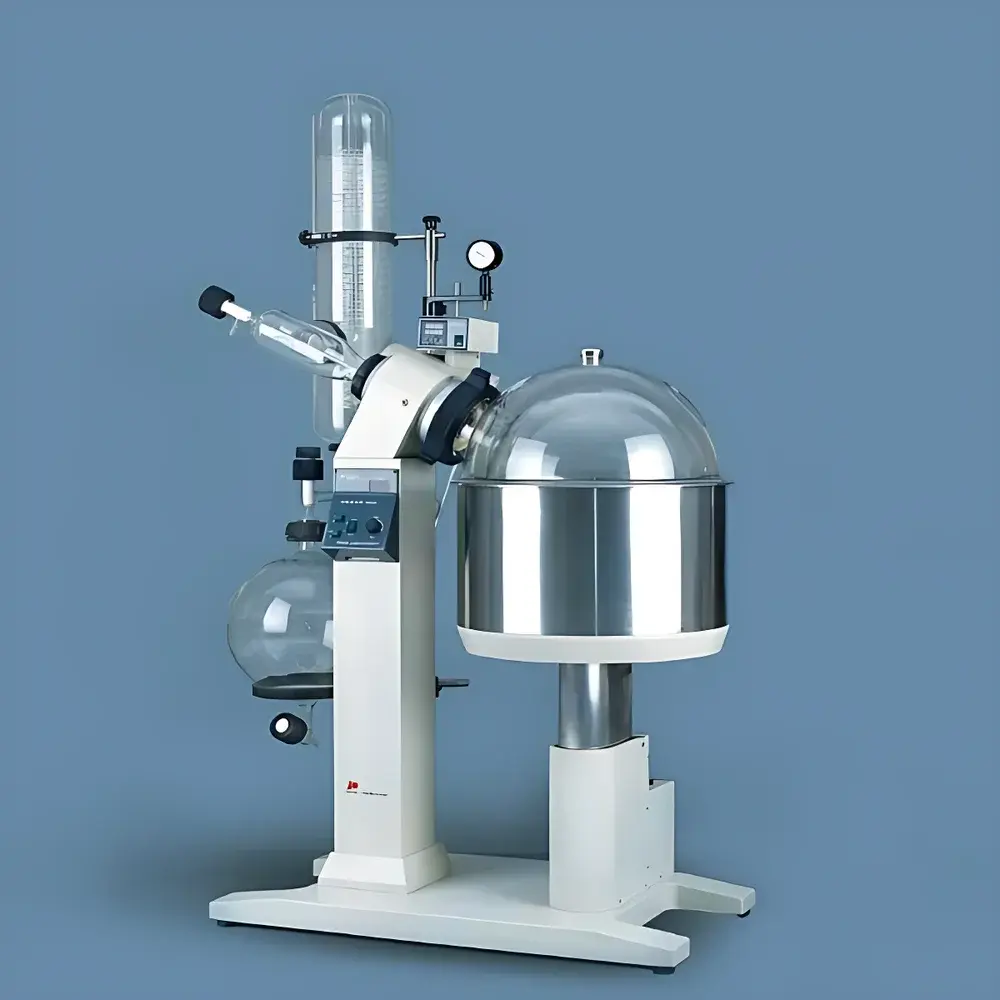
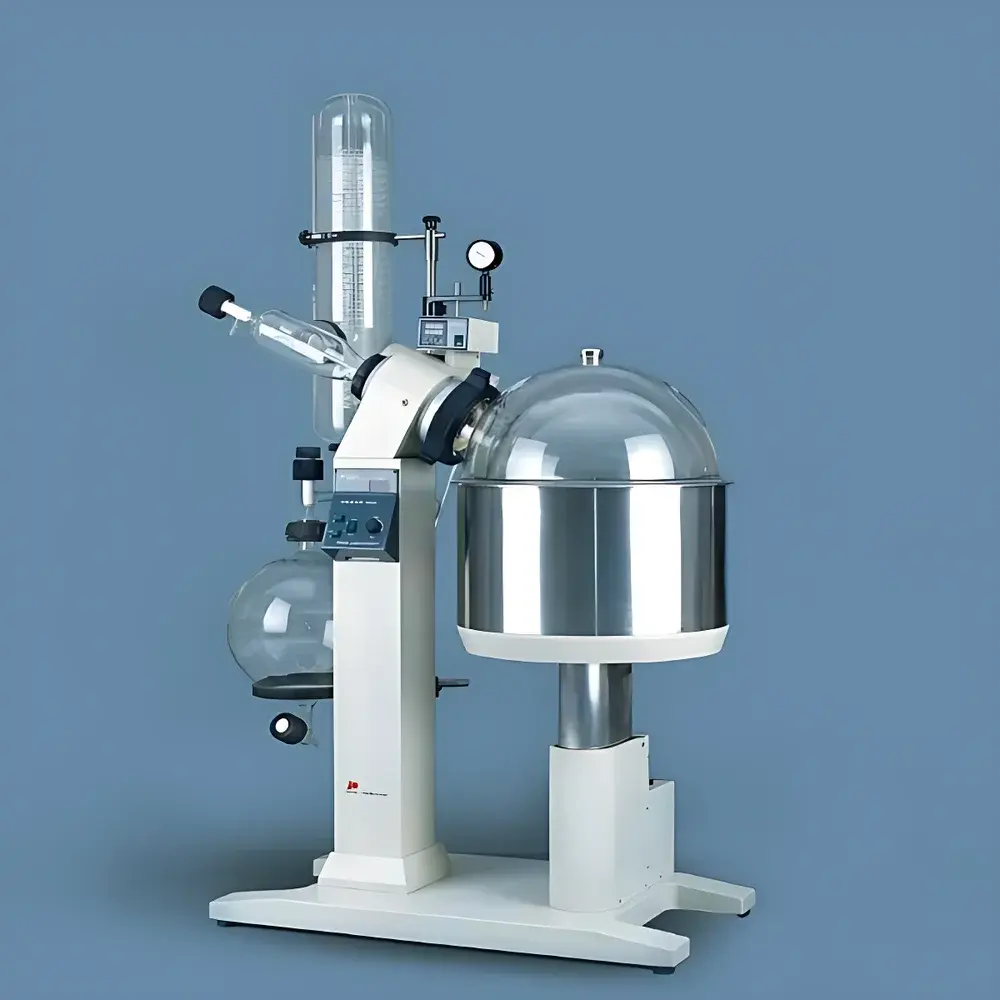
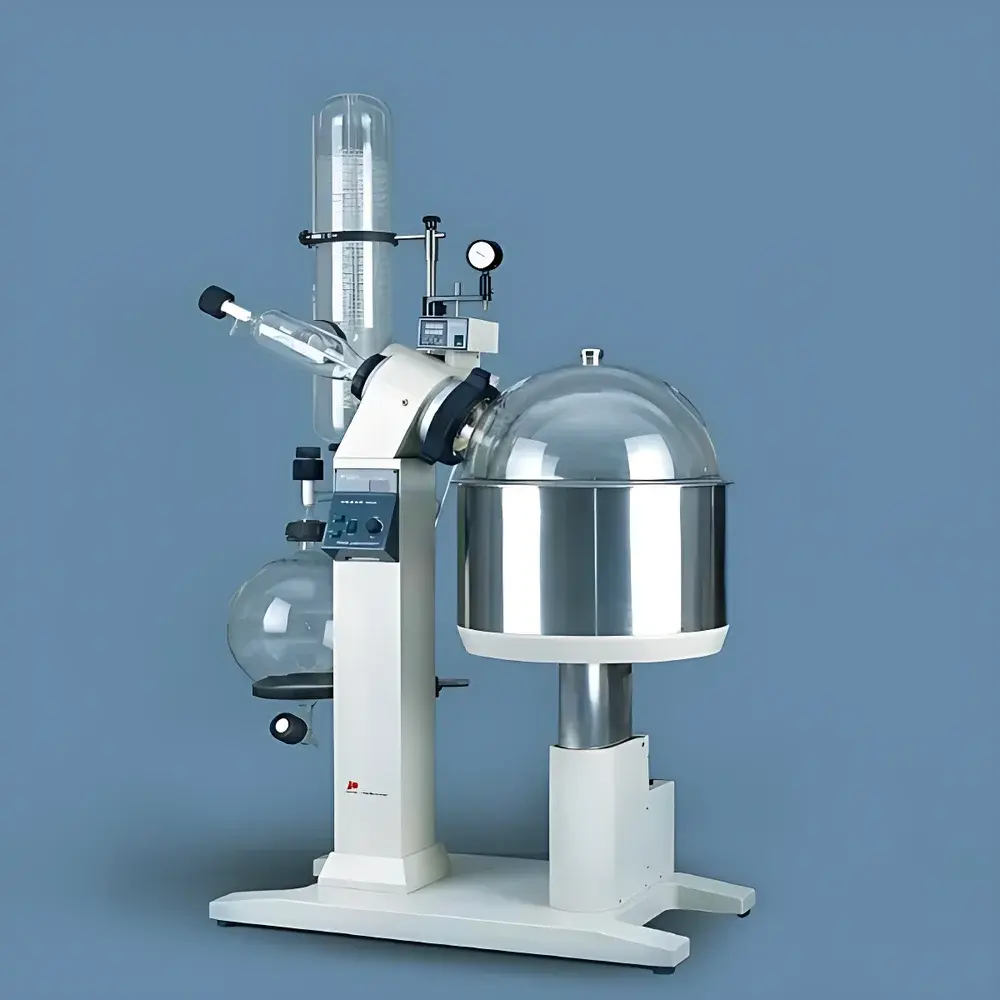
Shanghai Yarong RE-5220 Rotary Evaporator
| Brand | Shanghai Yarong / Yarong |
|---|---|
| Origin | Shanghai, China |
| Manufacturer Type | General Distributor |
| Region Category | Domestic (China) |
| Model | RE-5220 |
| Quotation | Upon Request |
| Rotating Flask Capacity | 20 L |
| Flask Flange Diameter | Ø125 mm |
| Rotation Speed Range | 0–120 rpm (digital display) |
| Heating Bath | One-piece pressed stainless steel water bath |
| Temperature Control | Digital PID controller, range: ambient to 99 °C ±1 °C |
| Condenser Type | Vertical triple-loop reflux condenser |
| Collection Flask Capacity | 10 L |
| Motor | Single-phase AC induction motor, 220 V / 50 Hz, 125 W |
| Total Power Consumption | 4625 W |
| Lift Stroke | 0–190 mm (motorized vertical lift) |
| Dimensions (L×W×H) | 850 × 520 × 1600 mm |
| Net Weight | 130 kg |
| Construction Materials | Anodized aluminum alloy frame, 304 stainless steel bath, PTFE-sealed joints |
Overview
The Shanghai Yarong RE-5220 Rotary Evaporator is an industrial-grade, floor-standing vacuum distillation system engineered for high-throughput solvent removal, concentration, and recovery in research laboratories, pilot-scale production, and quality control environments. It operates on the fundamental principle of rotary evaporation: simultaneous rotation of a sample-containing flask under reduced pressure while immersed in a precisely controlled water bath. This configuration lowers the boiling point of solvents, accelerates vaporization kinetics, and enhances heat transfer efficiency via dynamic film formation on the inner flask surface. The RE-5220 is specifically designed for applications requiring large-volume processing—its 20 L rotating flask and 10 L collection vessel support batch handling beyond typical benchtop systems, making it suitable for extraction workflows in phytochemistry, pharmaceutical intermediate purification, polymer solution processing, and environmental sample preparation.
Key Features
- High-capacity 20 L rotating flask with Ø125 mm standard taper ground-glass joint, enabling rapid mass transfer and uniform thin-film formation during rotation.
- Digital PID temperature controller with ±1 °C accuracy across 0–99 °C range; integrated into a one-piece deep-drawn 304 stainless steel water bath for corrosion resistance and thermal stability.
- Motorized vertical lift mechanism offering 190 mm travel range with smooth, repeatable positioning—critical for safe flask immersion/extraction under vacuum and for process reproducibility.
- Vertical triple-loop reflux condenser constructed from borosilicate glass and high-efficiency coolant channels, achieving >95% condensation efficiency for low-boiling solvents including acetone, ethanol, ethyl acetate, and dichloromethane.
- PTFE-coated sealing components and vacuum-tight ground-glass joints conforming to ISO 3585 specifications, ensuring long-term chemical compatibility with acidic, basic, and halogenated media.
- Robust structural architecture combining anodized aluminum alloy support frames and reinforced stainless steel load-bearing elements, rated for continuous operation at full load (130 kg total mass).
Sample Compatibility & Compliance
The RE-5220 accommodates a broad spectrum of thermally sensitive and volatile organic/inorganic solutions, including but not limited to plant extracts, API suspensions, catalyst slurries, polymer melts (dilute), and wastewater concentrates. Its design adheres to general laboratory safety standards per IEC 61010-1 (Electrical Safety for Laboratory Equipment) and incorporates mechanical interlocks to prevent accidental flask detachment during rotation. While not certified to specific GMP or FDA 21 CFR Part 11 requirements out-of-the-box, the system supports integration into compliant workflows when paired with validated SOPs, calibrated temperature sensors (traceable to NIST standards), and documented maintenance logs—common practice in GLP-regulated academic and contract research organizations.
Software & Data Management
The RE-5220 operates as a standalone analog-digital hybrid instrument: temperature setpoint and rotation speed are adjusted via front-panel membrane switches with real-time LED digital readouts. No embedded software or data logging capability is included; however, external PT100 probes and programmable logic controllers (PLCs) can be interfaced via 0–10 V analog outputs (optional retrofit). For audit-ready environments, users commonly integrate the unit into centralized Lab Information Management Systems (LIMS) using third-party data acquisition modules that record bath temperature, rotation rate, and operational timestamps—supporting traceability per ISO/IEC 17025 and internal QA protocols.
Applications
- Concentration of natural product extracts (e.g., alkaloids, flavonoids) from aqueous or alcoholic macerates without thermal degradation.
- Recovery and recycling of high-purity solvents in synthetic chemistry workflows—reducing waste disposal costs and improving EHS metrics.
- Drying of heat-labile biopolymers such as hyaluronic acid or chitosan derivatives prior to lyophilization or formulation.
- Removal of residual solvents from active pharmaceutical ingredients (APIs) in compliance with ICH Q3C guidelines.
- Pre-concentration of environmental water samples (e.g., PFAS, pesticides) prior to GC-MS or LC-MS/MS analysis.
- Pilot-scale distillation of fragrance oils and essential oil fractions under controlled vacuum profiles.
FAQ
What vacuum level is recommended for optimal performance with the RE-5220?
A stable vacuum between 5–50 mbar (depending on solvent boiling point) is typically employed; use a two-stage diaphragm or oil-sealed rotary vane pump capable of ≤0.1 mbar ultimate pressure.
Can the RE-5220 be used with corrosive solvents such as concentrated HCl or HF?
No—standard PTFE seals and borosilicate glass components are incompatible with hydrofluoric acid and fuming sulfuric acid; alternative fluoropolymer-lined systems are required.
Is the water bath temperature calibration traceable to national standards?
Factory calibration is performed using reference thermometers; end-users must perform periodic verification with NIST-traceable RTDs or thermistors per internal QA procedures.
Does the unit include overtemperature or dry-run protection?
Yes—the heating bath features dual independent thermal cutoffs: a bimetallic safety thermostat (105 °C) and electronic PID-based upper-limit lockout.
What maintenance intervals are recommended for long-term reliability?
Vacuum grease on ground-glass joints should be renewed every 200 operating hours; condenser coil cleaning and motor bearing inspection are advised every 6 months under continuous use.



