
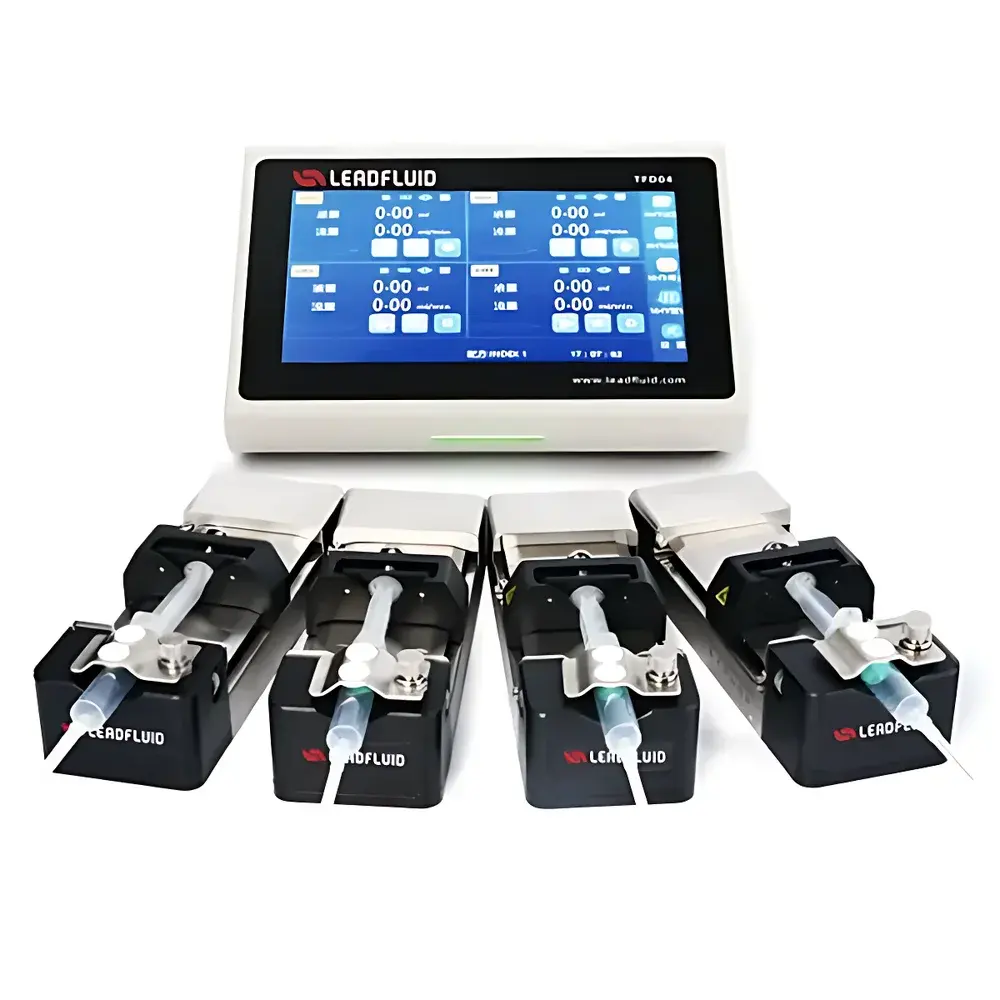
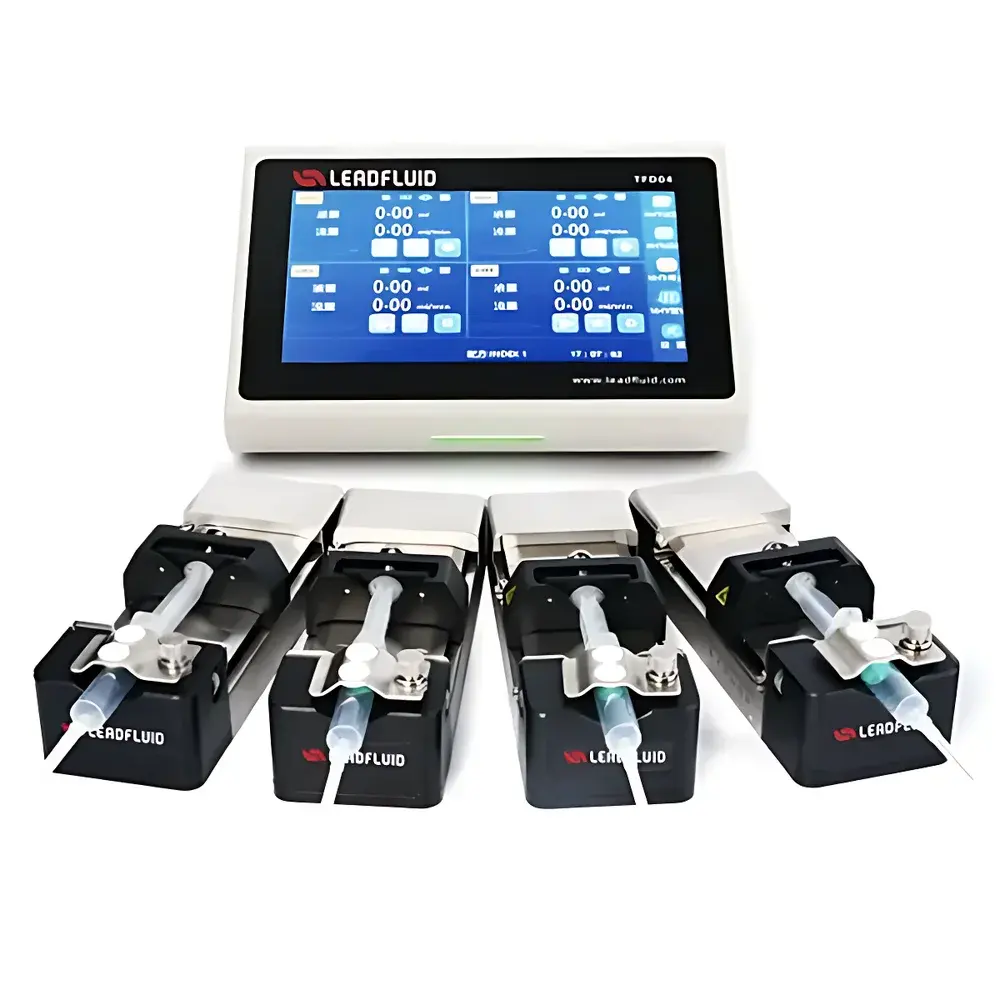
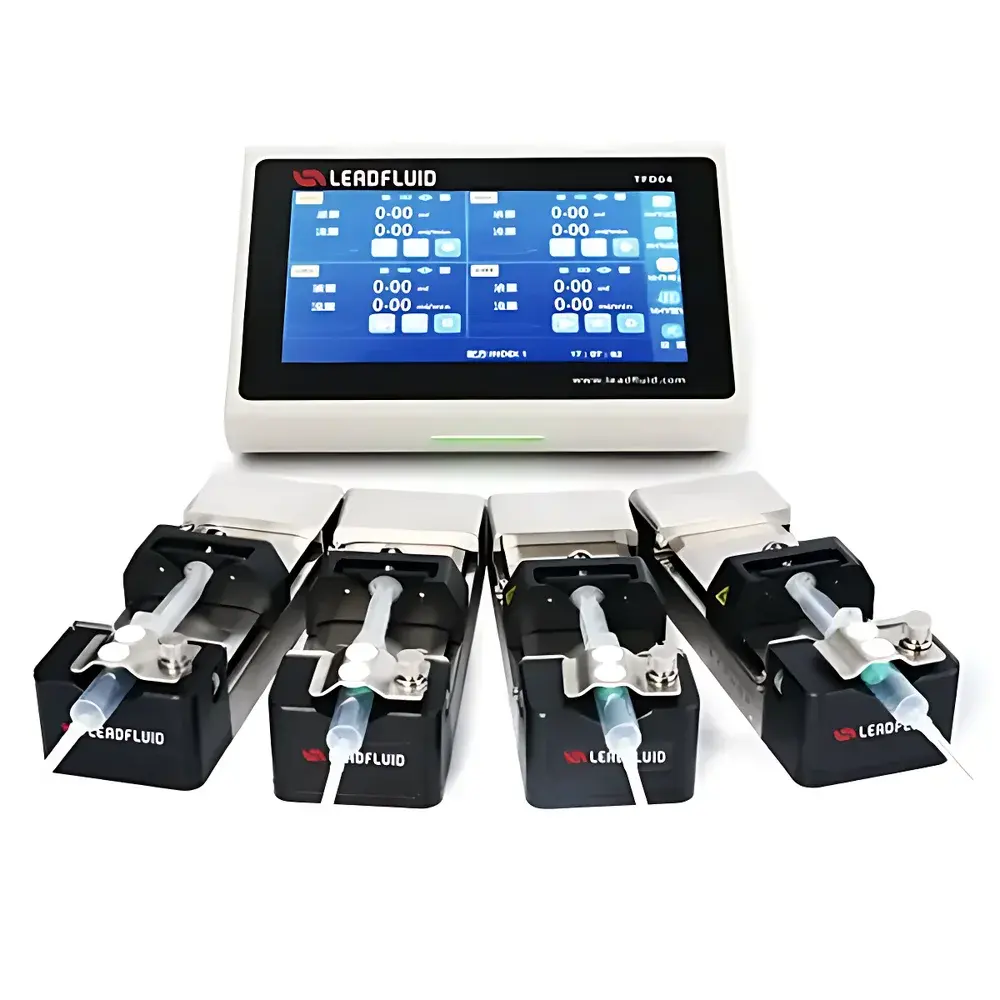
LeadFluid TFD04 Multi-Channel Laboratory Syringe Pump
| Brand | LeadFluid |
|---|---|
| Origin | Hebei, China |
| Model | TFD04 |
| Instrument Type | Micro-volume Syringe Pump |
| Flow Rate Range | 0.184 nL/min – 83.318 mL/min |
| Accuracy | < ±0.5% |
| Repeatability | < ±0.5% |
| Channel Capacity | 1–8 independently controlled channels |
| Syringe Compatibility | 0.5 µL – 60 mL (with interchangeable drive units) |
| Control Interface | 7-inch 65,536-color capacitive touchscreen |
| Communication Protocol | RS485 with Modbus RTU support |
| Input Voltage | AC 100–240 V, 50/60 Hz |
| Operating Temperature | 5–40 °C |
| Relative Humidity | < 80% RH |
| Enclosure | Reinforced metal chassis with corrosion-resistant coating |
| Power Consumption | 40 W (controller) + 30 W per drive unit |
| Dimensions (W×H×D) | 200 × 142 × 88 mm |
| Weight | 2.0 kg (controller only) |
Overview
The LeadFluid TFD04 Multi-Channel Laboratory Syringe Pump is an engineered solution for precise, programmable fluid delivery in research and quality control environments. Based on stepper motor-driven linear actuation and microstepping control architecture, the TFD04 delivers volumetric flow rates ranging from sub-nanoliter to milliliter-per-minute scales—enabling applications spanning microfluidics, analytical sample introduction, electrophysiology perfusion, chemical synthesis dosing, and chromatographic mobile-phase delivery. Its core design adheres to fundamental principles of displacement-based pumping: flow is determined by syringe plunger displacement velocity, calibrated against known syringe barrel geometry. This eliminates dependency on fluid viscosity or backpressure for accuracy—making it inherently suitable for low-flow, high-precision tasks where gravimetric or pressure-based systems exhibit drift or compressibility artifacts.
Key Features
- Independent per-channel control for 1–8 pump modules, supporting heterogeneous syringe configurations and asynchronous operation.
- 7-inch high-resolution capacitive touchscreen with LF-Touch-OS firmware—optimized for glove-compatible interaction and real-time parameter adjustment.
- Intelligent flow calibration wizard that guides users through syringe-specific linearization using reference volume measurement, compensating for mechanical hysteresis and lead-screw backlash.
- Four operational modes: Infuse only, Withdraw only, Infuse-then-Withdraw, and Withdraw-then-Infuse—each configurable with independent rate, volume, and dwell parameters.
- Programmable delay start (0.1 s – 999 h), cyclic execution (1–9999 cycles), and inter-cycle interval timing (0.1 s – 999 h).
- Hardware-level electrical isolation on all external control I/O lines (start/stop/pause), ensuring immunity to ground-loop interference in multi-instrument setups.
- Robust enclosure constructed from powder-coated aluminum alloy, rated IP32 for dust resistance and surface moisture protection; internal PCBs conformally coated for humidity and ESD resilience.
- Wide-input AC power supply (100–240 V, 50/60 Hz) with active PFC, enabling stable operation in variable-lab-grid conditions without external regulators.
Sample Compatibility & Compliance
The TFD04 accommodates standard Luer-lock and Luer-slip syringes from major manufacturers—including BD, Hamilton, and SGE—in volumes from 0.5 µL (e.g., 10 µL glass microsyringes) up to 60 mL (polypropylene disposable units). Custom syringe profiles can be registered via the touchscreen interface to ensure correct stroke-to-volume mapping. While not certified to IEC 61010-1 as a standalone medical device, the system meets general laboratory equipment safety requirements per GB 4793.1–2007 (equivalent to EN 61010-1:2010) and electromagnetic compatibility standards per GB/T 18268.1–2010 (IEC 61326-1:2012). Its deterministic open-loop control architecture supports audit-ready workflows under GLP and GMP frameworks when paired with validated SOPs and calibration logs.
Software & Data Management
The embedded LF-Touch-OS provides local storage for up to five complete method templates—including flow profiles, cycle definitions, and hardware assignments—with timestamped version history. RS485 Modbus RTU communication enables integration into SCADA, PLC, or custom LabVIEW/Python control systems for centralized orchestration. Status signals (TTL 5 V) report real-time run state and direction, facilitating hardware interlocks with valves or detectors. Though no cloud connectivity or FDA 21 CFR Part 11-compliant electronic signature module is included, the system supports full audit-trail generation via external logging—capturing parameter changes, start/stop events, and error codes with millisecond resolution when interfaced with compliant data acquisition software.
Applications
- Controlled reagent addition in flow chemistry reactors requiring stoichiometric precision across multiple inlets.
- Perfusion of neuronal cultures in patch-clamp rigs, maintaining stable osmolarity and drug concentration gradients over extended durations.
- Automated calibration standard delivery in ICP-MS and LC-MS systems, minimizing carryover and improving RSD between injections.
- Microscale solvent exchange in cryo-EM grid preparation, where nanoliter-level accuracy prevents ice contamination.
- Time-resolved kinetic sampling in stopped-flow spectrophotometry, synchronized with detector triggers via TTL output.
- Multi-syringe gradient formation for HPLC method development, leveraging independent channel timing to emulate binary or ternary mixing profiles.
FAQ
What syringe sizes are natively supported?
The TFD04 supports syringes from 0.5 µL to 60 mL via interchangeable drive units; built-in libraries include common models from Hamilton, BD, and SGE. Custom geometries may be added manually.
Is the flow accuracy maintained across the full range?
Accuracy of < ±0.5% is specified for plunger travel exceeding 30% of maximum stroke—ensuring metrological validity during routine operation while acknowledging reduced resolution at extreme low-volume endpoints.
Can the pump operate unattended for extended periods?
Yes—cyclic operation, delay timers, and power-failure memory allow fully autonomous execution of multi-hour protocols without host supervision.
Does it support analog voltage input for external rate modulation?
No—the TFD04 accepts only digital TTL-level start/stop/pause commands and Modbus register writes; analog rate control is not implemented.
How is calibration traceability established?
Users perform volumetric calibration using NIST-traceable graduated cylinders or gravimetric methods; results are stored as device-specific correction factors within the LF-Touch-OS calibration table.



