
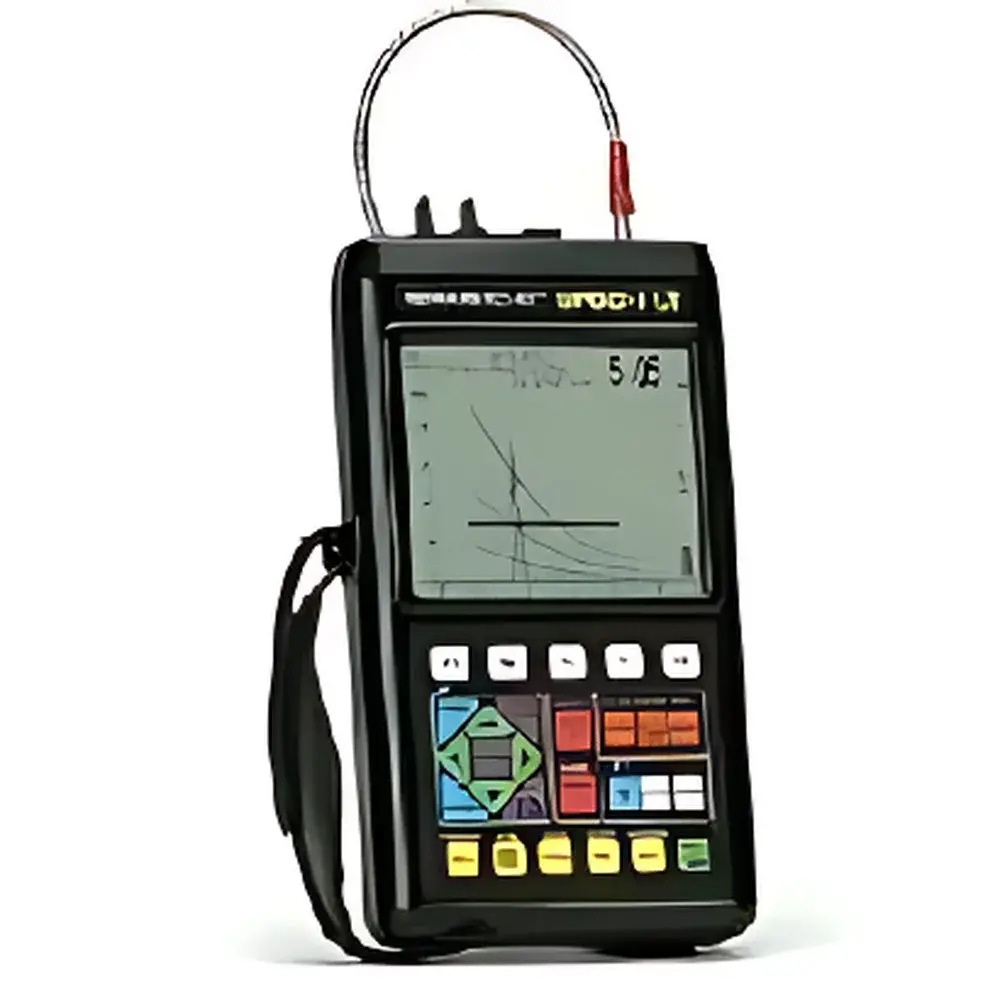
Panametrics EPOCH LT Portable Ultrasonic Flaw Detector
| Origin | USA |
|---|---|
| Manufacturer Type | Authorized Distributor |
| Origin Category | Imported |
| Model | EPOCH LT |
| Pricing | Available Upon Request |
Overview
The Panametrics EPOCH LT is a compact, lightweight, and cost-optimized ultrasonic flaw detector engineered for field-deployable non-destructive testing (NDT) of metallic and composite structures. Based on pulse-echo, through-transmission, and dual-element inspection methodologies, the instrument delivers reliable defect detection—including cracks, lack of fusion, porosity, and laminar discontinuities—in welds, castings, forgings, and rolled products. Its core architecture employs time-of-flight diffraction (TOFD)-compatible signal processing, wideband pulser-receiver electronics (0.3–20 MHz bandwidth), and real-time digital signal acquisition with 60 Hz minimum screen refresh rate—ensuring stable waveform visualization during dynamic scanning. Designed to meet the operational demands of pipeline integrity teams, aerospace MRO technicians, and structural steel inspectors, the EPOCH LT complies with foundational NDT procedural requirements aligned with ASTM E114, E317, and ISO 16810, while supporting traceable calibration workflows per ASNT SNT-TC-1A and EN 473.
Key Features
- Ultra-portable form factor: 1.0 kg net weight with ergonomic rubberized housing and IP65-rated ingress protection for dust/water resistance
- High-contrast 320 × 240 pixel monochrome LCD display with selectable full-screen or split-screen A-scan presentation
- Automated probe calibration routine for zero-offset and material sound velocity validation—reducing setup time and operator dependency
- Real-time waveform freeze function enabling immediate capture of A-scan traces and associated sound path data
- Peak memory mode for identifying and holding maximum amplitude echoes across multiple scans
- Configurable units for sound path measurement: millimeters, inches, or microseconds—supporting both metric and legacy engineering documentation standards
- RF (radio frequency) display mode for raw unrectified signal analysis—essential for advanced signal interpretation and phase-sensitive evaluation
- Dual alarm modes: entry/exit gate triggering and minimum-depth threshold alerts with audible and visual indicators
- Integrated NiMH rechargeable battery providing up to 8 hours of continuous operation; full charge achieved in ≤2 hours
- LEMO 00 coaxial connector standard for compatibility with industry-standard contact, angle-beam, and immersion transducers
Sample Compatibility & Compliance
The EPOCH LT supports inspection of ferrous and non-ferrous metals (e.g., carbon steel, stainless steel, aluminum, titanium), plastics, and fiber-reinforced composites. It accommodates sound velocity ranges from 635 m/s (e.g., polymers) to 15,240 m/s (e.g., beryllium), enabling accurate thickness measurement and flaw sizing across diverse material families. Fixed-angle wedge configurations (0°, 30°, 45°, 60°, 70°) and variable-angle wedges (10°–85°, ±0.1° resolution) facilitate compliance with AWS D1.1 (Structural Welding Code – Steel) and AWS D1.5 (Bridge Welding Code) procedures. All stored calibration setups and thickness readings are timestamped and user-tagged, supporting audit-ready documentation under GLP and internal quality management systems.
Software & Data Management
Data transfer occurs via high-speed USB 2.0 interface to Windows-based PCs. The instrument stores up to 100 calibration setups and 2,000 thickness measurements in internal memory—expandable to 500 calibrations and 10,000 thickness records using optional memory upgrade firmware. Optional software modules include Distance-Amplitude Correction (DAC) curve generation per ASTM E1316, Time-Varying Gain (TVG) compensation for attenuation correction, and Echo-to-Echo thickness measurement—eliminating front-surface interference in corroded or coated components. All digital records maintain metadata including date/time stamp, operator ID, material type, sound velocity, and gate settings—facilitating traceability and alignment with FDA 21 CFR Part 11 electronic record requirements when deployed in regulated manufacturing environments.
Applications
- Weld inspection in oil & gas pipelines, pressure vessels, and offshore platforms
- In-service corrosion mapping and remaining wall thickness assessment
- Manufacturing QA/QC of castings, forgings, and extrusions prior to machining or heat treatment
- Aerospace component screening for subsurface discontinuities in landing gear, engine mounts, and airframe structures
- Railway rail head and axle inspection per EN 13674-1 and AAR M-107/M-208 specifications
- Educational NDT training programs requiring intuitive interface and repeatable performance
FAQ
What is the minimum detectable flaw size achievable with the EPOCH LT?
Detection sensitivity is application-dependent and governed by transducer frequency, material attenuation, and surface condition. Under optimal conditions using a 5 MHz contact transducer on low-attenuation carbon steel, sub-millimeter planar reflectors (e.g., 0.3 mm deep notches) can be resolved.
Does the EPOCH LT support encoded scanning or motorized probe positioning?
No—the EPOCH LT is designed as a manual, handheld inspection tool without integrated encoder input or motor control interfaces. For automated scanning, consider the EPOCH 650 or OmniScan MX2 platforms.
Can the instrument perform shear-wave inspections on welded joints?
Yes—when paired with appropriate angle-beam transducers (e.g., 45°, 60°, or 70° wedges) and calibrated for the target material’s shear-wave velocity, the EPOCH LT supports standard shear-wave weld inspection per AWS D1.1 Annex K.
Is battery replacement user-serviceable?
The NiMH battery pack is field-replaceable using standard service tools and does not require factory recalibration upon replacement.
What environmental certifications does the device hold?
The EPOCH LT meets MIL-STD-810G for shock/vibration resistance and operates reliably within –10 °C to +50 °C ambient temperature; storage range extends to –40 °C to +70 °C (battery- and LCD-dependent).



