
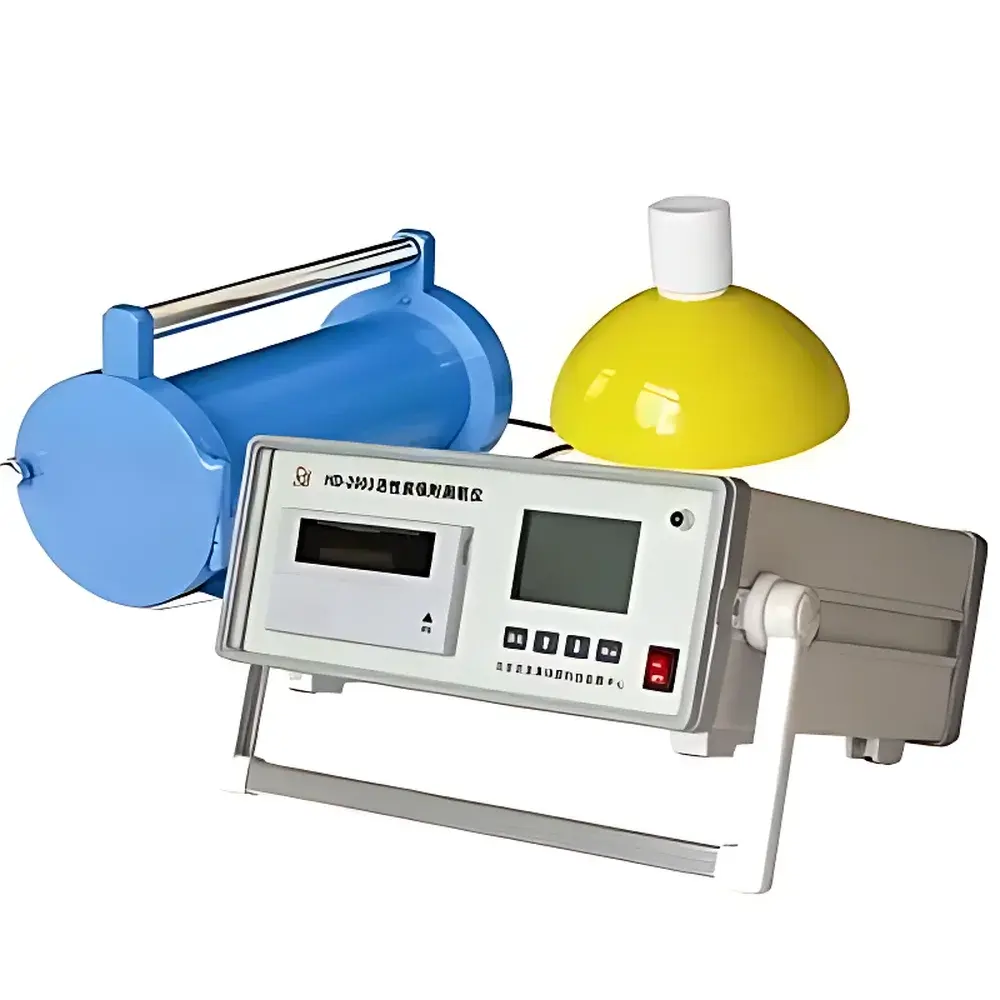
HD2003 Activated Carbon Adsorption Radon Monitor
| Origin | Beijing, China |
|---|---|
| Manufacturer Type | Authorized Distributor |
| Origin Category | Domestic (PRC) |
| Model | HD2003 |
| Pricing | Available Upon Request |
| Measurement Range (Radon Concentration) | 100–100,000 Bq/m³ |
| Measurement Range (Radon Exhalation Rate) | 0.001–1.000 Bq/m²·s |
| Sensitivity | ≥1.5 s⁻¹ per (Bq/L) |
| Energy Threshold | 50 keV |
| Nonlinearity | ≤10% |
| Repeatability | ≤10% |
| Stability | ≤5% |
| Operating Temperature | 0–40 °C |
| Relative Humidity | ≤90% RH at 40 °C |
| Lead Chamber Dimensions & Weight | 34 × 15 × 20 cm, 25 kg |
| Control Unit Dimensions & Weight | 50 × 31 × 22 cm, 1.5 kg |
| Calibration & Certification | Certified and calibrated by the National Institute of Metrology (NIM), PRC |
Overview
The HD2003 Activated Carbon Adsorption Radon Monitor is a field-deployable, gamma-spectrometric radon measurement system engineered for quantitative assessment of soil gas radon concentration (Bq/m³) and radon exhalation rate (Bq/m²·s). It operates on the principle of passive adsorption of 222Rn onto high-surface-area activated carbon, followed by delayed gamma spectrometry of its short-lived progeny (214Pb and 214Bi) using a NaI(Tl) scintillation detector housed within a low-background lead shield. This methodology conforms to established protocols for environmental radon surveys—including ASTM D6768-22 (Standard Guide for Radon Measurements in Soil Gas) and ISO 11665-2:2021 (Measurement of radioactivity — Radon-222 — Part 2: Integrated measurement method for determining average activity concentration). The instrument is specifically designed for geological prospecting, uranium exploration, radon-prone area mapping, and regulatory environmental impact assessments where trace-level radon quantification in unsaturated soil zones is required.
Key Features
- Compact, integrated lead shielding (34 × 15 × 20 cm; 25 kg) providing >95% attenuation of ambient gamma background above 50 keV, enabling high signal-to-noise ratio detection.
- Dedicated activated carbon adsorption cartridge with controlled geometry and mass, optimized for equilibrium-based 222Rn capture under variable soil moisture and temperature conditions.
- Onboard calibration source (typically 241Am or 133Ba) for daily energy and efficiency verification—traceable to NIM reference standards.
- Embedded microprocessor with non-volatile memory supporting up to 1,000 measurement cycles with timestamp, temperature, humidity, and spectral metadata logging.
- Standard USB 2.0 interface compliant with CDC/ACM class drivers for seamless integration with Windows/Linux-based acquisition software—no proprietary dongles or legacy serial adapters required.
- Robust mechanical architecture rated for field use: IP54 enclosure rating, shock-absorbing transport case, and thermal stabilization circuitry maintaining detector gain stability across 0–40 °C ambient range.
Sample Compatibility & Compliance
The HD2003 is validated for direct soil gas sampling via stainless-steel probe insertion (depth: 0.5–1.0 m) using standard ASTM D6768-compliant sampling manifolds. It accepts both continuous flow-through and static accumulation modes, with adsorption durations configurable from 1 to 72 hours. All hardware components—including carbon cartridges, detector housing, and gas-tight sampling ports—meet RoHS Directive 2011/65/EU material restrictions. Instrument performance data and calibration records satisfy GLP documentation requirements per OECD Series on Principles of Good Laboratory Practice. Full traceability to the National Institute of Metrology (NIM), China, is provided with each unit shipment, including uncertainty budget (k = 2) for radon concentration measurements.
Software & Data Management
The HD2003 ships with RadonView v3.2—a cross-platform desktop application supporting spectral deconvolution (using least-squares fitting of 295 keV and 609 keV photopeaks), decay correction, and exhalation rate derivation via Fick’s first law implementation. Raw spectra are stored in IEEE 32-bit floating-point binary format (.SPE) compatible with third-party analysis tools (e.g., Genie 2000, GammaVision). Audit trails record all user-initiated parameter changes, calibration events, and data exports in accordance with FDA 21 CFR Part 11 requirements for electronic records and signatures. Export options include CSV (with ISO 8601 timestamps), PDF reports (NIM-certified template), and XML metadata bundles for LIMS integration.
Applications
- Geological uranium exploration through identification of anomalous soil radon gradients correlated with subsurface fracture networks.
- Site characterization for nuclear facility decommissioning, where residual radon flux must be quantified against IAEA Safety Standards Series No. RS-G-1.7.
- National radon mapping programs requiring standardized, inter-laboratory comparable measurements per WHO Handbook on Indoor Radon (2009).
- Validation of radon mitigation designs in high-exhalation zones (e.g., granite bedrock regions) prior to construction.
- Academic research on radon transport mechanisms in variably saturated soils under controlled climatic chamber conditions.
FAQ
What is the minimum detectable activity (MDA) for radon concentration under typical field conditions?
The MDA is instrument- and protocol-dependent; using a 24-hour adsorption cycle at 25 °C and 50% RH, the typical MDA is 85 Bq/m³ (k = 1.645, 95% confidence).
Can the HD2003 be used for indoor air radon monitoring?
No—it is optimized for soil gas sampling. Indoor air applications require active-flow electret ion chambers or alpha-track detectors per ISO 11665-4.
Is firmware upgrade capability supported remotely?
Yes, via signed .BIN file upload through the USB interface; all updates undergo cryptographic signature verification.
Does the system support external GPS synchronization?
Yes—via optional TTL-level NMEA 0183 input for geotagging spectral acquisitions in survey mode.
How frequently must the activated carbon cartridge be replaced?
Cartridges are single-use and must be replaced after each measurement cycle; shelf life before use is 12 months when sealed under argon.







