
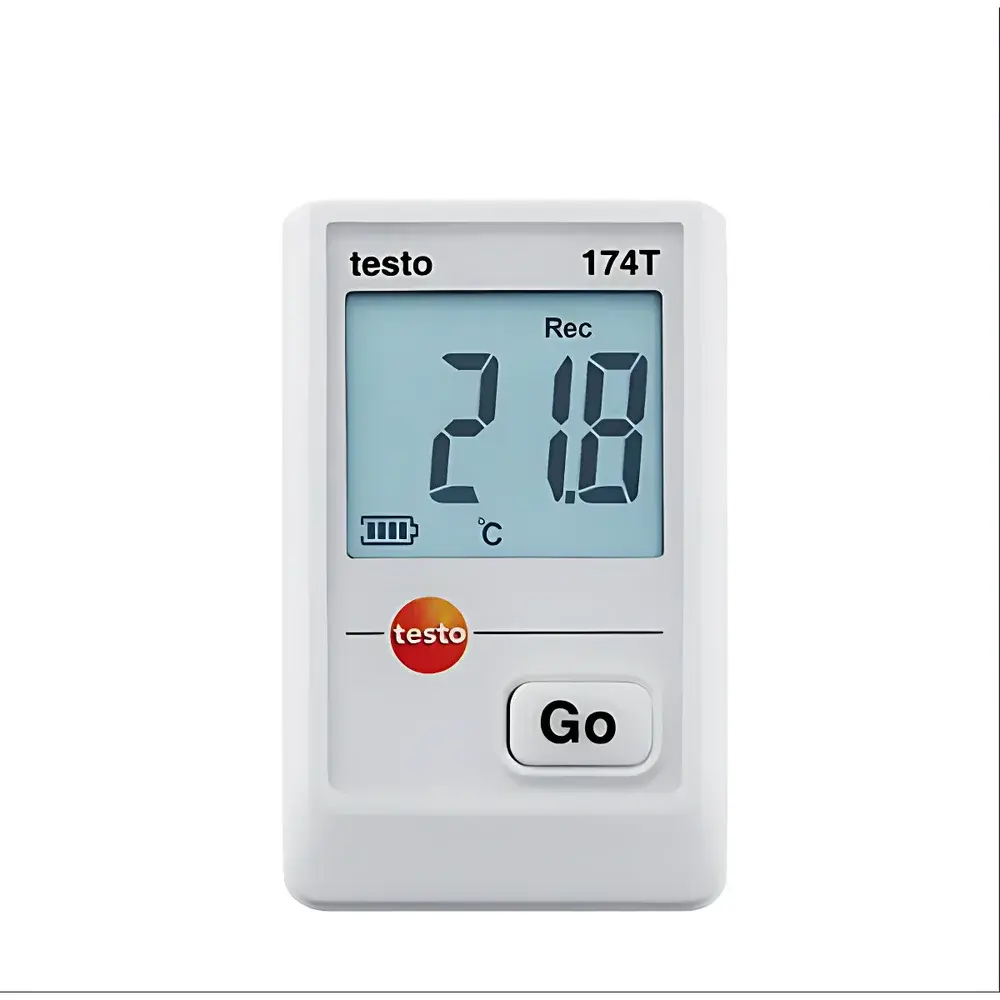
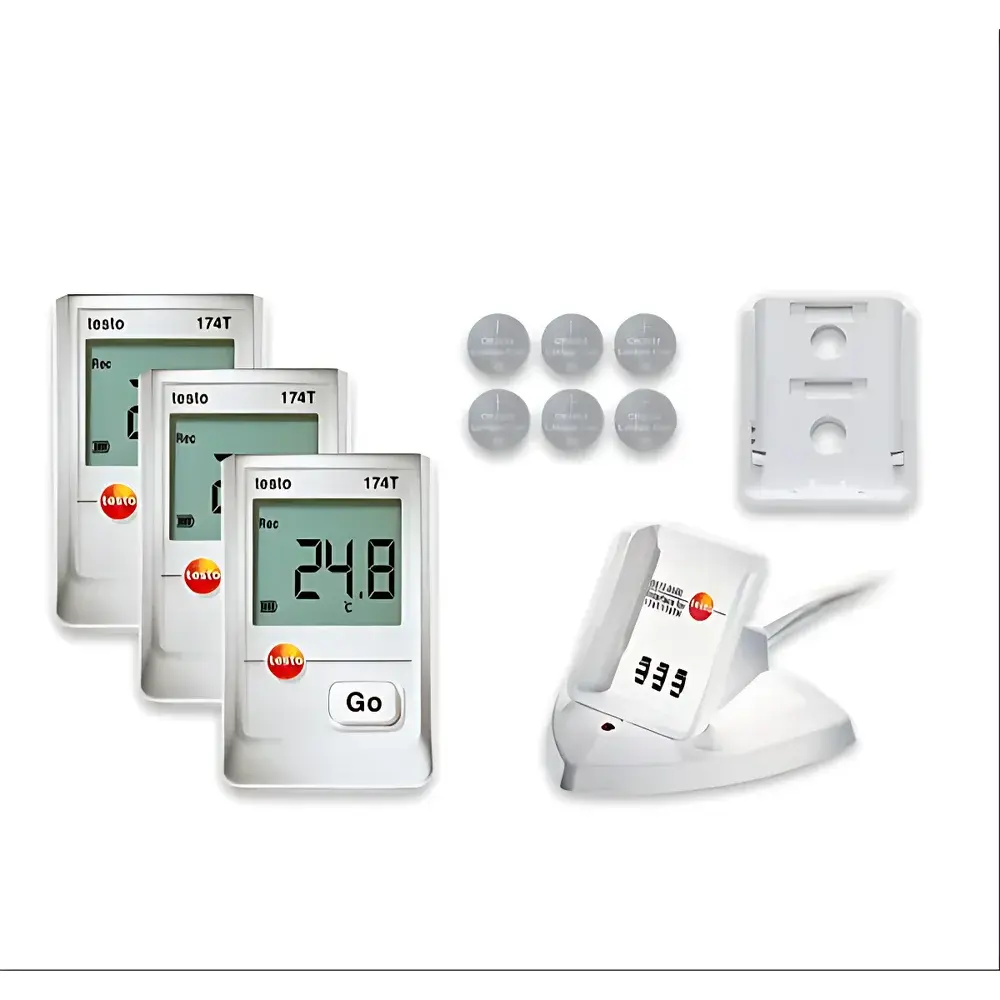
testo 174T Mini Temperature Data Logger Kit
| Brand | testo |
|---|---|
| Model | 174T |
| Origin | Germany |
| Temperature Range | -30 °C to +70 °C |
| Memory Capacity | 16,000 measurements |
| Logging Interval | Configurable (e.g., 15 min) |
| Compliance | EN 12830 certified |
| Software | ComSoft Basic (included on CD-ROM) |
| Interface | USB |
| Data Export | Excel-compatible |
| Auto-Backup | Yes (on battery change or depletion) |
| Battery Replacement | User-serviceable |
Overview
The testo 174T Mini Temperature Data Logger Kit is a compact, EN 12830-compliant monitoring solution engineered for continuous, unattended temperature recording in cold chain environments. Designed according to the principles of precision thermometry and long-term data integrity, the system employs high-stability NTC thermistors with traceable calibration characteristics to deliver reliable air temperature measurements across critical storage zones. Its primary operational domain includes refrigerated and frozen food storage facilities—such as retail freezer cabinets, catering cold rooms, small-scale meat processing units, and high-bay frozen warehouses—where regulatory adherence to EU temperature monitoring standards is mandatory. The kit’s architecture supports deterministic time-stamped logging at user-defined intervals (commonly 15 minutes), ensuring temporal resolution sufficient for both routine compliance verification and root-cause analysis during thermal excursions.
Key Features
- Three pre-calibrated testo 174T miniature loggers housed in robust, IP65-rated enclosures for resistance to condensation and mechanical handling in industrial cold rooms.
- Wide operational temperature range of –30 °C to +70 °C, validated per EN 12830 Annex A for accuracy class ±0.5 °C within –25 °C to +25 °C and ±1.0 °C across full span.
- Non-volatile memory storing up to 16,000 timestamped measurement values; automatic data retention during battery replacement or depletion eliminates risk of record loss.
- User-replaceable CR2032 coin-cell batteries with typical service life exceeding 1 year at 15-minute logging intervals under standard operating conditions (–10 °C to +25 °C).
- Integrated LED status indicator and audible alarm for out-of-limit events, configurable via software to trigger visual alerts upon deviation from user-defined thresholds.
- Compact form factor (90 × 58 × 23 mm) enables discreet mounting near critical thermal zones—e.g., adjacent to evaporator units, doorways, or product stacking locations—without obstructing airflow or workflow.
Sample Compatibility & Compliance
The testo 174T is specifically designed for ambient air temperature monitoring—not surface or immersion applications—and is not intended for direct contact with liquids or aggressive atmospheres. It meets the essential requirements of EN 12830:2018 for temperature recording equipment used in the transport and storage of chilled and frozen foodstuffs. This includes mandatory performance criteria for measurement uncertainty, timekeeping stability (< ±10 s/day), data retention integrity, and tamper-resistant logging behavior. While not intrinsically rated for hazardous areas, its low-power electronics and passive sensor design render it suitable for installation in non-explosive cold storage environments compliant with IEC 60079-0 general requirements. For pharmaceutical cold chain validation, supplementary IQ/OQ documentation and individual unit calibration certificates (available optionally) support alignment with EU GMP Annex 15 and WHO Technical Report Series No. 961.
Software & Data Management
ComSoft Basic software—supplied on CD-ROM and compatible with Windows 7 through 11—is provided for device configuration, data retrieval, visualization, and export. The application enables batch programming of multiple loggers with identical parameters (start time, interval, alarm thresholds), significantly reducing setup overhead in multi-unit deployments. Raw datasets are stored in proprietary .tdf format but export natively to CSV and Excel (.xlsx) for integration into LIMS, ERP, or internal audit systems. Audit trails include metadata such as firmware version, configuration history, and download timestamps—supporting basic GLP-aligned documentation practices. Although ComSoft Basic does not implement FDA 21 CFR Part 11 electronic signature controls, its structured export workflow facilitates manual verification and archival in regulated environments where supplementary procedural controls are applied.
Applications
- Continuous monitoring of freezer cabinets and walk-in cold rooms in supermarkets, restaurants, and delicatessens.
- Validation and routine surveillance of temperature-controlled logistics hubs handling perishable goods.
- Supporting HACCP Plan implementation by documenting thermal profiles during storage phases subject to Critical Control Point (CCP) assessment.
- Baseline environmental qualification of new cold storage infrastructure prior to commissioning.
- Retrospective analysis of temperature deviations following equipment failure or power interruption incidents.
FAQ
Is the testo 174T suitable for measuring surface or liquid temperatures?
No—the device measures ambient air temperature only. Its NTC sensor is optimized for convective heat transfer in still or low-velocity air; direct contact with surfaces or immersion in fluids will compromise accuracy and may damage the housing.
Does the kit include calibration certificates?
The standard kit ships with factory calibration; optional accredited calibration certificates (DIN EN ISO/IEC 17025) are available upon request and carry traceability to national metrology institutes.
Can the logging interval be adjusted after deployment?
No—interval and start time must be programmed prior to deployment using ComSoft Basic; reconfiguration requires physical retrieval and USB connection.
What happens if the battery fails mid-recording?
The device automatically saves all acquired data to non-volatile memory before shutdown; no measurements are lost due to power interruption.
Is the software compatible with macOS or Linux?
ComSoft Basic is Windows-only; however, exported Excel files can be processed on any platform supporting standard spreadsheet applications.



