
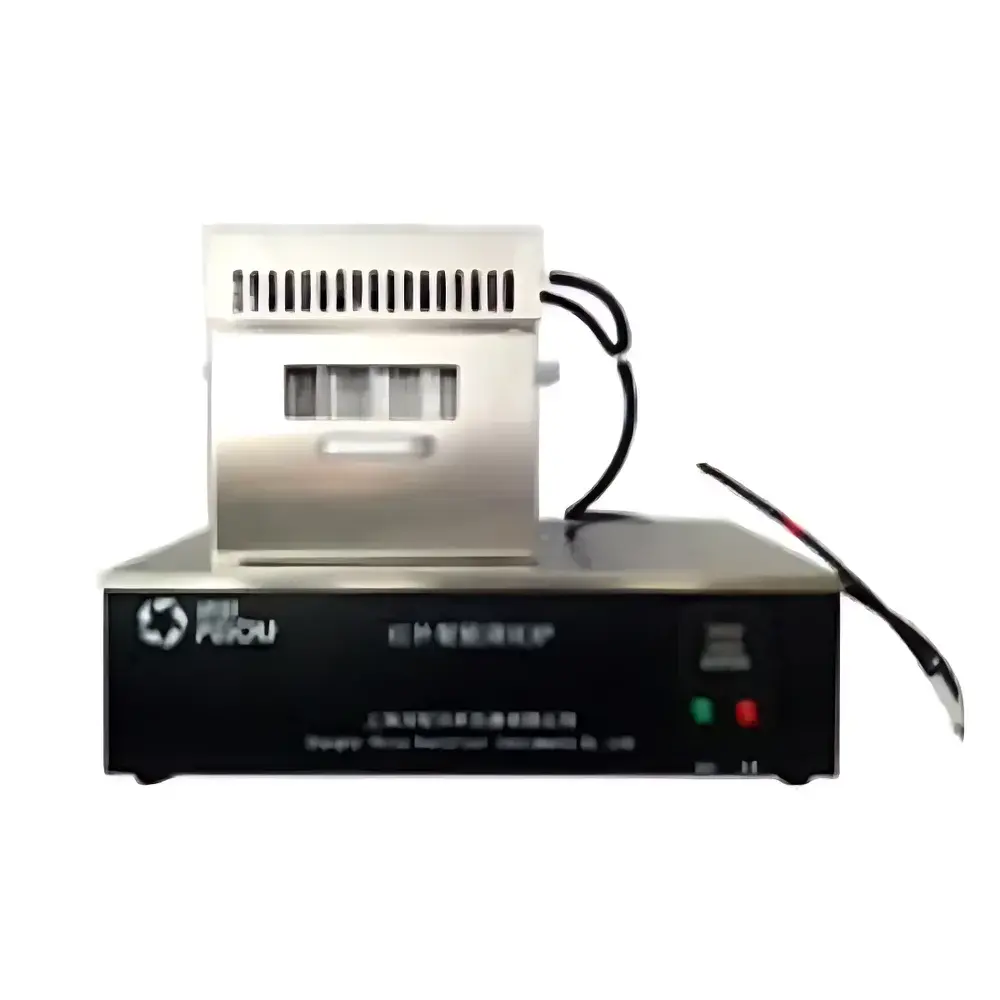
Peiou SKD-08S2 Quartz Infrared Digestion Furnace
| Brand | Peiou |
|---|---|
| Origin | Shanghai, China |
| Model | SKD-08S2 |
| Heating Element Type | Opal White Quartz Tube with Embedded Resistive Heating Alloy |
| Radiation Spectrum | Predominantly Far-Infrared (λ = 3–10 µm) |
| Max Operating Temperature | 550 °C (Continuous), 600 °C (Short-Term) |
| Temperature Control Accuracy | ±2 °C |
| Ramp Rate | Programmable, 0.1–20 °C/min |
| Sample Capacity | 8 × 16 mm or 8 × 20 mm Digestion Tubes |
| Power Supply | 220 V AC, 50/60 Hz |
| Safety Compliance | IEC 61010-1, GB/T 12804-2022 |
Overview
The Peiou SKD-08S2 Quartz Infrared Digestion Furnace is an engineered solution for controlled, uniform thermal decomposition of organic matrices in analytical sample preparation workflows. It operates on the principle of far-infrared (FIR) radiation heating, leveraging the molecular vibrational resonance of silicon–oxygen bonds in opal white quartz. When energized, the embedded resistive alloy within the quartz tube emits broadband electromagnetic energy; >97% of visible and near-infrared components are absorbed by the opal matrix, converting into thermal energy that excites lattice vibrations—resulting in efficient, directional FIR emission (peak wavelength ~4.2 µm). This mechanism enables rapid, contactless energy transfer directly to digestion vessels and their contents, minimizing thermal lag and reducing risk of localized overheating or splattering. Unlike conventional ceramic or metal-sheathed heaters, the quartz-based architecture eliminates surface contamination, catalytic side reactions, or outgassing—critical for trace-metal analysis (e.g., EPA Method 3050B, ISO 11466) and high-purity applications.
Key Features
- Opal white quartz heating tubes with intrinsic far-infrared emissivity (>0.92 at 400–500 °C), ensuring stable spectral output over extended service life
- Programmable temperature ramping (0.1–20 °C/min) and multi-step hold profiles, supporting standardized digestion protocols including ISO 14851 and ASTM D5587
- Thermal inertia < 30 s—enabling precise response to setpoint changes and minimizing overshoot during transitions
- Eight-position digestion block with precision-machined recesses for 16 mm or 20 mm borosilicate or quartz digestion tubes (compatible with standard Teflon-lined PTFE vessels)
- Dual-layer insulation and front-panel thermal shielding reduce ambient heat dissipation and improve operator safety
- Microprocessor-based PID controller with real-time temperature monitoring via integrated K-type thermocouple, calibrated traceably to NIST standards
Sample Compatibility & Compliance
The SKD-08S2 supports a wide range of sample types—including soils, sediments, biological tissues, polymers, and food matrices—when processed using HNO₃, HCl, HF, or H₂O₂-based digestion reagents. Its chemically inert quartz surface prevents leaching of metallic impurities (e.g., Cr, Ni, Fe), maintaining integrity for ICP-MS/OES quantification at sub-pptr levels. The furnace conforms to IEC 61010-1 for electrical safety in laboratory environments and meets GB/T 12804-2022 requirements for analytical instrumentation performance verification. While not certified for GLP/GMP production environments, its programmable logging capability and reproducible thermal profiles support audit-ready documentation under ISO/IEC 17025-accredited laboratories.
Software & Data Management
The SKD-08S2 features a built-in non-volatile memory storing up to 20 user-defined digestion methods, each with time-temperature segments, hold durations, and cooling parameters. All operational data—including actual vs. setpoint temperature curves, power consumption logs, and cycle completion timestamps—are recorded internally and exportable via USB interface in CSV format. No proprietary software is required; exported files integrate seamlessly with LIMS platforms (e.g., LabWare, Thermo Fisher SampleManager) and comply with basic ALCOA+ principles for data integrity. Optional RS-485 Modbus RTU interface enables integration into centralized lab automation systems for remote monitoring and scheduling.
Applications
- Preparation of environmental samples for heavy metal determination (Cd, Pb, As, Hg) per EPA SW-846 Methods 3050B and 3051A
- Acid digestion of plant and animal tissues prior to elemental analysis by ICP-OES or GF-AAS
- Decomposition of polymer composites for halogen content screening (ASTM D5887)
- Sample conditioning in pharmaceutical excipient testing where residue-on-ignition (ROI) or sulfated ash protocols apply (USP <281>)
- Research-scale mineral dissolution studies requiring controlled thermal kinetics without crucible interference
FAQ
Is the SKD-08S2 compatible with hydrofluoric acid (HF) digestion procedures?
Yes—provided digestion vessels are made of PTFE, quartz, or HF-resistant borosilicate glass. The quartz heating elements themselves are chemically inert to HF vapor under standard operating conditions.
Does the unit support 21 CFR Part 11-compliant electronic records?
No—the internal data logger does not include electronic signature, audit trail, or role-based access control. For regulated GxP environments, external validation and procedural controls must be implemented.
What is the expected service life of the quartz heating tubes?
Under typical usage (≤500 °C, 6 h/day), opal quartz tubes maintain >95% of initial emissivity after 5,000 operating hours, verified through periodic spectral radiometry.
Can the SKD-08S2 be used for dry ashing applications?
It is not designed for open-air ashing above 550 °C. For complete organic removal, use in conjunction with a muffle furnace following initial acid digestion.
Are calibration certificates provided with shipment?
A factory calibration report (traceable to national metrology institutes) is included. On-site calibration services and IQ/OQ documentation packages are available upon request.



