
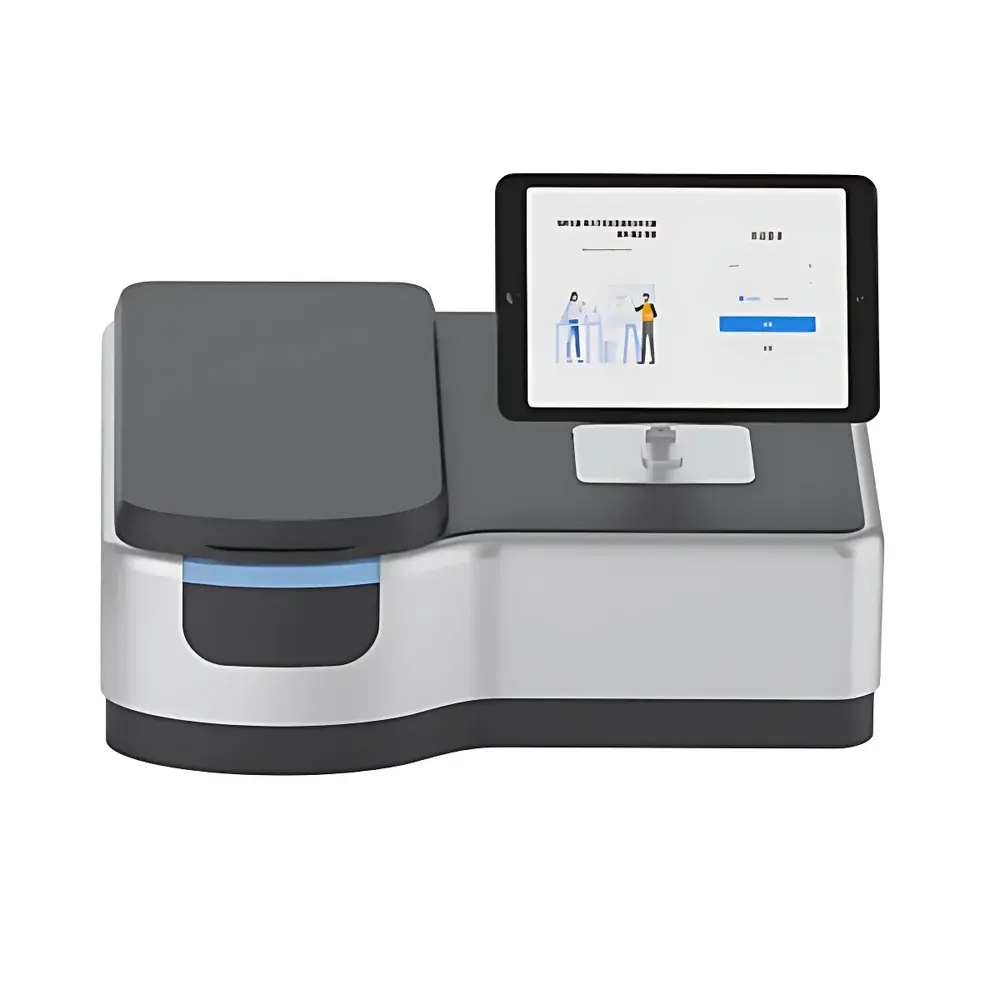
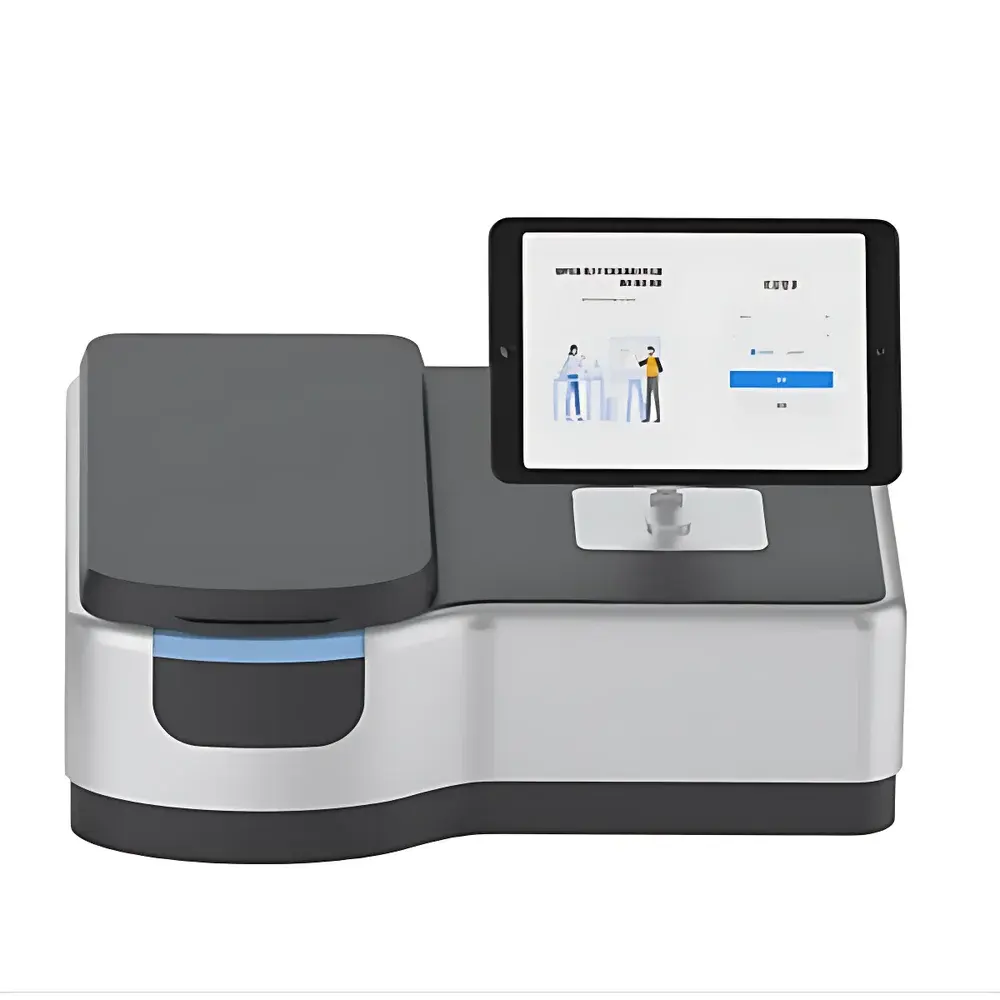
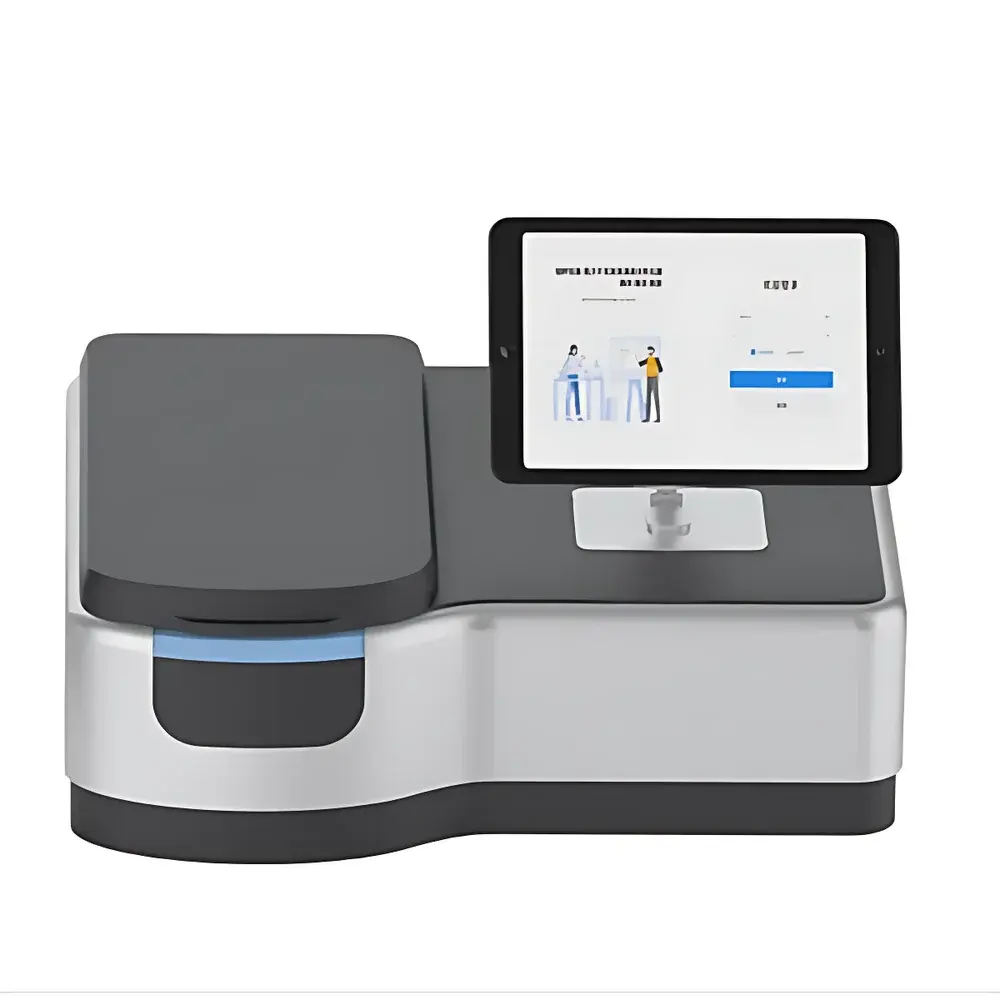
Yoke M5 Dual-Beam UV-Vis Spectrophotometer
| Brand | Yoke |
|---|---|
| Origin | Shanghai, China |
| Model | M5 |
| Optical System | Dual-Beam |
| Detector Type | Photodiode Array (PDA) |
| Wavelength Range | 190–1100 nm |
| Spectral Bandwidth | 0.1 / 0.2 / 0.5 / 1 / 2 / 4 / 5 nm (adjustable) |
| Wavelength Accuracy | ±2 nm |
| Wavelength Repeatability | ≤1 nm |
| Stray Light | ≤0.5% (at 220 nm, using NaI solution) |
| Photometric Resolution | 0.00001 Abs |
| Display | 11-inch 2.8K tablet with touch interface |
| Light Sources | Deuterium lamp + Tungsten-halogen lamp |
| Connectivity | Bluetooth, Wi-Fi, IoT-enabled remote monitoring |
Overview
The Yoke M5 Dual-Beam UV-Vis Spectrophotometer is an advanced laboratory-grade instrument engineered for high-precision absorbance, transmittance, and reflectance measurements across the ultraviolet, visible, and near-infrared spectral regions (190–1100 nm). Based on a true dual-beam optical architecture—where sample and reference beams are simultaneously measured—the M5 delivers exceptional baseline stability and real-time correction for source drift, solvent fluctuations, or environmental variability. Its core photometric engine integrates a high-sensitivity photodiode array (PDA) detector with a thermally stabilized optical bench and precision wavelength drive mechanism. This configuration ensures robust performance in routine QC, R&D, and regulatory-compliant environments—including those governed by ISO/IEC 17025, USP , and ASTM E275 and E387 standards for spectrophotometric validation.
Key Features
- Dual-beam optical design with real-time reference compensation, minimizing measurement drift during extended scans or kinetic assays.
- Adjustable spectral bandwidth (0.1–5 nm in seven discrete steps), enabling method flexibility for resolution-sensitive applications such as narrow-band dye analysis or broad-band polymer characterization.
- Integrated 11-inch 2.8K touchscreen tablet running embedded Linux-based firmware—supporting automatic language switching (English/Chinese), intuitive multi-interface navigation, and responsive gesture control.
- Intelligent diagnostics suite: self-check routines for wavelength accuracy, photometric linearity, stray light, and lamp energy output—with pass/fail reporting and timestamped audit logs compliant with GLP data integrity requirements.
- IoT-ready architecture with secure cloud connectivity: supports scheduled data export, remote instrument status monitoring, and configurable email/SMS alerts for abnormal readings, lamp aging warnings, or calibration expiry.
- Modular hardware platform compatible with optional accessories including temperature-controlled cuvette holders (±0.1 °C stability), integrating spheres (for diffuse reflectance), variable-pathlength cells (0.1–100 mm), and solid-sample reflectance stages with adjustable incidence angles (0°–85°).
Sample Compatibility & Compliance
The M5 accommodates standard 10-mm square cuvettes (quartz, glass, or plastic), microvolume adapters (down to 0.5 µL), flow cells, and film holders. Its PDA-based detection system eliminates mechanical slit scanning, enabling full-spectrum acquisition in under 1 second with high photometric reproducibility (<0.0002 Abs RSD at 1.0 Abs). All firmware and data handling modules comply with ALCOA+ principles (Attributable, Legible, Contemporaneous, Original, Accurate, Complete, Consistent, Enduring, Available) and support 21 CFR Part 11–ready user access controls—including role-based permissions (Administrator, Analyst, Viewer), electronic signatures, and immutable audit trails for all method changes, calibration events, and result exports.
Software & Data Management
The embedded software provides native support for all standard UV-Vis measurement modes: photometric quantitation (single/multi-point, linear/nonlinear calibration), kinetic time-course profiling, full-wavelength scanning (up to 3200 data points per scan), multi-wavelength analysis (up to 10 wavelengths simultaneously), 3D contour mapping (wavelength × time × absorbance), and biomolecular analysis (DNA/RNA/protein concentration, A260/A280 ratios, extinction coefficient calculation). Raw spectral data is stored in vendor-neutral CSV and JCAMP-DX formats. Optional PC software enables advanced spectral deconvolution, peak integration, and batch report generation aligned with ISO 17025 documentation templates.
Applications
The M5 serves diverse analytical workflows across pharmaceutical quality control (e.g., assay of active ingredients per USP monographs), environmental monitoring (nitrate, phosphate, COD analysis per EPA methods), food safety (colorant quantification, antioxidant capacity), nanomaterial characterization (plasmonic nanoparticle sizing via LSPR), and academic research (enzyme kinetics, ligand-binding studies, photochemical reaction monitoring). Its low stray light (3.5 Abs) make it suitable for both highly absorbing biological samples and dilute transition-metal complexes.
FAQ
Does the M5 meet regulatory requirements for GMP/GLP laboratories?
Yes—the instrument supports full audit trail logging, electronic signatures, and user privilege management, enabling compliance with FDA 21 CFR Part 11, EU Annex 11, and ISO/IEC 17025 documentation standards.
Can the M5 perform DNA/RNA quantification without third-party software?
Yes—pre-installed nucleic acid analysis modules calculate concentration, purity ratios (A260/A280, A260/A230), and molar extinction coefficients directly from raw spectra.
Is the deuterium lamp life extended through intelligent power management?
Yes—the firmware automatically powers down the D₂ lamp when idle and permits manual override; typical lifetime exceeds 2000 hours under standard usage protocols.
What spectral bandwidth setting is recommended for pharmacopeial assays?
For USP/EP-compliant methods requiring high resolution (e.g., impurity profiling), a 1 nm or 2 nm bandwidth is typically specified; the M5 allows precise selection and method locking to ensure inter-laboratory reproducibility.
How is data security maintained during wireless transmission?
All Bluetooth and Wi-Fi communications use TLS 1.2 encryption; local data storage employs AES-256 encryption, and cloud synchronization requires two-factor authentication and session timeout enforcement.





