
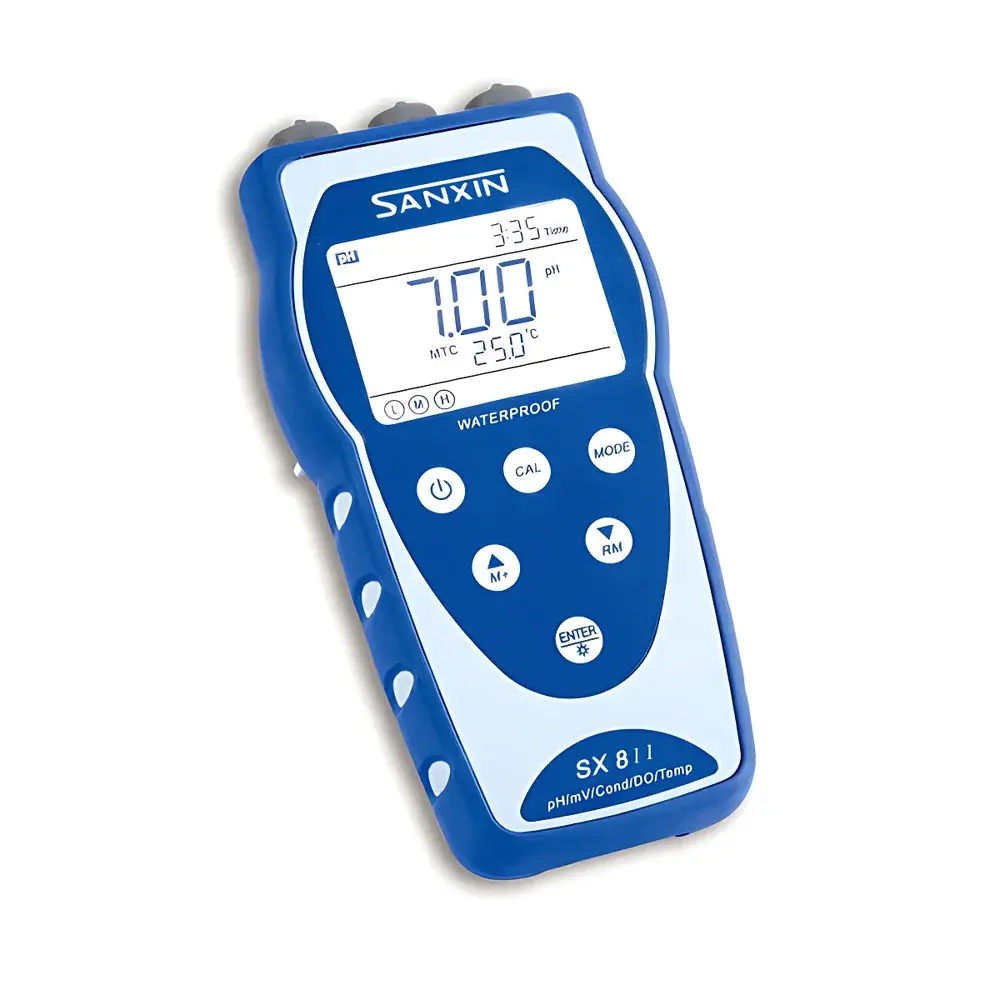
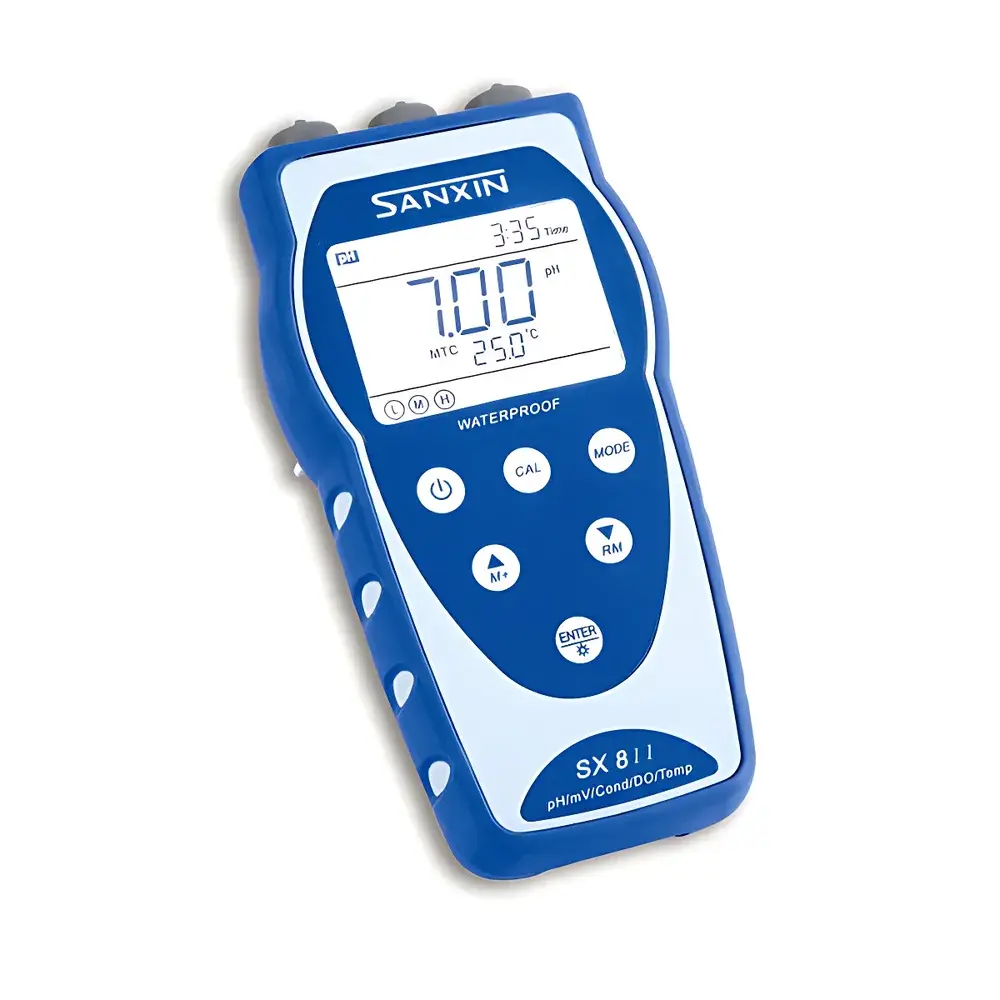
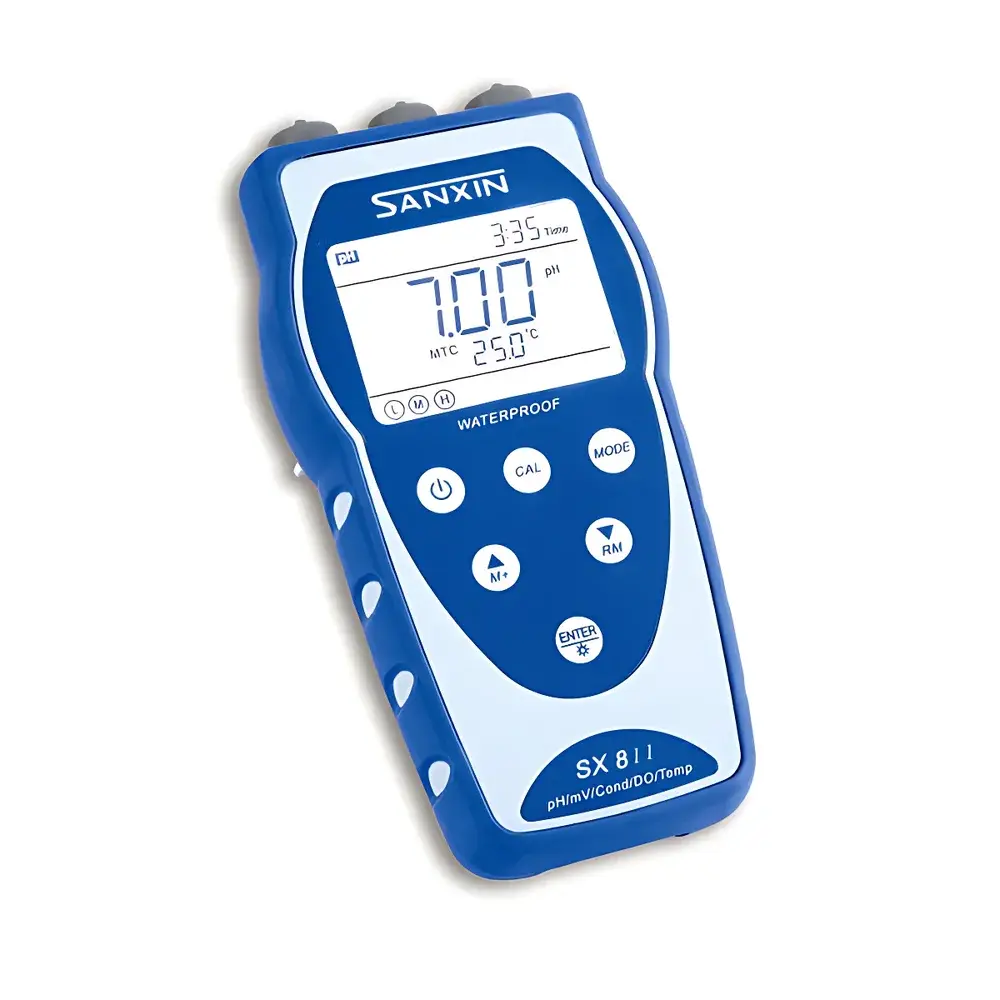
SANXIN SX811 Portable pH Meter
| Brand | SANXIN (Sanxin Peri) |
|---|---|
| Origin | Shanghai, China |
| Model | SX811 |
| Instrument Type | Portable |
| Parameter Type | Single-Parameter (pH/mV) |
| Measurement Range | −2.00 to 19.99 pH |
| Resolution | 0.01 pH |
| Accuracy | ±0.01 pH |
| Temperature Compensation Range | 0 to 100 °C (auto/manual) |
| mV Range | −1999 to +1999 mV |
| mV Resolution | 0.1 mV (±200 mV), 1 mV (elsewhere) |
| Input Impedance | ≥1×10¹² Ω |
| Input Current | ≤1×10⁻¹² A |
| Stability | ±0.01 pH/3 h |
| Calibration | 1–3 point auto-calibration with buffer recognition (USA/NIST/CH series), custom buffer support |
| Enclosure Rating | IP57 |
| Power | Rechargeable battery or USB 5 V DC adapter |
| Data Storage | Manual & timed auto-storage |
| Default Buffers | CH-series (pH 4.00, 7.00, 10.01) |
Overview
The SANXIN SX811 Portable pH Meter is a field-deployable, single-parameter electrochemical analyzer engineered for high-reproducibility pH and millivolt measurements in demanding industrial, environmental, and quality control settings. Based on potentiometric measurement principles—employing a glass electrode sensing element and reference junction—the SX811 delivers traceable, stable readings across an extended pH range of −2.00 to 19.99. Its design adheres to fundamental electrochemical standards governing electrode potential response (Nernst equation), input impedance requirements (>1×10¹² Ω), and low-input-current operation (≤1×10⁻¹² A) to minimize loading errors—critical for high-resistance samples such as deionized water or organic solvents. The instrument integrates automatic temperature compensation (ATC) using either built-in or external Pt1000 sensors, enabling non-linear compensation algorithms optimized for pure water and ammonia-added boiler water applications—common in power generation and petrochemical process monitoring.
Key Features
- IP57-rated rugged enclosure with soft-touch rubber overmold, enabling reliable operation in humid, dusty, or splash-prone environments—including outdoor fieldwork and plant floor deployment.
- Three-point auto-calibration with intelligent buffer recognition across three internationally aligned series: USA (e.g., pH 4.01, 7.00, 10.01), NIST (e.g., pH 4.005, 6.865, 9.180), and CH-series (pH 4.00, 7.00, 10.01), plus user-defined calibration solutions.
- Dual measurement modes: stable-read (averaged display) and auto-hold (freeze-on-stability), reducing operator interpretation variability during endpoint determination.
- Integrated real-time clock and GLP-compliant data management: each stored reading includes timestamp, electrode ID (if encoded), calibration history, ambient temperature, and operator ID (via optional software tagging).
- Dual power architecture: internal rechargeable battery (up to 100 hours continuous use) or direct USB 5 V DC supply—eliminating downtime during extended surveys or lab bench integration.
- Ergonomic convertible form factor: integrated fold-out stand enables stable benchtop operation; compact carry case includes all accessories—electrode, buffers, USB cable, adapter, and protective caps.
Sample Compatibility & Compliance
The SX811 supports aqueous, semi-aqueous, and low-conductivity matrices—including ultrapure water (with dedicated Pure Water mode applying resistivity-corrected nonlinearity), boiler feedwater, cooling tower fluids, wastewater effluents, and pharmaceutical rinse solutions. Electrode compatibility extends to standard BNC-connectable pH electrodes (e.g., included 201T-Q combination electrode) and optional ORP, ion-selective, or specialized low-ionic-strength probes. The instrument conforms to ISO 7027 (for turbidity-assisted pH validation), ASTM D1293 (standard test method for pH of water), and supports audit-ready workflows compliant with FDA 21 CFR Part 11 when used with validated PC-Link software and controlled electronic signatures.
Software & Data Management
PC-Link communication software (included on optical disc) enables bidirectional data exchange via USB. Raw measurements—including mV, temperature, calibration coefficients, and diagnostic flags—are exported in CSV or Excel-compatible formats. Software enforces secure user access levels, full audit trails (with immutable timestamps for calibration, storage, and configuration changes), and electronic signature capability for regulated environments. All stored data retain metadata per GLP Annex 11 requirements: instrument ID, sensor serial number, environmental conditions at time of measurement, and operator attribution. Internal memory retains up to 500 readings with automatic overwrite protection enabled by default.
Applications
- Power industry: Monitoring pH drift in condensate polishers, steam cycle chemistry, and ammonia-treated feedwater systems.
- Environmental field testing: Rapid assessment of surface water, groundwater, and soil leachates under variable ambient temperatures.
- Pharmaceutical QC: Final rinse verification for WFI (Water for Injection) systems and cleaning validation protocols.
- Food & beverage: Batch-to-batch consistency checks for acidic beverages, dairy processing streams, and fermentation broth monitoring.
- Educational labs: Teaching core electrochemical concepts—Nernst slope verification, junction potential effects, and temperature dependency modeling.
FAQ
Does the SX811 support USP or EP 2.2.3 compliance for pH measurement?
Yes—the instrument’s accuracy (±0.01 pH), resolution (0.01 pH), and ATC implementation meet the metrological requirements outlined in USP for routine pharmaceutical pH testing when paired with traceably calibrated electrodes and documented calibration records.
Can I use non-CH-series buffers for calibration in China-regulated facilities?
Yes. While CH-series buffers are preloaded for local regulatory alignment, the SX811 recognizes NIST and USA buffers without firmware modification—enabling cross-laboratory method transfer and international method validation.
Is the USB interface suitable for continuous real-time data logging?
No—the USB port supports discrete batch transfers only. For continuous streaming, an external analog output module (sold separately) must be interfaced via the accessory port.
What is the recommended recalibration frequency under GLP conditions?
Per ISO/IEC 17025:2017 Clause 7.7.1, recalibration shall occur before each analytical session or after every 24 hours of continuous use—whichever occurs first—documented with reference to certified buffer certificates.
How does the Pure Water pH mode differ from standard measurement?
It applies a dynamic conductivity-based correction algorithm that compensates for liquid junction potential shifts and carbonate interference—critical for sub-1 µS/cm conductivity samples where conventional linear ATC introduces systematic bias.






