
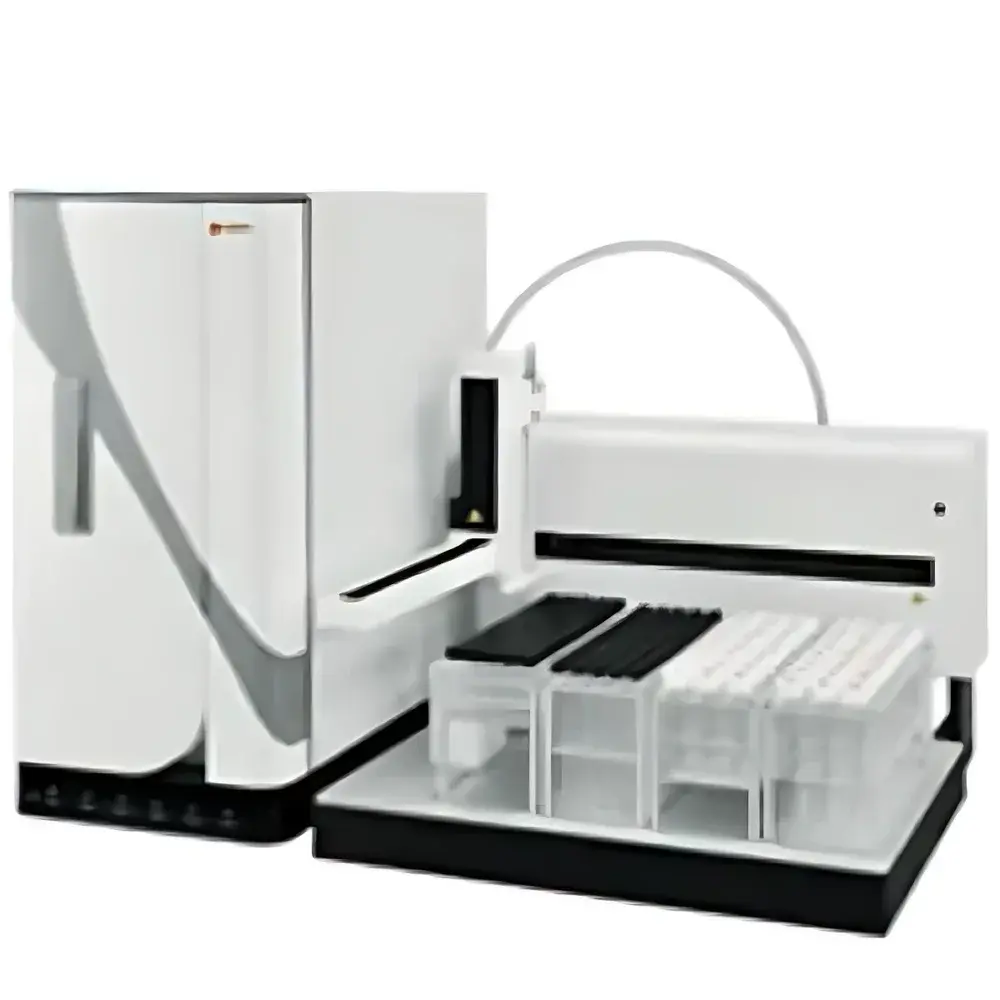
LabTech AutoClean Fully Automated Gel Permeation Chromatography (GPC) System
| Brand | LabTech |
|---|---|
| Model | AutoClean |
| Origin | Beijing, China |
| Equipment Type | Gel Purification System |
| Compliance | EPA Method 3640 |
| Application Scope | Pesticide Residue Analysis, Lipid- and Fat-Rich Matrix Cleanup, Macromolecule/Small-Molecule Fractionation |
| Configurable Integration | Compatible with Quantitative Concentration and Automated SPE Modules |
| Column | Pre-packed Stainless Steel GPC Column |
| Pump | Dual-Piston Precision Solvent Delivery Pump with Dampener |
| Detector | Variable-Wavelength UV Detector (UV-VIS) |
| Sample Handling | Full-Loop Injection Mode (≤10 mL), Auto-Sampling with Septum-Puncture Capability |
| Pressure Monitoring | Real-Time Pressure Sensing with Over-Pressure Alarm and Pressure Relief Function |
| Automation Platform | High-Accuracy 3-Axis Robotic Positioning System for Injection and Fraction Collection |
| Solvent Efficiency | Optimized Flow Path Design Reduces Solvent Consumption by >30% vs. Manual GPC |
| Column Protection | Integrated Back-Pressure Regulation Extends Analytical Column Lifespan in Downstream GC/HPLC Applications |
| Software | PC-Based Control with Audit Trail, Method Archiving, and Run Log Export (21 CFR Part 11 Ready) |
Overview
The LabTech AutoClean Fully Automated Gel Permeation Chromatography (GPC) System is an engineered solution for high-reproducibility size-exclusion-based sample cleanup in trace-level analytical workflows. Operating on the principle of molecular size exclusion in cross-linked dextran or polyacrylamide gels, the system separates analytes from complex biological and environmental matrices based on hydrodynamic volume—effectively removing macromolecular interferences (e.g., lipids, proteins, pigments, and polymers) while retaining small-molecule targets such as pesticides, PCBs, PAHs, and pharmaceutical residues. Designed to meet the stringent procedural requirements of U.S. EPA Method 3640, the AutoClean system delivers consistent fractionation performance across diverse sample types including edible oils, animal tissues, soil extracts, and plant homogenates. Its fully automated architecture eliminates manual column packing, solvent switching, and timed fraction collection—reducing operator variability and improving inter-laboratory method transferability.
Key Features
- Fully automated GPC workflow: integrated auto-sampling, gradient-compatible solvent delivery, real-time UV monitoring, and programmable fraction collection—all under unified software control.
- Pre-packed stainless steel GPC columns: factory-validated for reproducible pore size distribution (e.g., Bio-Beads SX-3 or equivalent), eliminating column preparation time and batch-to-batch variability.
- Dual-piston precision pump with passive dampener: ensures flow stability ≤±0.5% RSD across 0.5–10.0 mL/min range; compatible with chlorinated and non-polar solvents (e.g., hexane, dichloromethane, ethyl acetate).
- Variable-wavelength UV detector (190–400 nm): enables real-time elution profile visualization for method development, peak tracking, and fraction trigger optimization.
- Full-loop injection mode: supports complete introduction of samples up to 10 mL without loop overfill or dilution artifacts—critical for low-concentration residue analysis.
- Three-axis robotic platform with septum-piercing autosampler: maintains solvent integrity during repeated injections; prevents evaporation and oxidation of volatile analytes.
- Real-time pressure monitoring with configurable alarm thresholds and automatic pressure relief: protects column integrity and ensures system safety during high-viscosity matrix injections.
Sample Compatibility & Compliance
The AutoClean system is validated for use with EPA Method 3640 and aligns with ISO 17025 quality management requirements for accredited laboratories. It routinely processes samples containing ≥20% fat/oil content (e.g., fish tissue, milk powder, avocado extract) without column clogging or resolution loss. The system supports GLP-compliant operation through electronic signatures, user-access controls, and audit-trail-enabled software logging. All hardware components comply with IEC 61010-1 safety standards for laboratory equipment. Column effluent compatibility has been verified with downstream GC-ECD, GC-MS/MS, and LC-MS/MS instrumentation—enabling seamless integration into regulated food safety (FDA Bacteriological Analytical Manual), environmental (ISO 1871, EN 15662), and agrochemical residue testing protocols.
Software & Data Management
Control and data acquisition are managed via LabTech’s GPC-Studio v3.x software—a Windows-based application supporting method creation, sequence scheduling, real-time chromatogram display, and fraction-triggered collection logic. The software includes built-in EPA 3640 template methods, customizable UV threshold triggers, and time-window fractionation. All user actions—including method edits, run starts/stops, and parameter changes—are recorded in a tamper-evident audit trail compliant with FDA 21 CFR Part 11 requirements. Data export supports CSV, PDF, and native .gpc formats for LIMS integration. Remote monitoring and diagnostic logs are accessible via secure LAN connection, facilitating preventive maintenance planning and instrument uptime optimization.
Applications
- Pesticide multiresidue analysis in fruits, vegetables, and cereals—removing co-extracted chlorophyll and waxes prior to GC/MS quantitation.
- Fat removal from animal tissue extracts for persistent organic pollutant (POP) analysis per Stockholm Convention monitoring programs.
- Cleanup of lipid-rich biofluids (e.g., serum, plasma) in metabolomics studies to reduce ion suppression in LC-MS.
- Isolation of high-MW natural products (e.g., polysaccharides, glycoproteins) from crude fermentation broths.
- Preparative-scale fractionation of polymer additives (e.g., antioxidants, plasticizers) from recycled plastics prior to IR or NMR characterization.
FAQ
Does the AutoClean system support method validation per ISO/IEC 17025?
Yes—the system’s documented calibration procedures, performance qualification reports, and software audit trail functionality support full compliance with ISO/IEC 17025:2017 clause 7.7 (Method Validation) and 7.8 (Reporting of Results).
Can the AutoClean be interfaced with third-party concentration or SPE modules?
Yes—it features standardized fluidic and electrical interfaces (RS-232, TTL I/O, 24 V DC trigger lines) enabling seamless integration with LabTech’s AutoVap quantitative concentrators and AutoSPE-860 solid-phase extraction platforms.
What is the typical column lifetime under routine EPA 3640 operation?
When operated within specified pressure limits (<150 bar) and cleaned post-run with appropriate solvent gradients, pre-packed columns demonstrate ≥200 injections with ≤5% resolution drift (measured by polystyrene standard retention time shift).
Is UV detector wavelength calibration traceable to NIST standards?
Yes—each detector is supplied with a NIST-traceable holmium oxide filter certificate; wavelength accuracy is verified at 241.1 nm, 279.4 nm, 333.7 nm, and 360.9 nm during factory acceptance testing.
How does the system handle highly viscous or particulate-containing extracts?
Samples must be pre-filtered (0.45 µm PTFE) prior to injection; the system includes an in-line 0.2 µm guard filter upstream of the column. For viscous matrices, optional low-flow method templates (0.3–0.8 mL/min) are available to maintain laminar flow and minimize shear-induced degradation.



