
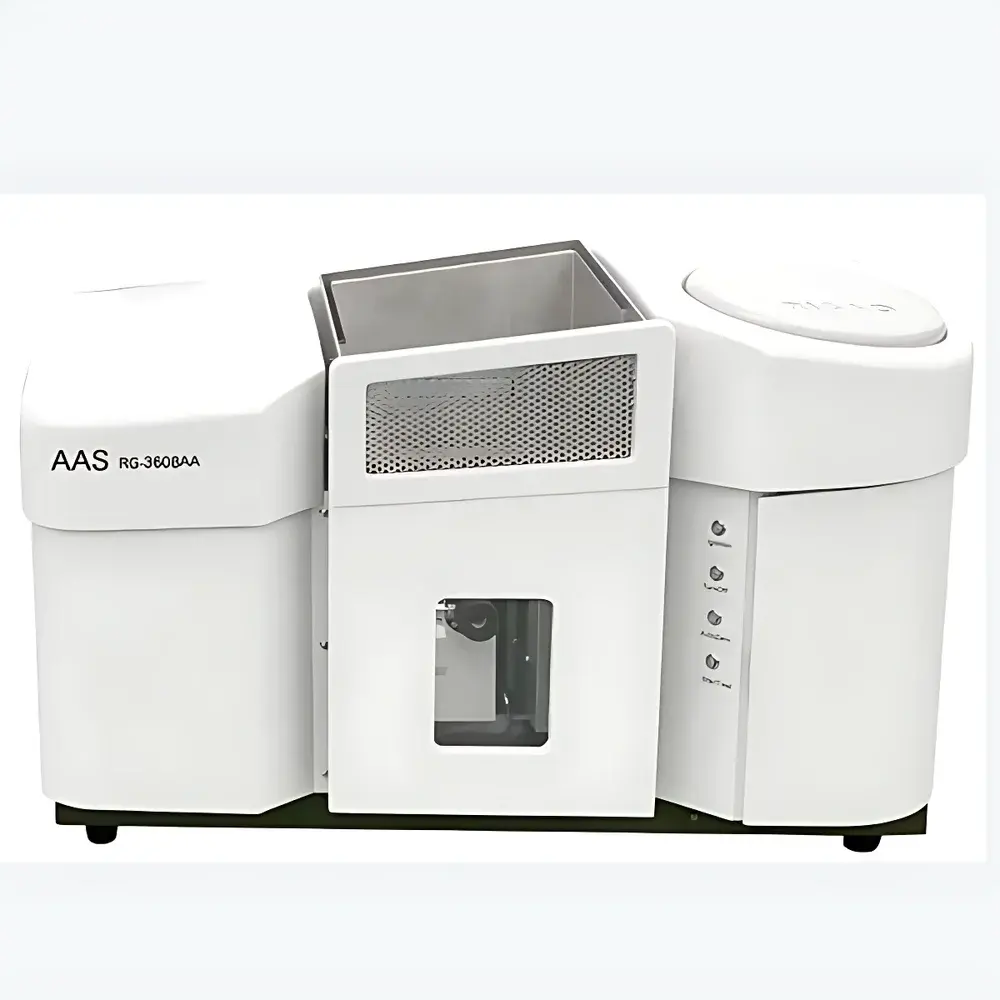
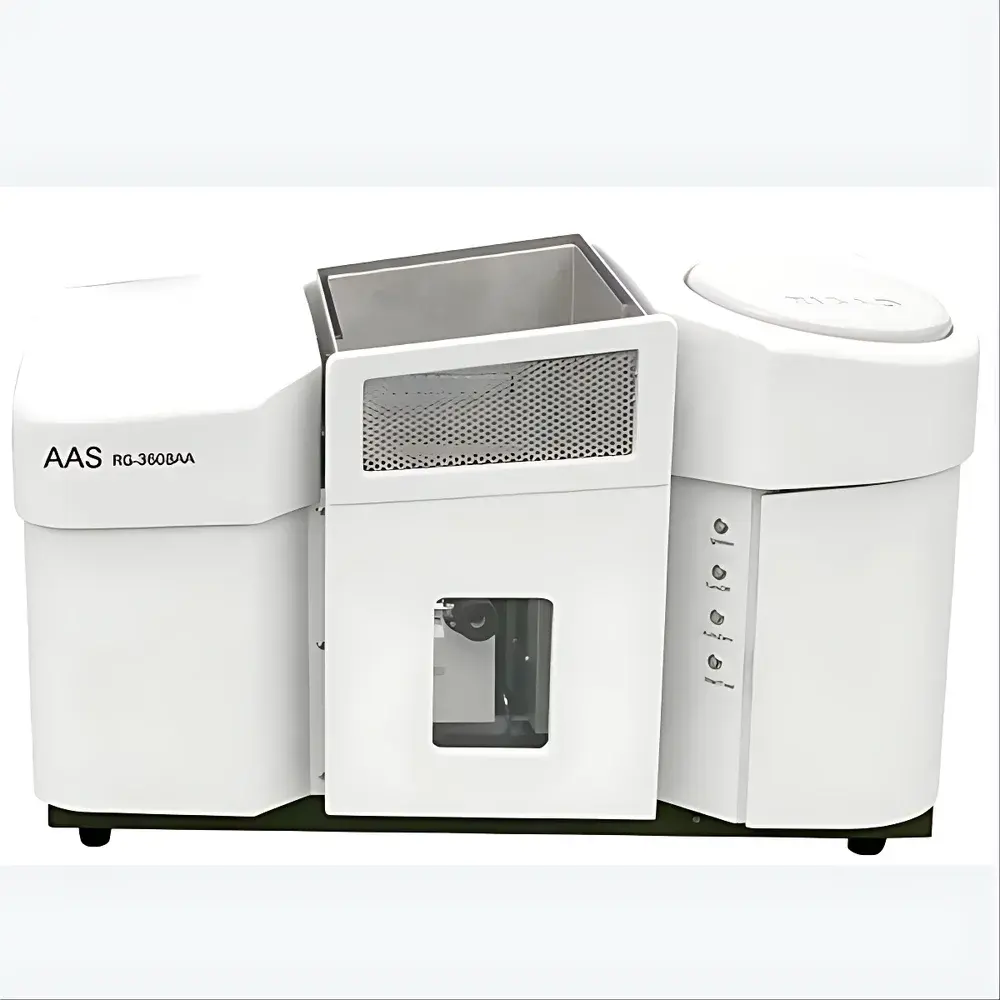
Yoke RG-3604AA Single-Flame Atomic Absorption Spectrophotometer
| Brand | Yoke |
|---|---|
| Origin | Shanghai, China |
| Model | RG-3604AA |
| Wavelength Range | 190–900 nm |
| Wavelength Repeatability | ≤0.05 nm |
| Wavelength Accuracy | ±0.1 nm |
| Photometric Range (Absorbance) | 0–2.0 A |
| Optical System | Single-beam |
| Lamp Positions | 4 |
| Background Correction | Combined D₂ Lamp + Self-Reversal Full-Spectrum Background Correction |
Overview
The Yoke RG-3604AA is a single-flame atomic absorption spectrophotometer engineered for routine and research-grade elemental quantification in environmental, pharmaceutical, clinical, and industrial laboratories. It operates on the fundamental principle of atomic absorption spectroscopy (AAS), wherein ground-state free atoms in a flame atomizer absorb characteristic radiation emitted by hollow cathode lamps (HCLs) or electrodeless discharge lamps (EDLs). The instrument measures absorbance at discrete wavelengths—corresponding to electronic transitions of target elements—to determine concentration via Beer–Lambert law calibration. Its optical architecture employs a high-efficiency all-reflective monochromator system with precision Czerny–Turner configuration, minimizing chromatic aberration and maximizing signal-to-noise ratio across the full UV–Vis spectral range (190–900 nm). Designed for robustness and operational consistency, the RG-3604AA integrates flame atomization with intelligent gas flow regulation and dual-mode background correction—ensuring reliable trace metal analysis down to sub-ppb levels in aqueous and acid-digested samples.
Key Features
- High-stability all-reflective optical path with optimized grating efficiency and low stray light (<0.001% at 220 nm), delivering superior photometric precision and long-term baseline stability.
- Intelligent flame gas control module with real-time pressure monitoring, automatic air/acetylene or nitrous oxide/acetylene switching, and fail-safe interlock logic compliant with ISO 22000 and laboratory safety best practices.
- Dual-background correction capability: simultaneous deuterium lamp (D₂) correction for broadband molecular absorption and self-reversal (SR) correction for structured, element-specific continuum interference—enabling accurate measurement in complex matrices such as wastewater digests or biological tissue extracts.
- Four-position automated lamp turret with 360° rotational alignment, supporting rapid sequential analysis of multi-element protocols without manual repositioning or recalibration.
- Motorized, software-controlled burner head elevation and alignment, ensuring optimal nebulizer–burner interface geometry and reproducible atomization efficiency across daily operation.
- Integrated flame atomizer with high-efficiency concentric nebulizer, impact bead desolvation chamber, and adjustable slot burner—optimized for sensitivity and memory effect reduction in Cu, Zn, Fe, Mn, Ca, Mg, and other common metals.
Sample Compatibility & Compliance
The RG-3604AA accepts liquid samples introduced via standard pneumatic nebulization, compatible with dilute aqueous standards (1–5% HNO₃), acid-digested environmental solids (per EPA Method 200.7/3050B), and diluted biological fluids (e.g., serum, urine per CLIA guidelines). It supports ASTM D1688 (copper in water), ISO 11885 (water quality – determination of selected elements by AAS), and USP heavy metals testing. Instrument firmware and data handling comply with ALCOA+ principles; audit trail functionality, electronic signatures, and user-access-level controls are implemented in RG-WinAAS software to support GLP and GMP environments under FDA 21 CFR Part 11 requirements.
Software & Data Management
RG-WinAAS is a Windows-native application built on Microsoft .NET Framework, providing method development, instrument control, real-time spectral visualization, and quantitative report generation. It supports calibration curve fitting (linear, quadratic, weighted least-squares), QC sample monitoring (spike recovery, duplicate analysis), and automatic drift correction using internal standard signals. All raw absorbance data, method parameters, and user actions are time-stamped and stored in encrypted SQLite databases with configurable backup intervals. Export formats include CSV, PDF, and XML for LIMS integration. Software validation documentation—including IQ/OQ protocols and change control logs—is available upon request for regulated users.
Applications
- Environmental monitoring: Pb, Cd, Cr, Ni, and As quantification in drinking water, soil leachates, and industrial effluents per EU Directive 2020/2184 and China’s GB/T 5750.6–2023.
- Food safety: Na, K, Ca, Mg, Fe, Zn, and Cu profiling in dairy, cereals, and infant formula in accordance with Codex Alimentarius STAN 1-1985 and GB 5009.268–2016.
- Pharmaceutical QA/QC: Residual catalyst metals (Pd, Pt, Rh) in active pharmaceutical ingredients (APIs) per ICH Q2(R2) and USP /.
- Clinical chemistry: Serum calcium, magnesium, and zinc assays aligned with CLSI EP9-A3 verification protocols.
- Geological and metallurgical labs: Rapid screening of ore concentrates and alloy dissolution residues using flame-AAS as a cost-effective alternative to ICP-OES for mid-Z elements.
FAQ
What flame gases are supported, and what safety features prevent accidental ignition?
The RG-3604AA supports air/acetylene and nitrous oxide/acetylene flame modes. Integrated pressure sensors, flame-out detection via optical feedback, and automatic gas shutoff upon power loss or flame extinction meet EN 61010-1:2019 Class II safety requirements.
Can the instrument perform direct analysis of solid samples?
No—RG-3604AA is configured exclusively for solution-based flame atomization. Solid samples require prior acid digestion (e.g., microwave-assisted HNO₃/HF/HClO₄) or slurry nebulization with appropriate matrix modifiers.
Is RG-WinAAS compatible with LIMS or ERP systems?
Yes—via configurable ODBC drivers and standardized CSV/PDF export. Custom API integration is supported through documented COM interfaces for enterprise-scale deployment.
What maintenance intervals are recommended for optimal performance?
Nebulizer cleaning every 8 hours of continuous use; burner head inspection weekly; D₂ lamp replacement every 500 h; annual wavelength calibration verification using holmium oxide and didymium filters per NIST SRM 2034.






