
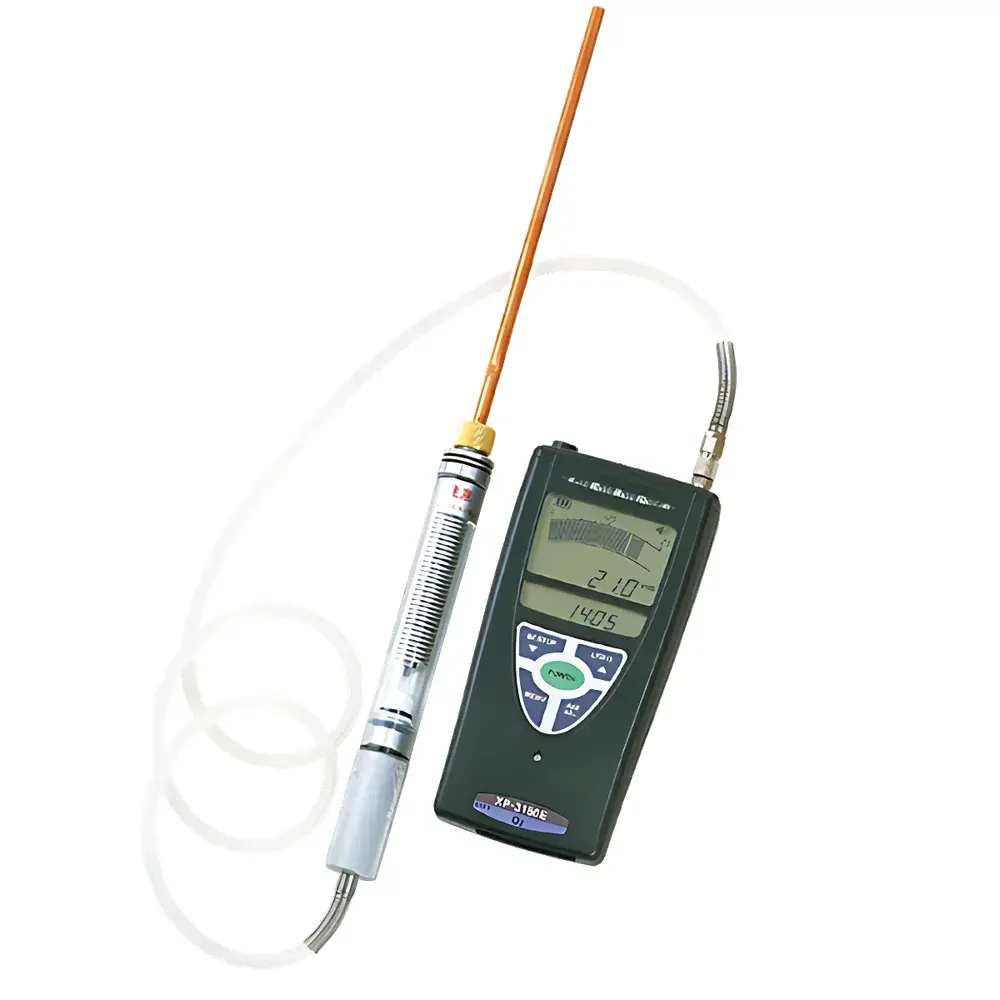
XP-3180E Portable Oxygen Concentration Analyzer (Brookfield-equivalent OEM design, Japan-sourced)
| Origin | Japan |
|---|---|
| Type | Portable Gas Detector |
| Target Gas | O₂ in Combustion Exhaust |
| Response Time | ≤45 s |
| Accuracy | ±0.3 vol% (per JIS T 8201) |
| Measurement Range | 0–25.0 vol% |
| Intrinsic Safety Rating | Ex ib IIB T3 |
| Power | 4× AA alkaline batteries (≈100 h operation, no backlight/no alarm) |
| Dimensions | 82 × 162 × 36 mm |
| Weight | ≈450 g (battery-free) |
| Detection Principle | Membrane-type Galvanic Cell |
| Display | Backlit LCD with dual numeric + bar-graph readout |
| Alarm | Audible buzzer + flashing red LED (configurable threshold, default 18.0 vol%) |
Overview
The XP-3180E is a portable, intrinsically safe oxygen concentration analyzer engineered for continuous, real-time monitoring of O₂ levels in high-temperature, high-humidity combustion exhaust streams. Designed to meet the operational demands of industrial combustion management—such as flue gas analysis from boilers, incinerators, gas engines, refrigeration chillers, and fire suppression systems—the instrument employs a temperature-compensated galvanic cell sensor with a hydrophobic membrane barrier. This electrochemical detection principle ensures stable output under variable dew point conditions and minimizes cross-sensitivity to CO, CO₂, H₂, and hydrocarbons—though prolonged exposure to elevated concentrations of these gases may accelerate sensor aging and require more frequent calibration verification per ISO 17025 traceable procedures. The device operates within 0–40 °C ambient range and delivers measurement data compliant with JIS T 8201:2019 for portable gas analyzers used in occupational safety and process optimization.
Key Features
- Intrinsically safe construction certified to Ex ib IIB T3, enabling safe deployment in Zone 1/2 hazardous areas where combustible gas mixtures may be present.
- Dual-mode display: high-contrast backlit LCD showing both numeric concentration (0.1 vol% resolution) and dynamic bar-graph visualization for rapid trend assessment during field inspections.
- Configurable audible and visual alarm system with user-settable O₂ threshold (default: 18.0 vol%), supporting compliance with OSHA 1910.134 and EU Directive 2014/34/EU requirements for atmospheric deficiency warning.
- Compact ergonomic housing (82 × 162 × 36 mm), weighing only 450 g without batteries—optimized for single-hand operation during extended shift-based monitoring or confined-space entry protocols.
- Auto-aspirated sampling via integrated pump and 1 m silicone intake hose; includes cooling condensate filter and replaceable particulate filter to protect sensor integrity in dirty exhaust environments.
- Extended battery life: up to 100 hours on four standard AA alkaline cells under nominal load (no backlight, no alarm activation), validated per IEC 60086-2 test cycles.
Sample Compatibility & Compliance
The XP-3180E is validated for use in combustion exhaust matrices containing water vapor, NOₓ, SO₂, and trace hydrocarbons—provided sample gas temperature is reduced to ≤40 °C prior to sensor inlet via the supplied cooling filter assembly. It is not intended for direct measurement in uncooled flue gas (>60 °C) or corrosive acid-gas streams (e.g., wet HCl/HF). Sensor performance adheres to JIS T 8201 accuracy specifications (±0.3 vol% full scale) when operated within specified environmental limits and maintained per manufacturer-recommended calibration intervals (typically every 30 days or after 200 hours of cumulative use). Device firmware and hardware architecture support audit-ready documentation for GLP/GMP-aligned quality systems, including timestamped alarm logs and error codes traceable to sensor health diagnostics.
Software & Data Management
Optional data logging functionality is available via USB-connected recording module (sold separately), which captures time-stamped O₂ readings at user-defined intervals (1–60 s). The bundled Windows-compatible software enables export to CSV or Excel formats, supports calibration certificate generation with operator ID and reference gas lot tracking, and maintains tamper-evident audit trails compliant with FDA 21 CFR Part 11 requirements when paired with electronic signature configuration. No cloud connectivity or remote telemetry is embedded—data remains locally controlled to satisfy ITAR and industrial cybersecurity policies.
Applications
- Combustion efficiency optimization in steam boilers and thermal oil heaters via excess air ratio calculation (λ = 21 / (21 − %O₂)).
- Incinerator off-gas monitoring to verify minimum O₂ thresholds required by EPA 40 CFR Part 60 Subpart Eb and EN 13445-5 for thermal oxidation completeness.
- Gas engine exhaust tuning for lean-burn operation while maintaining NOₓ control and avoiding flame instability.
- Fire suppression system integrity checks (e.g., IG-541, N₂, or CO₂ inerting) by verifying residual O₂ depletion below 12 vol% in protected enclosures.
- Pre-startup safety sweeps in boiler rooms and generator compartments to confirm atmospheric O₂ restoration after purge cycles.
FAQ
What calibration gases are required for routine verification?
Certified 20.9% O₂ in N₂ (±0.1% uncertainty) for zero/span check; optional 10.0% O₂ standard for mid-range linearity validation.
Can the XP-3180E measure O₂ in inert atmospheres containing high CO₂ or argon?
Yes—galvanic cell response is largely unaffected by background inert gas composition, though elevated CO₂ >15% may cause minor drift requiring recalibration.
Is the sensor replaceable by the end user?
Yes—the membrane-sealed galvanic cell is a field-swappable module with tool-free access; replacement interval is typically 12–18 months depending on cumulative exposure to condensate and particulates.
Does the device support analog output or Modbus communication?
No—this is a standalone portable analyzer with no analog output or industrial protocol interface; data acquisition relies solely on optional USB logging module.
How does the cooling filter prevent sensor damage in hot exhaust?
The stainless-steel cooling coil and PTFE-coated particulate filter reduce sample gas temperature to 99.5% of aerosols ≥1 µm, preventing electrolyte evaporation and membrane fouling.
Related Products







