
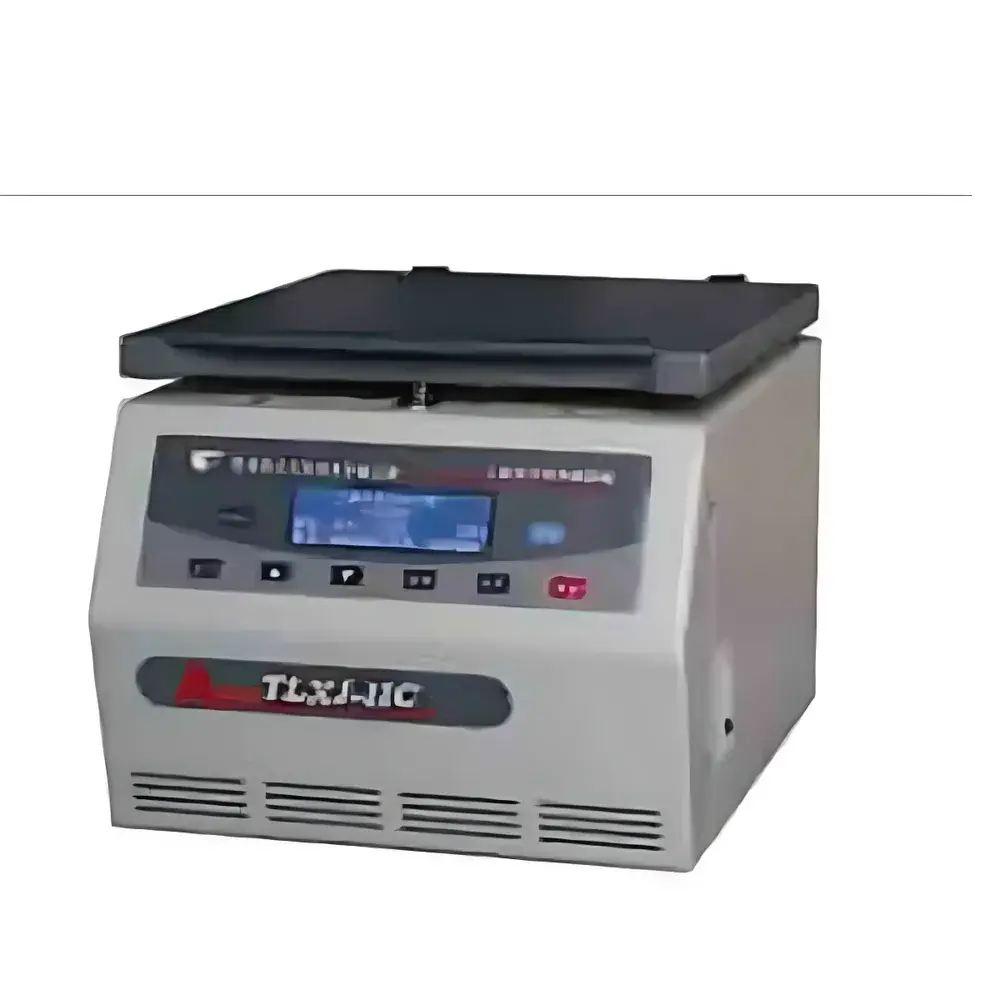
AnTing TLXJ-IIC Benchtop Low-Speed High-Capacity Centrifuge
| Brand | AnTing |
|---|---|
| Origin | Shanghai, China |
| Model | TLXJ-IIC |
| Instrument Type | Benchtop Centrifuge |
| Speed Range | Up to 3600 rpm |
| Max RCF | 2594 × g |
| Max Capacity | 6 × 500 mL (horizontal rotor) |
| Timer Range | 0–99 min |
| Power Supply | 220 V, 50 Hz, 750 W |
| Dimensions (L×W×H) | 725 mm × 555 mm × 435 mm |
| Net Weight | 90 kg |
| Construction | Reinforced polymer housing with electronic safety door lock |
| Compliance | Designed for GLP-compliant routine separation workflows in academic, QC, and production laboratories |
Overview
The AnTing TLXJ-IIC is a benchtop low-speed high-capacity centrifuge engineered for robust, repeatable sedimentation of large-volume samples under moderate gravitational forces. Operating on the principle of sedimentation centrifugation—where differential particle migration occurs under radial acceleration—the TLXJ-IIC delivers stable rotational performance at speeds up to 3600 rpm and a maximum relative centrifugal force (RCF) of 2594 × g. Its design prioritizes operational safety, mechanical stability, and long-term reliability in environments requiring frequent batch processing of biological suspensions, cell cultures, serum/plasma preparations, industrial emulsions, and environmental water samples. Unlike high-speed or ultracentrifuges, the TLXJ-IIC is optimized for applications where gentle pelleting, phase separation, or clarification of coarse particulates is required without inducing thermal stress or shear-induced aggregation.
Key Features
- High-capacity horizontal rotor configuration supporting six 500 mL bottles or conical tubes—enabling single-run processing of up to 3 L per cycle.
- Reinforced polymer chassis providing structural rigidity while minimizing overall mass; contributes to reduced vibration transmission and enhanced floor stability during operation.
- Electronically interlocked safety door system that prevents rotor rotation unless fully latched and automatically halts operation upon door opening.
- Precision-engineered brushless motor with soft-start/soft-stop ramp control to minimize mechanical shock during acceleration and deceleration phases.
- Digital timer interface with 1-minute resolution across a 0–99 minute range, supporting unattended operation with automatic shut-off.
- Integrated balancing detection algorithm that monitors rotational symmetry in real time and triggers audible/visual alerts if imbalance exceeds safe thresholds.
- Thermally insulated housing and passive airflow management to maintain ambient temperature rise below 8 °C during continuous 60-minute runs.
Sample Compatibility & Compliance
The TLXJ-IIC accommodates standard ISO-compliant centrifuge bottles (e.g., 500 mL polypropylene or polycarbonate), as well as common conical tube formats (15 mL, 50 mL) when used with optional adapter carriers. It supports both aqueous and mildly corrosive media (pH 4–10), though prolonged exposure to organic solvents or strong oxidizers is not recommended due to housing material limitations. The instrument complies with IEC 61010-1:2010 for laboratory electrical equipment safety and meets EN 61326-1:2013 electromagnetic compatibility requirements. While not certified for GMP manufacturing environments per FDA 21 CFR Part 11, its consistent RCF delivery, audit-ready timer logs, and mechanical traceability support GLP-aligned documentation practices in QA/QC and academic research settings.
Software & Data Management
The TLXJ-IIC operates via an embedded microcontroller-based interface with no external PC dependency. All operational parameters—including speed setpoint, RCF calculation, elapsed time, and fault codes—are displayed on a dual-line LCD screen with LED backlighting. No proprietary software or driver installation is required. For regulatory traceability, the unit maintains a non-volatile event log recording the last 100 run cycles, including start/stop timestamps, final speed, and any triggered safety interventions. Export functionality is not provided; however, manual transcription of logged data satisfies basic audit requirements under ISO/IEC 17025 and CLIA guidelines for routine centrifugation tasks.
Applications
- Preparative separation of mammalian blood components (RBC/WBC fractionation, platelet-rich plasma isolation).
- Clarification of fermentation broths, yeast suspensions, and microbial culture harvests prior to downstream filtration or chromatography.
- Industrial-scale dewatering of activated sludge or mineral slurries in environmental testing labs.
- Stabilization and phase separation of food emulsions (e.g., dairy cream, plant-based beverages) for quality assessment.
- Initial sedimentation steps in soil suspension analysis and sediment transport modeling studies.
- Routine pelleting of algae biomass or microcarrier-bound adherent cells in bioprocess development.
FAQ
What is the maximum rotor capacity for the TLXJ-IIC, and are rotors interchangeable with other AnTing models?
The TLXJ-IIC accepts only its dedicated horizontal rotor (part number TLXJ-HR-6×500), rated for 6 × 500 mL containers at full speed. Rotors are not cross-compatible with TLXJ-IIA or TLXJ-IIB variants due to differing flange geometry and balancing specifications.
Does the unit include RCF calibration certificates or factory verification reports?
No factory-issued calibration certificate is included by default; however, RCF values are calculated per ISO 15195:2019 using nominal rotor radius and speed input. Users may perform in-house verification using NIST-traceable tachometers and gravimetric balance methods.
Can the TLXJ-IIC operate continuously for more than 99 minutes?
No—the built-in timer enforces a hard limit of 99 minutes. For extended protocols, users must manually restart the cycle after completion; the device retains no memory of prior run history beyond the last 100 entries.
Is the electronic door lock compliant with IEC 61508 functional safety standards?
The interlock meets IEC 61010-1 mechanical safety requirements but is not SIL-rated. It functions as a Category 1 safety mechanism per EN ISO 13857, preventing inadvertent access during rotation but not intended for use in safety-critical process automation loops.
Related Products



