
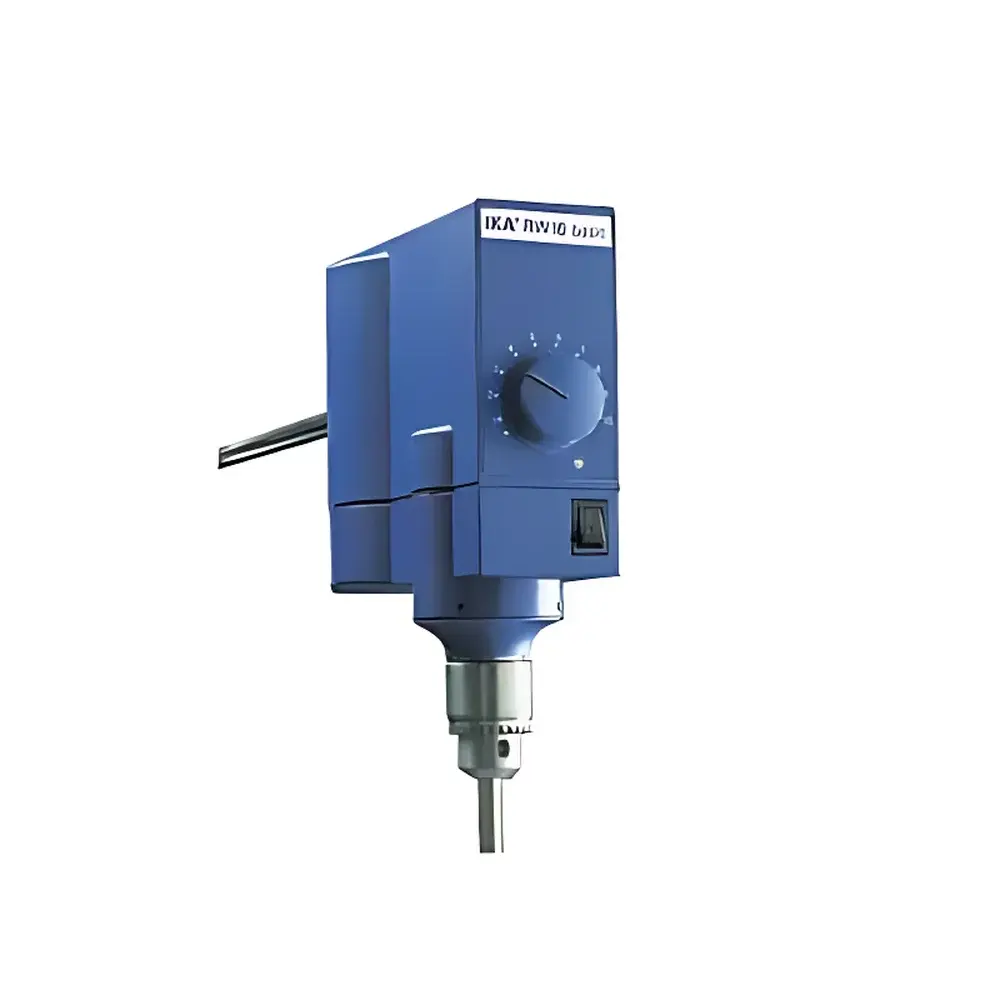
IKA RW16 Basic Overhead Stirrer
| Brand | IKA |
|---|---|
| Origin | Germany |
| Model | RW16 Basic |
| Max. Volume (H₂O) | 10 L |
| Speed Range | 40–1200 rpm |
| Input Power | 75 W |
| Output Power | 55 W |
| Max. Viscosity | 10,000 mPa·s |
| Max. Shaft Output Power | 53 W |
| Max. Torque | 40 N·cm |
| Torque at 60 rpm | 50 N·cm |
| Torque at 100 rpm | 48 N·cm |
| Torque at 1000 rpm | 34 N·cm |
| Chuck Range | 0.5–10 mm |
| Hollow Shaft ID | 11 mm |
| Delay Arm | Ø13 mm × 160 mm |
| Rated Torque | 0.4 N·m |
| Dimensions (W×H×D) | 80 × 222 × 190 mm |
| Weight | 2.8 kg |
| Ambient Temp. | 5–40 °C |
| Relative Humidity | ≤80 % |
| IP Rating | IP42 |
| Display | Analog Scale |
| Drive Type | Gearless Continuous Speed Control |
| Safety Features | Thermal Cut-off, Electronic Overload Protection, Safe Circuit Interruption |
Overview
The IKA RW16 Basic Overhead Stirrer is an entry-level, gearless laboratory stirrer engineered for precision, reliability, and operational simplicity in routine mixing applications. Designed for continuous duty under controlled ambient conditions, it employs a brushless DC motor coupled with electronic speed regulation—eliminating mechanical gearboxes and enabling smooth, stepless speed control from 40 to 1200 rpm. Its overhead configuration ensures stable torque transmission directly to the stirring shaft, minimizing vibration and enhancing reproducibility across repeated batch preparations. The unit is optimized for low-to-medium viscosity liquids (up to 10,000 mPa·s), with a maximum working volume of 10 L of water-equivalent media. Its compact footprint (80 × 222 × 190 mm), lightweight construction (2.8 kg), and quiet operation make it particularly suitable for teaching laboratories, undergraduate research facilities, quality control labs, and small-scale analytical workflows where space, noise constraints, and ease of integration are critical.
Key Features
- Gearless continuous speed control via analog dial—no mechanical gear shifting required, ensuring consistent torque delivery across the full 40–1200 rpm range
- Hollow stainless-steel stirring shaft (ID: 11 mm) permitting insertion of temperature probes or pH electrodes during operation without interrupting mixing
- Integrated safety circuit with thermal cut-off and electronic overload protection, compliant with DIN EN 60529 (IP42 rating) for dust and drip resistance
- Precision-machined keyless chuck with 0.5–10 mm clamping range, accommodating standard laboratory impellers without slippage
- Robust aluminum housing with heat-dissipating fin design, supporting extended operation at rated output (55 W motor power, 53 W shaft output)
- Analog speed scale calibrated per ISO 8502-1 for traceable rotational reference; no digital interface required for basic operation
Sample Compatibility & Compliance
The RW16 Basic supports a wide range of common laboratory impeller geometries—including propeller (R1342), centrifugal (R1352), dissolution (R1303), anchor (R1330), and vortex (R1311)—enabling adaptation to varied rheological profiles and vessel geometries. It maintains stable performance in aqueous, organic, and mildly corrosive solutions within the specified viscosity and temperature envelope (5–40 °C, ≤80 % RH). While not certified for hazardous area use, its IP42 enclosure meets general-purpose lab environmental requirements per IEC 60529. The device conforms to essential safety directives under the EU Machinery Directive 2006/42/EC and EMC Directive 2014/30/EU. No intrinsic calibration certificate is supplied; users performing GLP/GMP-regulated work are advised to implement periodic verification using traceable tachometers and torque standards per ASTM D2196 or ISO 3219.
Software & Data Management
The RW16 Basic operates as a standalone analog instrument without embedded firmware, USB connectivity, or data logging capability. This design prioritizes mechanical robustness, electromagnetic compatibility, and long-term serviceability over digital integration. Speed settings are manually selected and visually confirmed via the front-panel analog scale—ideal for environments where electromagnetic interference (EMI) must be minimized (e.g., near NMR spectrometers or electrophysiology rigs). For laboratories requiring audit trails or electronic records, external validation tools (e.g., handheld optical tachometers with timestamped output) may be employed in accordance with FDA 21 CFR Part 11 principles when used in regulated QC/QA processes. No software installation, driver dependency, or cloud synchronization is involved.
Applications
- Standardization of buffer and reagent preparation in academic teaching labs and university core facilities
- Homogenization of suspensions and emulsions in pharmaceutical preformulation studies
- Dissolution testing support (with R1303 impeller) under USP Apparatus II conditions
- Controlled agitation during titration, precipitation, or crystallization experiments
- Low-shear blending of cell culture media and polymer solutions in bioprocess development
- Routine QC mixing of calibration standards and reference materials in environmental and food testing labs
FAQ
Does the RW16 Basic support digital speed control or remote operation?
No. It is an analog-only instrument with manual dial adjustment and no communication interface.
Can the hollow shaft accommodate all standard temperature probes?
Yes—provided the probe diameter is ≤11 mm and its sheath material is chemically compatible with the sample; insertion is only possible when the shaft is stationary.
Is the RW16 Basic suitable for viscous polymer melts?
No. Its 10,000 mPa·s limit applies to Newtonian or near-Newtonian liquids at 25 °C; non-Newtonian, thermally sensitive, or high-yield-stress materials require higher-torque models (e.g., RW20 or RCT basic series).
What maintenance is required for long-term reliability?
Annual inspection of chuck integrity, shaft runout, and ventilation grilles; no lubrication or internal servicing is user-accessible.
Does IKA provide a factory calibration certificate with this model?
No—calibration documentation is not included by default; third-party verification is recommended for GxP environments.



